Becoming Patrick: Sinner and Saint - Part 17

The continuation of the multipart historical novelette that imagines the lost years of Saint Patrick’s youth, the terror of abduction, the grind of slavery, and the quiet awakening of faith that changed everything. Because the historical record says little about his formative years, much of this story is fictional and meant to entertain and edify. Where sources fall silent, I’ve chosen plausible details; where Patrick speaks in his own writings, I’ve tried to honor his tone and faith.
If you haven’t read the previous releases here are the links:
[ Part 1 ] [ Part 2 ] [ Part 3 ] [ Part 4 ] [ Part 5 ] [ Part 6 ] [ Part 7 ] [ Part 8 ] [ Part 9 ] [ Part 10 ]
[ Part 11] [ Part 12 ] [ Part 13 ] [ Part 14 ] [ Part 15 ] [ Part 16 ]
Formative Fruits
Years did not make Patrick brilliant. They made him faithful which is harder to measure. Men can count correct answers. They can mark a clean line of Latin, a recited psalm, a properly ordered argument. They can nod over a student who knew where Augustine ended and Ambrose began, who could stand before clerics and make doctrine sound like polished stone.
Patrick was not that man. He tried, God knew he tried.
Ink resisted him. Grammar mocked him. Latin, which had once been the language of home and prayer, became under instruction a field full of hidden stones. He stumbled over cases, forgot endings, lost the thread of arguments that younger men followed as easily as a path to a well. He would understand a passage in his bones and then fail to explain it with his tongue.
More than once, a cleric half his age corrected him. Patrick thanked him. Then went outside and worked until his hands hurt.
Father Ciarán found him once behind the church, splitting wood with more force than wisdom. “Books do not bleed because you are angry,” the priest said.
Patrick drove the axe down. The log cracked. “No,” he said. “Only I do.”
Father Ciarán watched him for a while. “Good,” he said. “Then the lesson has reached flesh.”
Patrick wanted to throw the axe into the mud. Instead he set it down. That was progress. Years were built from such victories.
If the classroom humbled him, ministry steadied him. He remembered the names of the sick when he forgot grammatical rules. He knew which widow refused charity unless it came disguised as work. He could sit beside a fevered child all night without fidgeting. He could speak to ashamed men without making their shame larger. He could carry bread without making a sermon of it. He could find the wounded place in a quarrel and press mercy there before blood came.
Scripture did not always come out of him in ordered phrases. It came out in bread and patience. In consolation given by the grave. And, in children taught to pray without being frightened of God.
Father Ciarán noticed. As did reports to the bishop. So did Coroticus, though he pretended not to.
Each year Patrick came to Alt Clut for examination. Each year he stood, or sat, or paced under questions about doctrine, discipline, obedience, pride, dreams, Scripture, Ireland. Each year he answered as well as he could, which was never as well as he wished.
After his examination each year, near the end, he asked to go. To go back to Ireland. Sometimes carefully. Sometimes fiercely. Once so badly that Father Ciarán would not speak to him until evening. Once so tenderly that even the bishop looked away.
Always the answer was delay. More study. More service. More obedience. More time.
Patrick wore the refusals like stones in his cloak and carried them home.
Then came another year. The road to Alt Clut was familiar by then. The Rock no longer startled him, though it still stood like judgment above the river. Coroticus’s men knew him. Some greeted him with mockery softened into habit. Others simply nodded. Siger was in port again, as he often seemed to be when Patrick came for review, salt-worn and watchful, always pretending that coincidence was cheaper than concern. “You still failing books?” Siger asked when Patrick passed him near the lower yard.
“Yes.”
“Good. Learned men sink ships by explaining storms.”
Patrick almost smiled. “And sailors survive by refusing explanation?”
“Sailors survive by knowing when to stop talking.” The words stayed with Patrick longer than they should have.
The examination began after noon and lasted until the light bent westward. Patrick failed early.
He confused one citation, corrected himself too late, and saw one of the younger clerics mark it with merciless accuracy. He gave a clumsy answer on grace and freedom, then saved it, perhaps, by speaking of a drowning man who cannot throw himself the rope but can still cling when mercy reaches him. He stumbled through a psalm. He answered well on penance. Poorly on order. Better on mercy. Too strongly, perhaps, on captives.
The bishop watched all of it. Father Ciarán stood near the wall with his arms folded and his old face unreadable. At the end, the bishop asked, “What is mercy?”
Patrick was tired enough not to polish the answer. “God stooping without becoming less,” he said. “And then commanding us to stoop, though we fear becoming nothing.”
The room went still. Father Ciarán looked at him. Patrick looked down, embarrassed. “I may have said that poorly.”
“No,” the bishop said. The questioning ended. The bishop dismissed the clerics. One by one they gathered tablets, murmured, bowed, and left. Father Ciarán remained. So did Patrick.
This was the moment. It had always been the moment. The place where he asked, can I go to Ireland now? The place where the old longing rose, familiar and fierce, pushing against his ribs.
The bishop looked at him. Patrick felt the question in the room though no one spoke it. His mouth opened, then closed.
He bowed. “My lord bishop.”
The bishop’s eyes narrowed slightly.
Patrick turned to go. No one stopped him. He walked out into the evening with the unsaid thing burning behind his teeth.
Alt Clut was loud around him: gulls over the river, men shouting in the yards, hammers, dogs, the lowing of cattle penned too close. Patrick heard all of it as if from underwater. He found a place near the church wall where the stones still held the day’s warmth and sat there until the light drained out of the sky.
Father Ciarán found him after dark. The priest lowered himself beside him slowly, with a small breath of pain he tried to hide. Patrick pretended not to notice as he finished vespers. For a while neither spoke.
At last Father Ciarán said, “You did not ask.”
Patrick looked at the ground. “No.”
Father Ciarán waited. Patrick gave him nothing more. The old priest’s gaze sharpened, but he did not press. Perhaps that was mercy. Perhaps discipline. With Father Ciarán, they were often the same thing.
“We will sleep here tonight,” he said. “We return in the morning.”
Patrick nodded. After compline sleep did not come. He lay on a narrow pallet in a side room near the church, listening to Alt Clut settle badly into night. Men laughed too long in the distance. Somewhere a woman scolded a child. A door struck wood. A dog barked and was silenced. The Rock held them all in its dark fist.
Patrick rose for Lauds to begin his day. Afterwards he was gathering his bedroll and satchel for the journey home. Of course, Father Ciarán was already standing there, waiting for Patrick so they could be off.
Patricius,” a young cleric said, knocking at the doorway. Patrick turned at once.
“The bishop summons you.”
He followed without a word. They went through the cold corridors by lamplight. The bishop was waiting in the small chamber where Patrick had once been questioned after bringing the three girls from the river. The same crucifix hung on the wall. The same table stood beneath it. Older now. Or perhaps Patrick was.
The bishop sat with a lamp beside him and no papers before him. That frightened Patrick more than documents would have. “Sit,” the bishop said.
Patrick sat. Father Ciarán remained standing near the door.
The bishop studied Patrick for a long time. Then he asked, “Why did you not ask?”
Patrick’s hands tightened in his lap. There it was. Not accusation, not yet, “My lord?”
The bishop’s gaze did not move. “Do not answer questions with fog. For years you have come before me with Ireland in your throat. You have pleaded, argued, burned, submitted poorly, submitted better, and asked again. Yesterday you did not ask.” He leaned forward. “Why?”
Patrick looked at Father Ciarán. The priest gave him nothing.
Patrick breathed in. Then he said the thing he had told no one. “Because the call changed.”
Father Ciarán went still. The bishop’s eyes sharpened. “When?”
“A few weeks ago.”
“What did it say?”
Patrick swallowed. For a moment he was back outside the little church, needle in hand, cloak across his knees, river moving beyond the wall, the old ache waiting in him as always.
“It said,” Patrick whispered, “obedient silence.”
The bishop closed his eyes. Father Ciarán’s lips parted, but no sound came.
Patrick forced himself not to explain too quickly. “It was not like before,” he said. “Not voices. Not Ireland. Not the crying.” His throat tightened. “Only that. Obedient silence.”
The bishop opened his eyes. “And so you were silent.”
Patrick nodded. “I wanted to ask.”
“I know.”
Patrick’s voice dropped. “I thought perhaps silence would be taken for indifference.”
“No. What was it?”
Patrick’s hands loosened slowly. “Obedience,” he said.
The word came quietly. Without triumph. The bishop stood. He was old enough now that standing cost him. Patrick saw it and nearly rose, but Father Ciarán’s glance stopped him. The bishop came around the table and stood before Patrick. “For years,” he said, “I have waited for you to stop trying to seize what God had not yet placed in your hands.”
Patrick’s throat tightened. “I feared,” the bishop continued, “not that your call was false, but that you would make it yours. Your mission. Your wound. Your Ireland. Your captives. Your obedience with your fist closed around it.”
Patrick lowered his head. The words hurt because they were true.
“Today,” the bishop said, “you let the desire remain and did not grasp it.”
Patrick closed his eyes. The bishop placed a hand on his shoulder. “Patricius son of Calpornius,” he said, “I release you to return to Ireland.”
The room disappeared for a moment. Patrick lowered himself to one knee because his legs had forgotten their duty. The bishop’s hand remained on his shoulder. Father Ciarán came beside them slowly. No one spoke. There are silences too full for words, and this was one. At last Patrick whispered, “I am afraid.”
The bishop said, “Good.”
Father Ciarán said, “At last.”
Patrick looked up at him through blurred eyes. The old priest’s face trembled at the edges. “Fear may keep you teachable,” Father Ciarán said.
The bishop lifted his hand. “You will be ordained, and you will be sent under authority,” he said. “Not alone. Not as a wanderer. Not as a man chasing voices. You will carry letters. You will carry teaching. You will carry the Church, poorly perhaps, but truly.”
Patrick bowed his head. “And you will obey,” the bishop said.
Patrick closed his eyes. “Yes.”
This time the word had no heat in it. Only weight.
The Passage Arranged
Coroticus received the bishop’s decision with the expression of a man who had been expecting rain and was still irritated to find himself wet. “So,” he said, leaning back beneath the smoke-dark beams of his hall, “the Church has decided to throw you back at Ireland.”
“The Church sends him,” the bishop said.
Coroticus waved one hand. “Holy distinctions.”
“They are often the only kind that matter,” Father Ciarán said.
Coroticus smiled at that, though not kindly. His eyes moved to Patrick, taking in the clean tunic, the travel cloak, the crook in his hand, the face that still looked more like a penitent than a conqueror. “You understand,” Coroticus said, “that Ireland is not waiting politely for you.”
Patrick bowed his head. “I understand.”
“No,” Coroticus said. “You remember. That is not the same thing.”
Patrick did not answer. Perhaps once he would have. The silence drew Coroticus’s attention more sharply than speech would have. He studied Patrick, then looked past him toward the side of the hall.
“Siger.” The sea-captain pushed himself away from a post where he had been standing half in shadow, as if he had only wandered there by accident and had not, year after year, found reason to be in Alt Clut whenever Patrick came for examination.
“My lord,” Siger said.
“You will take him across.”
Siger looked at Patrick. “Will I?”
Coroticus’s smile thinned. “You will.”
Siger scratched at the gray in his beard. “Sea takes what it likes. I only ask it nicely.”
“Then ask nicely.”
The captain’s mouth twitched. “And payment?”
“You will be paid.”
“That is the first Christian thing I have heard today.”
Father Ciarán muttered something under his breath. Patrick almost smiled. Almost.
Coroticus pointed at Patrick. “You will not go alone.”
Patrick’s hand tightened on the crook.
“You will have assistants,” Coroticus continued. “Men who can carry provisions, keep watch, speak when silence would get you killed, and be silent when your tongue would do the same.”
“I do not need guards,” Patrick said. The old heat rose with the words. Then another word rose beneath it. Obedient silence.
Patrick stopped. The hall seemed to wait for the argument it expected from him. He bowed his head. “As you judge best,” he said.
Coroticus stared at him. Siger’s brow lifted. Father Ciarán looked briefly toward the bishop, and the bishop did not smile, but something near satisfaction settled in his eyes.
“Well,” Coroticus said at last. “Either he is ill, or holiness has made him less entertaining.”
“Formation,” the bishop said.
“Exhaustion,” Siger said.
“Grace,” Father Ciarán said.
Patrick looked down so no one would see his face.
The arrangements were made quickly after that. Letters of authority. A small chest of altar vessels and cloths. Bread that would harden before it fed anyone.
Coroticus assigned two of his own men. The bishop added a third, and a young cleric who looked terrified of Ireland but pretended not to be.
The farewells came at the lower shore. Calpornius embraced Patrick hard, as if still trying to feel bone beneath cloth and assure himself his son was not already a memory. “When you were taken,” his father said quietly, “I asked God to return you. He did. I did not think to ask what He would return you for.”
Patrick closed his eyes. “I will write when I can.”
“See that you do.” It was stern. It was mercy.
Aelia held his face in both hands. For a moment she said nothing at all. Her thumbs moved once beneath his eyes, as if wiping away tears he had not yet shed. “You were mine first,” she whispered.
Patrick’s face broke. “I know.”
“Do not forget.”
“I won’t.”
Then, after a breath, she said, “But you were never only mine.” That cost her. He saw it. He would carry the cost across the sea.
Darerca stood apart until Patrick came to her. “Do not promise quickly,” she said.
He stopped. “You promise with your eyes before your mouth speaks.”
Patrick nodded slowly. “Then I will not promise to come back.”
Her mouth tightened. “I will promise to remember you,” he said. “Every day. At the altar. On the road. When I am afraid. When I am not.” His voice roughened. “And I will write when I can.”
Darerca looked at him for a long moment. Then she stepped forward and embraced him fiercely. “You are crueler honest,” she said into his shoulder.
He laughed once, brokenly. “Father Ciarán says the same.”
“I do not like agreeing with him.”
“No one does.”
Father Ciarán’s farewell came last. He handed Patrick the shepherd’s crook. The carved cross had been cleaned and darkened with oil. Patrick knew where the blood had once been. “Do not trust yourself too much,” Father Ciarán said.
“I know.”
“Do not distrust God because you distrust yourself.”
Patrick swallowed. “I will try.”
“Do not preach as if you own mercy.”
“No.”
“Do not let kings buy your silence.” Patrick looked at him.
Father Ciarán’s eyes were sharp and bright with age. “And do not let anger at sinners make you forget you are one.”
Patrick bowed his head. The old priest placed both hands over it and blessed him. When he finished, he said only, “Go with Christ, Patrick.”
Siger shouted from the ship, “If priests have finished making the wind wait, we sail.”
Father Ciarán shut his eyes. “May God teach that man reverence.”
Patrick wiped his face. “He may have chosen harder work with me.” Then he took up the crook, turned, and walked down to the ship.
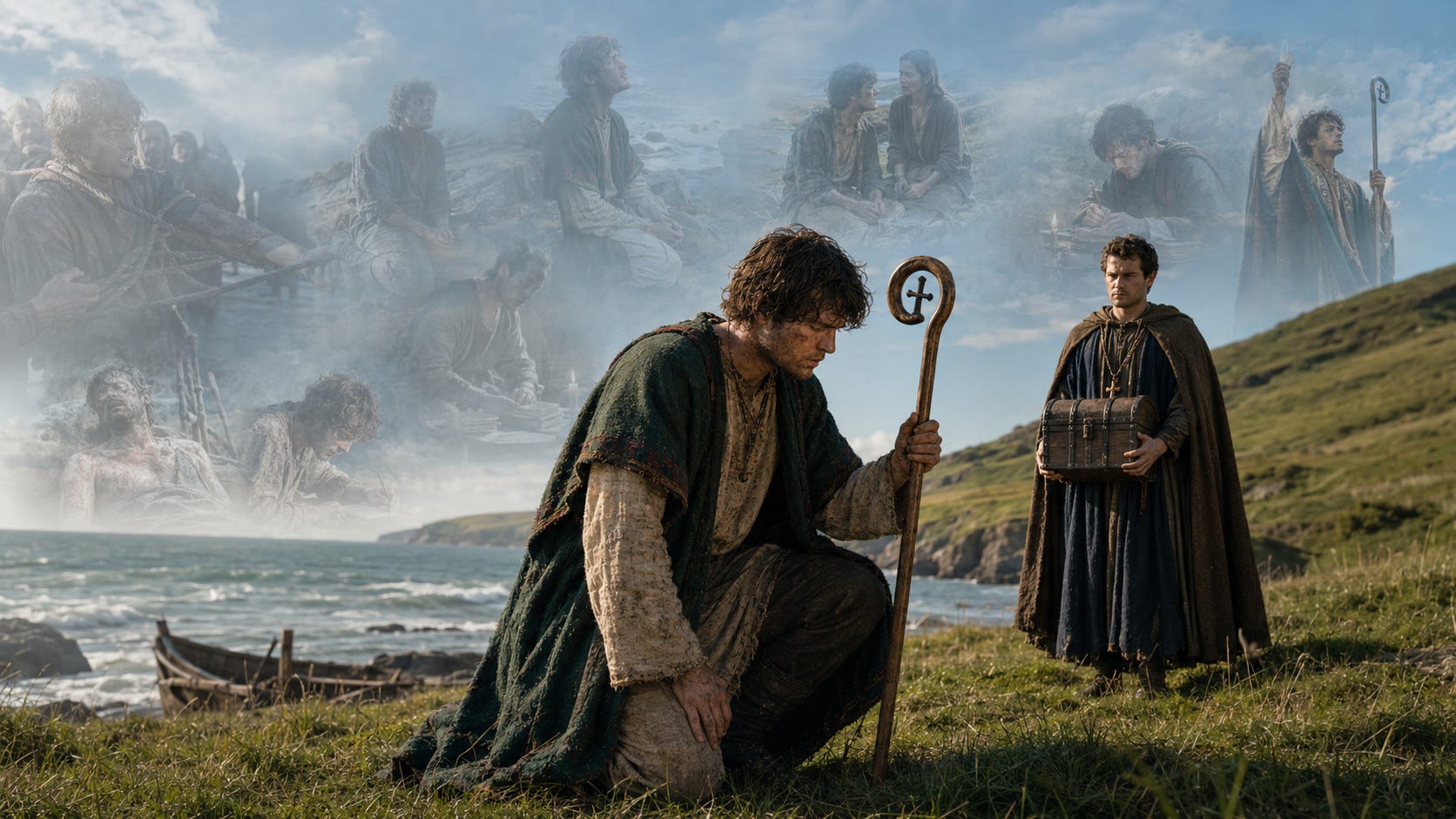
The Shore of Ireland
The crossing was not dramatic. Patrick had expected it to be. Some part of him, still foolish after all the years of correction, had imagined storm or sign, the sea rising to accuse him or welcome him, clouds breaking open, wind carrying a voice clear enough that even Siger would stop pretending not to fear holy things.
But the sea did what the sea had always done. It moved.
Gray under gray sky, green under broken light, black when evening waters extinguished the sun. It lifted the ship and let it fall. It slapped the hull with no interest in theology. Gulls followed until they tired of hope. Ropes creaked. Sailcloth snapped. The rough noises of work and rest went on as if a man returning to the land of his captivity were no more remarkable than a barrel of salted fish.
Siger seemed pleased by this. “Sea doesn’t care why you cross,” he said on the second morning, finding Patrick near the rail. “Best thing about it.”
Patrick looked out over the water. “That is also the worst thing about it.”
Siger grunted. “Priests ruin every comfort.”
Patrick almost smiled. Coroticus’s men did poorly with the crossing. One vomited until even the sailors took pity on him. Another prayed too loudly, as if God would soften the wind if only He could hear him. The young cleric sent by the bishop kept both hands clamped around a small chest of wrapped vessels as if pirates, waves, and Ireland itself had designs upon the chalice.
Patrick worked when Siger allowed it. Not much. Enough to remember the old ship, the hunger, the terrible mercy of labor that did not ask what a man felt. When his fingers closed around rope, memory rose, but not as a chain. More like an old scar aching before it rains.
At night he prayed. No voices came. That unsettled him more than storm would have. For years Ireland had called within him. Sometimes loud enough to wake him. Now that he was going, the call had fallen silent. The absence was not emptiness. The strange thing was Patrick did not feel abandoned. Peace, perhaps. Or waiting. He did not trust himself enough to name it.
Ireland rose on the third morning. Low at first, a darkness in the mist. Then shape. Then land. Green-black and wet, with hills lifting behind the shore and smoke no thicker than thread in the distance. Birds moved above it. The water between ship and coast brightened in long broken pieces, as if the sun had scattered coins across the tide.
Patrick’s hand tightened around the shepherd’s crook. There it was. Not dream. Not memory. Earth. Soil. The place of rope and prayer. The land that had made him a slave and taught him to speak to God because there had been no one else left to hear.
Siger came beside him and said nothing. That was kind of him. After a while Patrick said, “I thought I would be more afraid.”
“You will be,” Siger said. Patrick looked at him.
The captain shrugged. “Fear has sense enough to wait until it’s useful.”
Patrick turned back to the shore. By afternoon they anchored offshore, unwilling to trust the shallows before local tides were better read. Boats took them in through cold water and weed-thick rock. The first time Patrick’s boot struck Irish ground, he stopped.
The shore was narrow, stones slick underfoot, grass bending above the sand and seaweed strands. The land climbed toward low hills, rough and bright after rain. Somewhere unseen, a bird called once and was answered by a chorus.
Patrick waited. He did not know for what. Doubt, perhaps. The call, perhaps. Nothing came. Only wind and the water lapping against the Irish shore. He knelt and pressed his fingers into the damp earth. Cold moved into his skin.
For a moment he was twenty things at once: the boy dragged from Britain, the slave on Miliucc’s hill, the runaway in the bog, the son at Aelia’s hearth, the wounded fool in a raiders’ camp, the failed student, the ordained man, the one sent. None of them vanished. None of them ruled him. He bowed his head. “Christ be with me,” he whispered. The wind moved over the grass.
Siger’s voice came from behind him. “You planning to kiss every stone, or shall we make camp before your guards start naming themselves martyrs?”
Patrick rose. “I am ready.”
“No,” Siger said. “But you’re here.”
The camp was made above the first rise where the ground lifted dry enough to sleep on. Coroticus’s men set a watch. The young cleric checked the chest of vessels once more, then sat on it. Siger’s sailors hauled the last supplies ashore, complaining in three languages.
By sunset the ship lay offshore at anchor, dark against the reddening water. Smoke from their small fire bent inland. Men ate. Low talk of local chiefs and settlements passed between Siger, Patrick, and one of Coroticus’s men.
Patrick listened more than he spoke. Obedient silence still held him, no longer as restraint but a calmness. Siger found him later at the edge of camp. The captain stood beside him, looking toward the inland hills.
“Well,” he said, “there it is.”
“Yes.”
“Still want it?”
Patrick watched mist gather in the low places. “No.”
Siger glanced at him. Patrick smiled faintly. “But I love it.”
The captain was quiet at that. Then he spat to the side, though without conviction. “That sounds dangerous.”
“It is.”
Siger nodded once, as if satisfied by the honesty. For a while they stood together while evening sank. At last Siger said, “This is where I leave you.”
Patrick looked toward the ship. “I thought you sailed in the morning.”
“I do.” Patrick understood. “Ah,” he said. “That is not what you meant.”
“No.” Patrick waited. Siger’s eyes stayed on the hills. “I carried you away once. I carried you back. That is enough meddling for one life.”
Patrick felt the words enter him slowly. “You call that meddling?”
“I call it bad seamanship. Men like you alter the weather.”
Patrick laughed softly. Siger looked at him then, without mockery but a calmness that showed his age. “You pray for me still?” the captain asked.
“Yes.”
“I told you to stop. You ignored me.”
“Yes.”
Siger shook his head. “Priests.”
Patrick’s throat tightened. “I will keep ignoring you.”
The captain looked away first. “See that you do it quietly,” he said.
Night settled. One by one, the camp softened into sleep. The guards murmured at their posts. The young cleric finally stopped checking the chest. Coroticus’s men rolled themselves in cloaks. Siger returned to the boats, and then to the ship offshore, to wait for first light and the morning tide.
Patrick lay beneath his cloak unable to sleep for a long time. He listened to Ireland breathe around him. Wind in grass. Water against stone. A guard coughing softly. Silence between all things. The call did not return. And still, for the first time since he had heard the voices of the Irish, Patrick did not fear. He closed his eyes. The silence held comfort.
Go Now
Patrick woke before first light. For a moment he did not move.
The camp lay around him in the deep hush before dawn, that hour when the world seems to be holding its breath before God commands it to begin again. The fire had settled into red eyes beneath ash. Coroticus’s guards lay wrapped in their cloaks, heads bent forward, sleep having taken them in spite of duty. The rest of the men did not stir.
Even the sea seemed careful not to wake a soul. Offshore, Siger’s ship rested at anchor, dark against the paling water, mast rising like a black stroke against the first weakness of morning.
Patrick sat up slowly. No one woke. He listened. The long silence that had followed him across the sea gathered around him, not empty now, not merely peaceful, but full, like a cup held steady.
Then it broke. Go now. Patrick closed his eyes.
The words came without violence or thunder. No cry or terrible pressure in his chest. They arrived as command arrives when a man has stopped arguing against the One who gives it. Go now. Find and teach My children.
Patrick bowed his head. There was no fear in him for one whole breath. Only obedience.
Then the fear returned, as fear does, but it returned in a different way. Not as throne. Not as a shaking hand. Somewhere distant, where it could walk with him and not rule him.
He reached for the shepherd’s crook. The wood met his palm like an old friend and an old wound. He took up his satchel, checked by touch for the wrapped letters, the small book, the few things entrusted to him by the bishop. He fastened his cloak. He rose.
Only the crook striking softly against Irish earth.
He had taken three steps beyond the campfire when he heard movement ahead of him, just beyond the low red reach of the embers. Patrick stopped. A small shape shifted at the edge of the dark. The young cleric was sitting awake, staring at Patrick with wide, sleepless eyes, one hand still on the little chest he had guarded all through the crossing as if Heaven’s vessels might escape if he blinked. Waiting.
For a moment neither spoke. Patrick lifted one finger to his lips.
The cleric swallowed. Then, with surprising care, he rose without waking the others.
He wrapped the strap of the chest across his shoulder, gathered his cloak around him, and stepped over a sleeping man’s boot with the delicacy of a thief stealing silence.
Patrick frowned and shook his head once. Stay. The cleric shook his head back. His face was pale, frightened, stubborn. Patrick leaned close enough to whisper. “You were not commanded.”
The cleric’s throat moved. “I was sent with you.”
“This is my cross to carry,” Patrick whispered. “Not yours.”
The cleric glanced toward the sleeping camp, then back at Patrick. “You carry the cross for Christ, so it is my duty to carry it too.”
Patrick almost rebuked him. The words rose easily. Too easily. Then he saw the boy’s hands trembling around the chest strap.
Not ambition. Fear. And beneath it, duty. Patrick remembered too suddenly what it was to stand at the edge of another man’s command and not know whether obedience meant staying safe or stepping into the dark.
“What is your name?” Patrick whispered.
The cleric blinked, as if no one had thought to ask him since Britain. “Judoc.”
Patrick held his gaze. “Judoc,” he said quietly, “if you come, you come without complaint.” The cleric nodded quickly. “And without boasting later.” Another nod. “And if I tell you to run?”
Judoc’s mouth tightened. “I will run.”
Patrick did not believe him. That, too, could be dealt with later. He looked once more at the sleeping camp, at the men Coroticus had assigned, at the guards who would wake angry, at the careful plans still folded inside the bishop’s letters. Obedient silence did not mean obedience was always understood by those left sleeping.
The command had not changed. Go now. Patrick turned. Judoc followed.
Together they left the camp while dawn thinned the mist over the grass.
The land rose before them, wet and green and waiting. Each step took Patrick farther from the fire, from the sleeping guards, from the ship rocking gently offshore, from the last visible thread tying him to Britain. He did not look back until the first hill forced him to.
At the crest, he stopped.
Below, the camp still slept. Smoke lifted faintly from the ash. Beyond them, the ship lay at anchor. On its deck, alone, stood Siger. One hand resting on a rope, his cloak moving in the wind.
Patrick did not know how long he had been watching.
Beside Patrick, Judoc went still. “He sees us,” the cleric whispered.
“Yes.”
Siger lifted one hand. Not high. Not sentimental. Enough.
Patrick felt the farewell strike him in a place words would not have reached. Salt and gratitude and grief together. He knew, with a certainty he could not have explained, that he would never see Siger again. He lifted his own hand in answer. Across the water and the morning mist they held the gesture a heartbeat longer than either man’s nature allowed.
Then Siger dropped his arm.
Patrick turned, knowing he would pray for Siger all his days. Judoc looked at him, pale, afraid, still gripping the chest as if it contained fire.
“Where do we go?” the cleric asked.
Patrick looked ahead. Ireland lay before them, wet, green, waiting. His hand tightened around the crook. “Forward to find His children,” he said.
And he walked over the hill into the land that had once owned him, with Judoc following a few steps behind.
Author’s Note
And so Becoming Patrick comes to its end. Not with conquest, not with triumph, but with obedience.
Patrick disappears over the hill into the land that once enslaved him, now returned to it as a man sent. The story does not end because Patrick’s work is finished. In truth, it is only beginning. But this has always been the shape of this tale: not the full legend of Saint Patrick, but the long, painful becoming of the man who could one day carry the Gospel back across the sea.
Thank you for reading, encouraging, commenting, and walking through this story with me. Your engagement helped shape the journey, and I am deeply grateful.
Becoming Patrick will be revised and prepared for publication. When that happens, most of these segments will move behind the paywall, so now is a good time to catch up, reread, or share the series with someone who might enjoy it.
I would also love to hear from you: which saints, eras, or Catholic fictional themes would you like me to explore next? Another saint’s hidden years? A martyr’s family? A monastery on the edge of collapse? A conversion story? A spiritual battle told quietly through ordinary lives?
Let me know where you would like the next road to lead.