Becoming Patrick: Sinner and Saint - Part 13
The Madness of Obedience
The continuation of the multipart historical novelette that imagines the lost years of Saint Patrick’s youth, the terror of abduction, the grind of slavery, and the quiet awakening of faith that changed everything. Because the historical record says little about his formative years, much of this story is fictional and meant to entertain and edify. Where sources fall silent, I’ve chosen plausible details; where Patrick speaks in his own writings, I’ve tried to honor his tone and faith.
If you haven’t read the previous releases here are the links:
[ Part 1 ] [ Part 2 ] [ Part 3 ] [ Part 4 ] [ Part 5 ] [ Part 6 ] [ Part 7 ] [ Part 8 ] [ Part 9 ] [ Part 10 ]
[ Part 11] [ Part 12 ]
The Three
Patrick told Father Ciarán before the sun had fully climbed.
He expected disbelief. Or worse, tenderness. He expected the priest to lay a hand on his shoulder and speak in that grave, patient way older men used when younger men had mistaken fire in the blood for a word from Heaven.
But Father Ciarán did not dismiss him. That was somehow worse.
They stood in the little church while morning gathered in the cracks of the door. The lamp still burned. Wax had sagged down one side like frozen tears. Patrick’s shepherd’s crook rested against the wall, the cross carved into its hook catching what little light there was.
Father Ciarán listened without moving.
Patrick told it straight. The voices. The Irish. The phrase that had struck him awake. The command that had followed. Go back.
When he finished, silence stood between them.
Father Ciarán’s face was pale in the lamp-glow, old and unreadable. “At least,” he said finally, “you are frightened.”
Patrick looked up sharply.
“That is good,” Father Ciarán said. “A man who hears such a thing and is not frightened is either a fool, a liar, or already half-mad with pride.”
Patrick swallowed. “Then you believe me?”
“I believe you heard something.” Father Ciarán’s eyes sharpened. “I believe it has the shape of the first call. I believe it does not flatter you. I believe it drives you toward the cross and not toward applause.”
Patrick felt the smallest looseness in his chest.
Then Father Ciarán said, “And I believe you are not ready.”
The looseness vanished. Patrick’s hand tightened around the edge of the bench. “Father—”
“No.” The priest’s voice was not loud. It did not need to be. “You are not a weapon to be thrown at Ireland because you burn. You are not yet formed. You are still learning how not to make your wounds into commands.”
Patrick flinched. Father Ciarán saw it and did not soften. “The bishop will need more than a dream. The Church will need more than your terror. If God is sending you, He is not sending you outside obedience.”
Patrick stared at the crucifix on the wall.
Outside, somewhere down the lane, children laughed. The sound struck him in the ribs. “People are being taken now,” Patrick said.
“Yes.”
“Children.”
“Yes.”
“I know what happens to them.”
Father Ciarán’s face tightened, and for one moment his age showed through the sternness like bone through skin. “Yes,” he said again.
Patrick’s voice dropped. “Then how can I wait?”
Father Ciarán looked at him for a long time.
“By suffering the waiting,” he said. “If the call is from God, delay will purify it. If it is from your guilt, delay may expose it.”
Patrick almost laughed. It came out bitter and broken. “And if delay costs lives?”
The priest did not answer quickly. That silence was honest. Patrick hated him for it.
At last Father Ciarán said, “Then we pray for mercy upon what we cannot command.”
The old anger rose in Patrick, sudden and hot. Command. Always that word. As a child he had wanted to command stones. As a slave he had learned command under a stick. Now even mercy felt like something men discussed while children were dragged into the dark.
He bowed his head because if he looked at Father Ciarán another moment, he might say something he could not unsay.
“I need to pray,” Patrick said.
Father Ciarán studied him. The priest knew him too well.
“Pray here,” he said.
Patrick nodded. He knelt.
Father Ciarán waited a moment, then turned toward the side room, perhaps to fetch a book, perhaps to give him the dignity of silence. His footsteps faded.
Patrick stayed still until the sound was gone. Then the voice in him rose again. Not loud. Worse. Near.
Go now. His breath stopped. He looked toward the door. Go now.
Every sensible thing in him recoiled. Father Ciarán was right. The bishop would be right. His father would be right. He was unfinished, unordained, unready, still ruled half the time by fear and shame and the fierce animal refusal to be owned again.
Go now. Patrick rose.
He took the shepherd’s crook from the wall. His fingers closed around the smoothed wood. The carved cross rested above his hand, plain and rough and impossible to pretend was enough. Then he slipped out of the church before Father Ciarán returned.
He did not go home. If he went home, Aelia would see his face. If Aelia saw his face, he would not leave. So he followed the river. Downstream.
The Clyde moved beside him, loud over stone, as if trying to cover the sound of his disobedience. Or his obedience. He could not tell which. He kept low where the bank folded and walked until the settlement thinned behind him, until the familiar paths gave way to reeds and wet grass and the smell of mud.
All day he followed the water.
He did not eat. He drank from his cupped hand. Once he heard riders somewhere above the bank and crouched beneath willow-shadow until they passed. Twice he nearly turned back. Each time, the thought of the children by the river came to him, their small bodies running uphill, Darerca’s face white with fear.
Then another image came. Hands reaching. Rope. He kept walking. By dusk, he smelt smoke. Not village smoke. Not hearth smoke.
A little further he spotted a thin dark smudge rising from a hollow near the riverbend where the trees crowded close and the bank dipped out of sight from the higher ground.
Patrick stopped. His heart began to hammer so hard that his vision pulsed with it.
Voices drifted toward him. Irish.
Men laughing. A curse. The low moan of cattle. Then a sound that made his stomach twist: someone crying softly and trying not to be heard.
He had found them. Or God had led him. Or had madness led him?
Patrick stood in the reeds until the light weakened and the smoke thickened and the sky turned the color of old iron. His legs wanted to run. His mind wanted a plan. He had neither.
Only the crook. Only the cross. Only the command. He stepped out into the open.
The first raider saw him and went still. Then another. Then another.
Conversation died in pieces. A man near the fire rose with a knife in his hand. Someone laughed once, uncertainly, as if Patrick must be drunk or lost or too stupid to know what camp he had entered.
Patrick walked straight toward them with the shepherd’s crook in one hand and his other hand open at his side.
No weapon. No shield. No men behind him.
Only the cross carved into the crook’s hook, lifted slightly before him.
That unnerved them more than a spear would have.
Men knew what to do with spears. They did not know what to do with a man who walked alone into a raiders’ camp carrying a cross.
A voice cut through the hollow. “You.”
Patrick recognized him before he fully saw him: the leader from the riverbank, broad-shouldered, scar pale at the cheek, eyes narrowed with the sharp disgust of a man seeing a problem return.
The leader stepped forward slowly. Around the camp, men shifted. Patrick saw captives near the far side of the fire—bound, huddled, faces turned toward him with the blank desperation of people who no longer trusted hope because hope had become cruel.
There were men among them. Women. Children.
Patrick’s throat tightened.
The leader spoke in Irish. “You should have stayed behind your women and walls.”
Patrick’s mouth was dry, but he replied in Irish. “I came alone.”
A few of the raiders laughed. “Then you came stupid,” one said.
The leader’s gaze dropped to the crook. “Or mad.”
Patrick lifted the cross a fraction. His hand trembled. He hated that they could see it.
“I came in the name of God.” This time the laughter was louder.
One man spat into the fire. Another made a crude sign with his fingers and grinned at the others.
The leader did not laugh. That was worse.
He came closer, close enough for Patrick to see the dirt under his nails, the old blood dark at his sleeve. “Your Christ comes back quickly,” he said. “Did he send you to pay?”
Patrick held his ground. The leader’s expression hardened. He nodded to one of his men.
The blow came from the side. A club struck Patrick across the shoulder and upper back with a force that drove the air from him. White pain flashed. His knees hit mud. The crook slipped from his fingers and clattered against stone.
The captives gasped. The raiders laughed again, relieved now, because pain made the strange ordinary.
Patrick’s mouth filled with mud and blood. For a moment he could not breathe.
Stay down, his body begged. Stay down and live.
He pressed one hand into the mud. Then the other. He rose.
Not gracefully. Not quickly. But he rose.
The laughter thinned. He bent, picked up the crook, and lifted the cross again.
The leader’s eyes narrowed. Another nod.
The second blow caught him lower, across the ribs. Pain opened like fire. Patrick staggered, nearly fell, bit down on a cry, and tasted blood.
The world tilted. He saw the captives watching him.
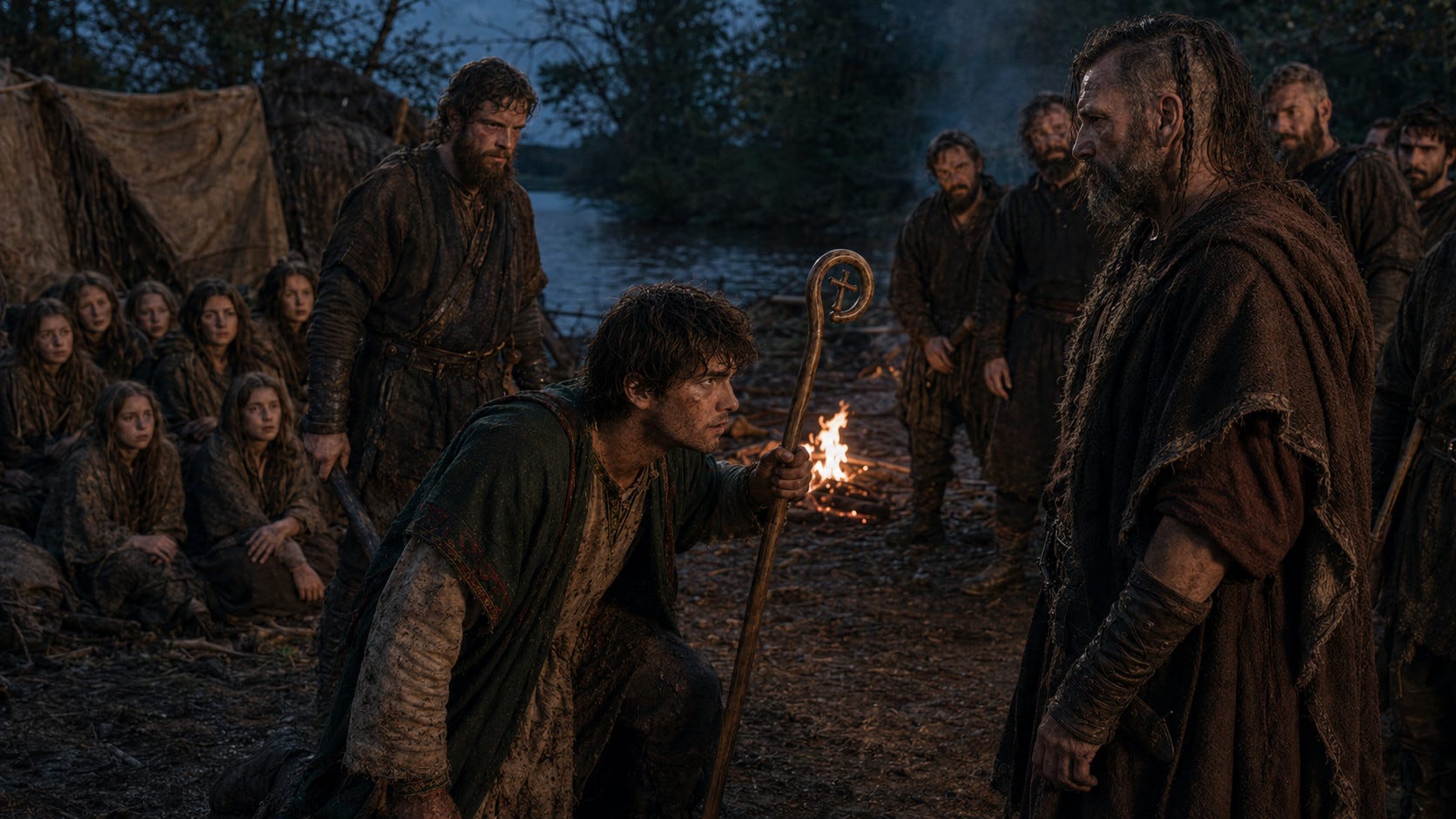
He saw one girl with dirt on her face and eyes too old for her body. Nia? Not Nia. Every child became Nia if he looked too long.
He straightened. The camp went quiet enough that the river could be heard beyond the trees.
Patrick spoke before his fear returned with teeth.
“I am alone,” he said in Irish. “No men follow me. No spear is hidden. No trap waits.”
The leader tilted his head. “Then why come?”
Patrick swallowed. Because a voice woke me. Because your captives cried in my sleep. Because I know what rope does. Because I am afraid not to.
“God sent me,” he said finally.
The raiders jeered, but not as loudly as before.
The leader looked at him for a long moment. “Your God sends broken men?”
Patrick’s answer came before thought. “Who else can He send?”
Something moved across the leader’s face, too quick to name. Then it vanished.
“You speak Irish like a slave,” he said.
“I was one.” That stirred the camp.
The leader’s smile returned, slow and dangerous. “Then perhaps you ran from someone who still owns you.”
“No man owns me.”
“Every man is owned.”
Patrick lifted the cross higher, though his arm screamed. “I belong to Christ.”
More laughter. Harsher now, because the claim was becoming uncomfortable.
The leader turned partly to his men, performing ease. “Hear him. He belongs to a god who buys no cattle.”
Patrick’s voice sharpened. “Does your god own the river?”
That quieted one man near the fire. The leader looked back.
Patrick took one step forward. It hurt. He took it anyway.
“Does your god own the wind?” he asked. “The sea? The ground under your feet? You give fear one name for water, another for sky, another for earth, and still you make signs in the mud when you think something unseen stands near.”
The leader’s face hardened.
Patrick knew he had touched the memory of the riverbank. Good. Or dangerous. There was no difference now.
“My God is one,” Patrick said. “And not alone.”
The men stared. Patrick could hear his own heartbeat.
“One God,” he continued, the Irish rough in his mouth, “Father, Son, and Spirit. Three, and one. Not quarreling like frightened kings. Not divided like men over stolen cattle. One will. One power. One mercy. The Maker of earth and water and sky.”
A raider barked a laugh. “Three is not one.”
“No,” another sneered. “His god cannot count.”
Laughter broke out again, louder this time, grateful for mockery. Patrick waited.
He had learned from Father Ciarán that truth did not need to shout over fools. It only had to remain when the noise ended.
The leader watched him through the laughter, eyes narrowed, calculating again. “So,” he said when the camp quieted, “your three-one God sent you here as a gift.”
A few men chuckled.
The leader stepped closer. “Maybe we bind you, holy slave. Maybe we sell you back to the man you ran from. Maybe your God sent you to us because we are favored.”
Patrick felt the old terror rise, Miliucc’s yard, rope, the empty bedroll. Then, astonishingly, the fear passed through him and kept going.
It did not leave him brave. It left him clear.
“If you bind me,” Patrick said, “you will not reach your home.”
The leader’s smile vanished.
Patrick pointed toward the darkening river with the crook. “The waters will take you. Or the wind will turn against you. Or the land will hold you until every captive here walks free.”
A murmur moved through the raiders. Patrick pressed on, voice low now, not theatrical, not loud. “You know the world is alive with judgment. You know a man can offend what he does not see. I tell you: deny me, and you deny the God who rules what you fear.”
Silence. The fire snapped. One of the captives began to sob, very softly.
The leader stared at Patrick with hatred and uncertainty braided together. “You threaten me with your god.”
“I warn you with mercy.”
The leader spat. “Mercy.”
“Yes.”
“You want captives.”
“I want them free.”
“All?”
Patrick did not answer.
The leader laughed once, cold. “All? You came alone for all?”
Patrick’s throat tightened.
He looked at the captives. Too many. Too bound. Too far from help. If he demanded all, the leader would either kill him or laugh him into the mud. If he took none, he would return with empty hands and a soul torn wider.
The leader saw the calculation. His eyes brightened with cruel amusement. “One,” he said.
Patrick looked back at him.
“One captive,” the leader said. “Choose. Take one back to your Christ. Then go before I change my mind.”
The camp murmured. Some laughed. The captives stared at Patrick with sudden awful hope.
One. The word was a knife.
Patrick’s mind recoiled. One meant choosing who remained. One meant making himself master over another person’s fate. One meant walking away from all the faces he did not choose.
He swallowed. “No.”
The leader blinked, almost amused. “No?”
“Three,” Patrick said.
The raiders stared. Then laughter erupted, rough and incredulous.
“Three,” the leader repeated when it died. “Why three, madman?”
Patrick held his gaze. “Because my God is one God in three Persons,” he said. “If you would please Him, free three.”
A roar of mockery rose. Men slapped their knees. Someone shouted that Patrick’s God was greedy. Someone else said perhaps the three gods wanted three girls for themselves. The words were foul enough that Patrick’s jaw tightened, but he did not answer filth with filth.
He waited again. When the noise settled, the leader was still staring.
Not convinced. Not converted. But uncertain.
Superstitious men feared patterns. Three had become a pattern.
The leader’s tongue moved against his teeth. “Three,” he said softly. “And you choose?”
Patrick turned toward the captives. Their eyes struck him like stones.
Men. Women. Children. A boy no older than Aedan had been. An older man with blood in his beard. A young mother clutching an infant so tightly the child whimpered. Three girls bound together near the back, thin as reeds, their faces gray with terror.
Patrick could not choose. He would not.
He stepped toward them slowly, keeping his hands open, the crook angled away so it would not look like a threat.
In English, he said, loud enough for them all, “He will free three.”
A stir. Hope can be crueler than despair when it arrives without enough room.
Patrick’s voice shook once, then steadied. “I cannot choose. You must.”
The captives stared at him. One of the men began to speak, hoarse and urgent, but stopped when Patrick met his eyes.
Patrick looked at the men first. “What the women will face may be worse than death,” he said. The words cost him, but he said them plainly. “You know this.”
Silence fell among the captives. The older man with blood in his beard closed his eyes. Then he nodded once.
A young captive beside him began to weep soundlessly, but he nodded too.
The mother clutched her infant. Another woman bent forward, forehead nearly to the mud, whispering something Patrick could not hear.
There was no quarrel. That broke him more than quarrel would have. The captives did not scramble for mercy. They passed it like bread.
Three of the youngest girls were pushed forward, not shoved by force, but guided by trembling hands. One could barely stand. One had a bruise across her cheek. The smallest looked at Patrick as if he were something too dangerous to trust and too desperate not to follow.
Patrick turned back to the leader. “These three.”
The leader studied the girls, then Patrick. “You choose weak ones.”
“No,” Patrick said. “They chose mercy.”
The leader’s face twisted. “Take them, then.”
A raider cut their bonds. Not gently. Efficiently.
The girls stumbled toward Patrick. He did not touch them until they reached him, and even then he only opened his arm slightly, guiding without grasping.
The leader stepped close one final time. “If your God is false,” he said, “I will hear of it.”
Patrick met his eyes. “When you reach your home,” he said, voice low, “look for me.”
The leader frowned. “What?”
Patrick lifted the cross-crook between them. “Look for me when you reach your home. I will pray for you until then.”
The raiders laughed again, but uneasily now.
Patrick turned away before the leader could decide insult required blood. He walked out of the camp with the three girls close behind him, every step expecting a spear in the back. None came.
The river sounded louder as they reached the reeds. Behind them, the camp resumed its noise in broken pieces—curses, mutters, laughter that tried too hard.
Patrick did not look back. He kept the cross raised until the trees hid them.
Only then did his arm fall. Only then did pain take its full due. One of the girls made a small sound and reached as if to steady him.
Patrick shook his head. “Walk,” he whispered in English. “We walk until the river brings us home.”
And in the dark beside the Clyde, with three frightened souls following the sound of his staff striking stone, Patrick understood that he had not begun a mission. Not yet.
He had only taken the first disobedient step toward obedience.
Author’s Note (Part XIV):
Patrick’s obedience is not yet clean.
That is part of the point. He has heard a call, but he is still young in formation, still wounded, still quick to act when mercy and fear become tangled together. Father Ciarán is right: the Church cannot send a man simply because he burns. Dreams must be tested. Zeal must be purified. Even courage can become dangerous when it refuses obedience.
And yet grace does not always arrive in tidy order.
In this chapter, Patrick steps outside the bounds given to him and walks toward danger with nothing but a cross, a half-formed faith, and the memory of chains. His action is reckless. It is also merciful. The story is not asking us to pretend those two things are easy to separate.
The three captives he brings out of darkness do not make him ready for mission. They make the question impossible to ignore.
What follows must be judged; not by rumor, not by praise, not by Patrick’s fear or pain, but by the Church, by wisdom, and by whether this strange summons can survive the weight of obedience.