Becoming Patrick: Sinner and Saint - Part 14
Heroic Consequences

The continuation of the multipart historical novelette that imagines the lost years of Saint Patrick’s youth, the terror of abduction, the grind of slavery, and the quiet awakening of faith that changed everything. Because the historical record says little about his formative years, much of this story is fictional and meant to entertain and edify. Where sources fall silent, I’ve chosen plausible details; where Patrick speaks in his own writings, I’ve tried to honor his tone and faith.
If you haven’t read the previous releases here are the links:
[ Part 1 ] [ Part 2 ] [ Part 3 ] [ Part 4 ] [ Part 5 ] [ Part 6 ] [ Part 7 ] [ Part 8 ] [ Part 9 ] [ Part 10 ]
[ Part 11] [ Part 12 ] [Part 13]
Empty Church
Father Ciarán returned with the book under his arm and found the church empty.
For one foolish heartbeat he thought Patrick had moved deeper into the shadows, ashamed of being seen in prayer. The morning was still dim enough for a man to disappear inside it. The lamp guttered near the wall. The crucifix hung quiet above the altar. Damp stone breathed cold into the nave.
“Patrick?” No answer.
Father Ciarán took two steps forward. Then he saw the empty place beside the wall. The crook was gone.
The book slid from under his arm and struck the floor with a flat slap. For a moment he only stared. Disbelief came first, stupid and useless. Then anger, hot enough to make him young. “Fool,” he whispered.
The word sounded too small. He crossed the church in three strides, pushed through the door, and stood in the gray lane with the wind cutting under his cloak.
No Patrick. No staff. No time.
Father Ciarán knew before he let himself know. Not home. The river.
His anger collapsed into fear so quickly it nearly took his legs. He gathered his cloak and went hard down the lane toward Calpornius’s house, not running because running woke questions, but walking with such speed that two dogs lifted their heads and did not bark. Smoke had not yet risen from most roofs. The village still belonged to sleep, to the mercy of not knowing.
He knocked once. Too hard.
The door opened to Calpornius with sleep still in his face and suspicion already waking behind it. One look at Father Ciarán, and the sleep vanished. “What?”
Father Ciarán could not soften it. “He’s gone.”
Behind Calpornius, Aelia appeared with her hair unbound and her shawl caught loose around her shoulders. She looked from one man to the other. Her mouth opened, but no sound came. She knew.
Mothers knew before words. They heard disaster in the shape of silence.
Calpornius gripped the doorpost. “Gone where?”
Father Ciarán looked past him toward the unseen river.
Calpornius understood.
His face hardened so fast it was almost frightening. The father vanished. The deacon remained. Then the father came back worse. “He went after them.”
Father Ciarán said nothing.
Aelia made a sound then, not a cry, not yet, something smaller and more terrible. “No.”
Calpornius turned into the house. “Darerca stays inside.” His voice was rough, already moving. “Bar the door after us.”
Aelia caught his sleeve. “Bring him back.” The command broke on the last word.
Calpornius looked at her once, and all the force went out of his face. For half a breath he was only a man whose son had come back from slavery and now had walked willingly toward it.
“I will,” he said.
It was not a promise he had the power to make. He took down a short blade from above the hearth and called for his cloak.
Father Ciarán stepped back into the lane, already turning toward the nearest houses.
He woke men quietly first. Men who could ride. Men who knew how to hold their tongues until holding tongues became useless. But fear travels faster than feet. Doors opened. Faces appeared. Someone asked what had happened. Someone else said Patrick’s name.
Then the village began to stir.
Calpornius came out armed, his jaw set, his eyes dark. Two men brought ponies. Another had a spear. Aedan’s mother stood in her doorway with both hands clutched against her chest as if holding in her own heart. Marc’s uncle swore under his breath and crossed himself badly.
“Downstream,” Father Ciarán said. “He will have followed the bank.”
“Alone?” one of the men asked. Father Ciarán turned on him. The man looked away.
Calpornius mounted. His hands shook once on the reins, then steadied. “If you find him,” Father Ciarán said, voice hard, “do not let him speak first. Seize him if you must. Drag him if you have to.”
Calpornius’s eyes flashed. Father Ciarán did not apologize. “If he has gone where I think he has gone, and if he has gone because he thinks God sent him, words will not be enough.”
The riders turned toward the river path. For a moment, Father Ciarán wanted to go with them. His old legs even moved once, as if pride could make them young. Then he stopped. He knew the truth of his body. He would slow them. Pride would cost time.
So he stood in the lane while they rode out, hoofbeats dull in the wet earth, downstream into the gray. Only when they vanished beyond the bend did Father Ciarán turn back toward the church.
The village was awake now. Aelia stood at her door, one hand against the frame, white-faced and silent. Darerca peered from behind her, eyes wide with a fear unnatural for her age.
Father Ciarán could not look at them long. He went into the church and shut the door. The book still lay where it had fallen. He picked it up slowly and set it on the table. His hands were trembling now, anger leaving him with nothing to stand on but dread.
Then he knelt. No careful psalm came. No polished Latin. No beautiful prayer fit for a priest. Only a sound dragged out of him like blood from a wound. “Lord Jesus Christ,” he whispered, gripping the edge of the altar until his knuckles ached, “protect Patrick from the wild, from the raiders and from himself. Let his heart hear your voice and steer him safely if he is following Your purpose.”
Silence. He bowed lower. “Do not let him mistake You and be destroyed by that mistake.”
The lamp flickered. Outside, the village murmured and gathered and feared.
Father Ciarán pressed his forehead to his clasped hands. “Bring him back,” he said, and now his voice was no steadier than Aelia’s. “Scold him, break him, humble him, but bring him back.”
Then he stayed there, old knees on cold stone, praying like a man with a knife at his throat, while the riders searched the river and Patrick walked deeper into danger alone.
The Ones He Brought Back
The riders did not find Patrick. They found his tracks once, low by the river where the mud had taken the shape of his heel and the round bite of the shepherd’s crook. Then reeds swallowed the marks. The bank broke into stone. The river kept its secrets.
They returned with gray faces and wet cloaks as the pale of day was extinguished by night. Calpornius rode first, jaw locked so hard it seemed carved. Behind him came the others, silent in the way men are silent when they have failed and are not yet ready to admit it. No one asked aloud. No one needed to.
Aelia was still standing near the door. Father Ciarán saw her there, one hand fixed to the doorframe, her face bloodless beneath the loose fall of her hair. Darerca stood behind her, wrapped in a blanket, eyes hollow with waiting.
Calpornius dismounted. Aelia looked past him. Nothing. Then night took the settlement fully.
No one slept cleanly. Lamps burned behind shutters long after they should have died. Men checked spearheads and door-bars. Women whispered over children and listened too hard to every sound outside. The dogs barked at nothing and were cursed into silence. Once, near midnight, someone thought they heard a cry from the river path, and half the village spilled into the lane before shame and darkness sent them back inside.
Aelia did not undress. Calpornius sat by the door and slept with the short blade across his knees.
Father Ciarán kept vigil in the church with the book open before him and no memory of what he had read. Each time the wind moved under the door, he looked up.
Before dawn, they rose. The riders gathered again while the sky was still black at the edges, men speaking low, breath smoking in the cold. Calpornius first out already cloaked, his face hollowed by the night. Father Ciarán stood beside him and said nothing, because there was nothing left to say that would not sound like either comfort or despair.
For a moment the whole village seemed to hold its breath.
Then someone shouted from the lower path. Not alarm. Not joy. Something between the two.
Heads turned. Father Ciarán moved first, faster than his old knees liked. Calpornius was beside him at once. Aelia stepped into the lane before anyone could stop her. Down by the bend where the river path climbed toward the houses, four shapes emerged from the morning mist.
At first they looked like ghosts. One tall, bent badly to one side. Three smaller figures close behind him, stumbling, wrapped in scraps and fear.
Aelia saw the blood before she saw his face. She made no sound. Her hand went to her mouth as if to hold her soul in.
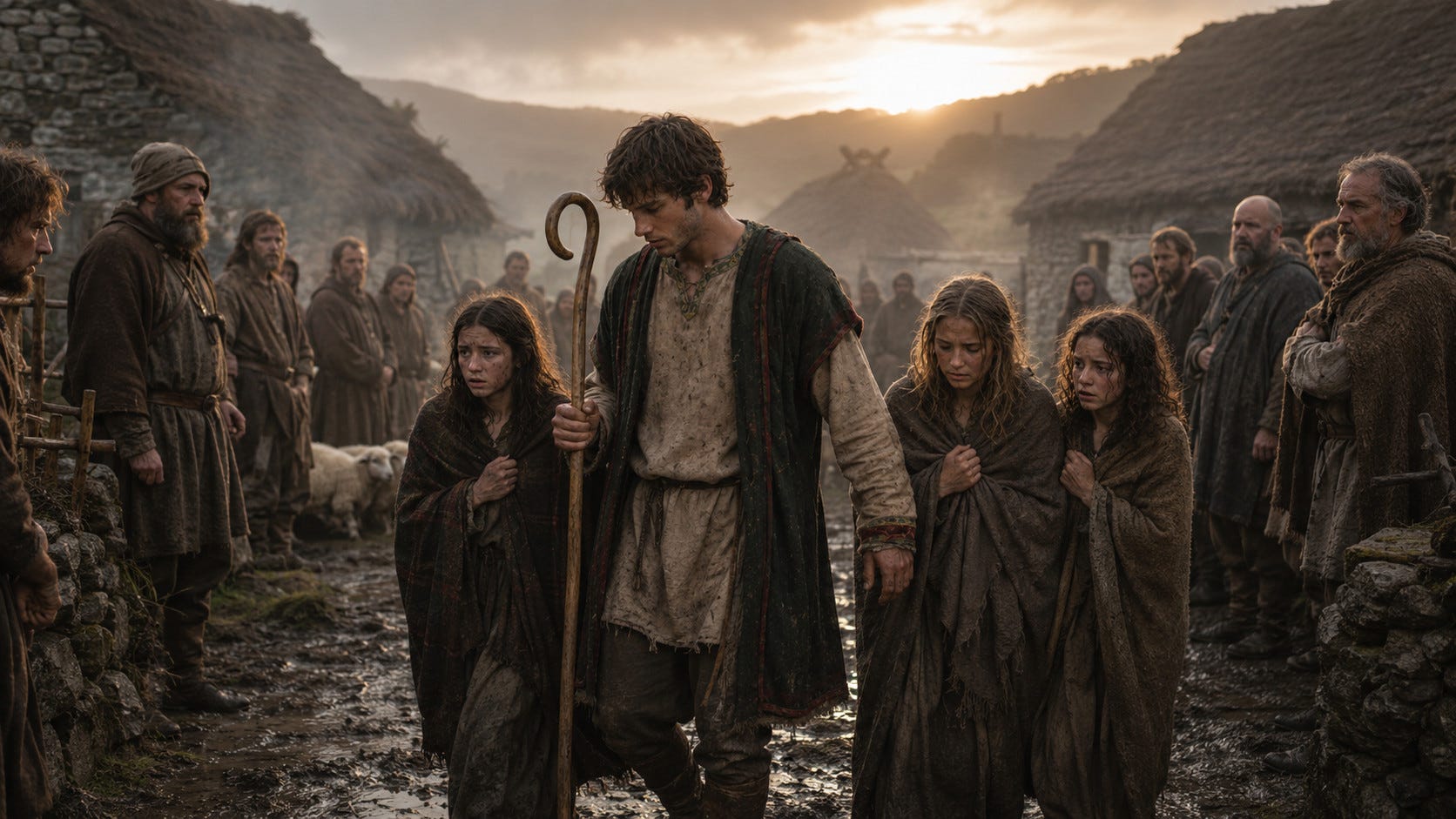
Patrick came on slowly, the shepherd’s crook striking earth with a dull, uneven sound. His cloak was torn at the shoulder. Mud darkened one side of him. Blood had dried along his mouth and down the line of his neck. He walked as if each breath had to be won by sheer will.
Behind him came three girls. Not village girls. Not known faces. Children, though one was nearly old enough to be called otherwise by cruel men. Their hair was tangled, their wrists raw where rope had bitten, their eyes wide and emptied by fear, too much night, and no sleep. The smallest clutched a torn strip of cloth to her chest with both hands.
The village began speaking all at once.
“Patrick!” “Who are they?”
“Saints preserve!”
“Get blankets.” “Water.” “Call the women.”
“Move aside.”
The sound swelled, broke, tangled around itself. A dog barked madly. Someone began to weep. Someone else crossed himself over and over, too quickly, as if speed made prayer stronger. Patrick lifted his eyes and found Father Ciarán.
For one breath the two men only looked at each other. Father Ciarán’s face changed, but not into relief. Relief was too simple. Anger still burned there. Fear had not left. And beneath both, something sharper, almost terrible: recognition.
Then Father Ciarán looked past Patrick. At the girls. Mercy stood there trembling.
That decided him. “Inside,” he said. His voice cut through the village noise.
Aelia moved toward Patrick, but one of the girls flinched at sudden motion, and Aelia stopped as if struck. Her mother’s instinct shifted in an instant from son to stranger-child. She opened both hands where the girls could see them.
“You are safe,” she said, though her voice shook. “Come. Warmth. Bread.” The oldest girl stared at her as if the words came from very far away.
Patrick tried to turn. “They need—” His voice failed.
Calpornius caught him by the arm. Not gently. Not cruelly. With the hard grip of a father who wanted to embrace and strike and hold upright and demand an answer all at once. “What have you done?” Calpornius breathed.
Patrick’s mouth worked. No sound came.
Calpornius’s fingers tightened, then loosened when Patrick’s knees dipped. “Fool,” he said, but the word broke in the middle.
Patrick gave the smallest shake of his head, as if denying the word or accepting it, no one could tell.
The women came then. Aelia, Marc’s aunt, two others with blankets and shawls. They did not crowd the girls. They moved slowly, speaking low, coaxing as if approaching frightened animals. One by one the girls allowed themselves to be wrapped.
The smallest began to cry only after the blanket touched her shoulders. That sound undid the village.
No loud wailing. No drama. Just a thin, exhausted child’s sob, and all the men who had been ready with spears and questions suddenly looked away.
Father Ciarán stepped close to Patrick. “You brought them out?” he asked.
Patrick swallowed. Blood cracked at the corner of his mouth. “Three,” he managed.
Father Ciarán’s eyes sharpened. “Only three?”
Pain passed across Patrick’s face so quickly it might have been another bruise. “I couldn’t—” He stopped. Breath caught. “There were more.”
The words landed like stones. Aelia closed her eyes.
Calpornius looked toward the river as if he could see the camp from where he stood and hated every inch of land between them. Father Ciarán’s jaw tightened. He did not ask more. Not here.
Not with the girls listening. “Get them inside,” he said.
The women led the three girls toward Calpornius’s house. Aelia went with them, though she looked back once at Patrick with a grief divided against itself. Darerca vanished inside ahead of them, sent running for cloths and warm water.
Patrick watched until the doorway swallowed the girls. Only then did his strength go. It left him all at once. The crook slipped from his hand. Calpornius caught him before he struck the ground, one arm around his chest, the other gripping his torn shoulder too hard. Patrick cried out despite himself.
Calpornius froze. Then he lowered him carefully, almost reverently, into the mud of the lane. “Patrick,” he said.
It was not rebuke now. It was the name of a child pulled from water.
Patrick blinked up at him, eyes unfocused. “I went alone,” he whispered.
“We know,” Father Ciarán said.
Patrick’s gaze found the priest’s face. “They laughed,” he said. “Then they were afraid.”
Father Ciarán knelt beside him, old knees sinking into the wet earth. “Do not spend your breath.”
Patrick did not seem to hear. “I told them…” He coughed and winced, one hand flying to his ribs. “I told them God was one. And three.”
Calpornius looked at Father Ciarán. Father Ciarán said nothing. Patrick’s eyes filled suddenly, not with pain, or not only pain. “There were more,” he whispered again.
The village quieted around him. “There are always more,” Father Ciarán said softly.
Patrick looked at him as if the words had cut deeper than the club. Then his face changed. His body tried once more to stay awake, to stand, to explain, to defend what could not yet be defended. It failed. His eyes rolled back. Calpornius caught his head before it hit the ground.
Aelia’s voice came from the doorway, sharp with terror. “Patrick!”
Father Ciarán laid two fingers at Patrick’s throat. A pulse. Fast. Stubborn. “He lives,” the priest said.
The words passed through the village like breath returning to a body. Calpornius bowed over his son, his forehead almost touching Patrick’s blood-matted hair. For one moment he looked as if he might gather him up and never release him again.
Then Father Ciarán stood. His face was gray. “Carry him inside,” he said. “And bar the door.”
Marc’s uncle frowned. “Bar it? From whom?”
Father Ciarán looked at the villagers gathered in the lane—their fear, their awe, their hunger for a story large enough to make sense of the morning. “From all of us,” he said.
No one answered. Calpornius lifted Patrick with help from two men. Patrick hung between them, limp and bloodied, one hand still curved as if around the absent crook. Father Ciarán bent and picked it up from the mud. The cross carved into the hook was dark with river dirt and blood from Patrick’s palm.
He held it a moment. Then he followed them inside, while the village stood outside in the brightening morning, staring at the closed door and the river beyond it, where mercy had come back wounded and carrying children.
To Alt Clut
They did not let the village in. That was Father Ciarán’s command, and for once no one argued with him.
The door stayed barred while morning climbed. Outside, voices gathered and broke apart, questions rising like crows beyond the wall. Inside, Calpornius’s house became too small for the mercy it held.
The three girls sat near the hearth wrapped in borrowed wool, bowls of broth held between their hands. They ate slowly at first, then with sudden hunger, then slowly again when their bodies remembered caution. Aelia knelt beside the smallest and wiped dirt from her cheek with a cloth warmed in water. Marc’s aunt worked at the rope-burns on their wrists, whispering soft, silly things because sense had failed them all.
Darerca hovered near the doorway with clean linen clutched against her chest. She watched the girls the way children watch a wound they know they might have become.
Patrick lay on a pallet near the far wall. He had woken once while Calpornius cut the torn cloth from his shoulder. He had tried to sit up. He had failed. Father Ciarán ordered him down with such force that Patrick obeyed before remembering he was no longer a child. His ribs were darkening. His back had already begun to swell. Blood had dried in the split at his mouth. Each breath cost him something.
Still, his eyes kept moving to the girls. As if he feared they would vanish if he looked away too long.
Aelia saw it and said, quietly, “They are here.”
Patrick’s gaze shifted to her.
“They are here,” she repeated, because sometimes mercy had to be spoken more than once before the wounded could trust it.
His mouth worked. “There were more.”
Aelia’s hand stilled. No one in the room moved.
Father Ciarán stood near the door with Patrick’s crook in his hand. The wood had been wiped clean, but river dirt still clung in the carved lines of the cross. He looked older than he had that morning. “There are always more,” he said.
Patrick closed his eyes.
Calpornius turned on the priest, anger flaring. “Is that comfort?”
“No,” Father Ciarán said. “It is truth.”
Calpornius’s jaw tightened. For a moment it seemed he might answer with something hard enough to wound them both. Then one of the girls whimpered in her sleep, and the anger went out of him badly, like a fire doused with dirty water.
He sat beside Patrick instead. Outside, the village pressed closer.
A man called Calpornius’s name. Another voice asked after the girls.
Someone said, not quietly enough, “God sent him.” Father Ciarán’s eyes lifted. There it was. The story beginning. Not evil. Not yet. But hungry.
Patrick heard it too. His eyes opened. “Do not,” Father Ciarán said.
Patrick’s brow tightened. “Do not what?”
“Do not listen.”
Patrick looked toward the door. Father Ciarán stepped between him and the sound of the village. “They will make of this what their grief requires. Some will call it holiness. Some will call it madness. Some will call it proof that God favors their sorrow over another’s. None of them are fit to judge it.”
Calpornius looked up. “And who is?”
“The Church,” Father Ciarán said. The word settled into the room.
Aelia looked from him to Patrick. “Now?”
“Now,” Father Ciarán said.
Calpornius stood. “He can barely breathe.”
“Then he can barely argue.” Father Ciarán’s voice was hard, but grief moved beneath it. “And that may be God’s kindness.”
Aelia’s face flashed. “You would move him like this?”
“I would save him from being devoured,” Father Ciarán said.
Silence. He turned slightly, not only to Aelia now, but to all of them. To Calpornius. To Darerca. To the women tending the girls. To Patrick himself, pale and watching from the pallet. “This cannot be judged by the village,” he said. “Not by grief. Not by praise. Not by his blood. Not by the tears of those he saved. If Patrick has obeyed God, then obedience will not fear authority. If he has followed his own wound, then praise will ruin him faster than rebuke.”
Patrick looked away. The words found him. Father Ciarán saw that they did.
He continued more quietly. “We go higher.”
Calpornius knew before he asked. “Alt Clut.”
Father Ciarán nodded. “The bishop is there, or near enough to be summoned under the Rock’s protection. Coroticus must also hear that raiders are moving this boldly along the river. These girls are witnesses. Patrick is witness. And if the raiders learn one settlement sent a man into their camp and walked away with captives, they may come back for answer.”
Aelia’s hands tightened in her lap.
“So we leave,” Calpornius said.
“Before noon.” Aelia made a sound of protest, but Father Ciarán raised a hand, not command, plea.
“If we wait, the village will either crown him or condemn him. Perhaps both. By nightfall there will be men boasting of him in the lanes and mothers bringing children for him to touch. By tomorrow there will be men asking why he brought three and not theirs. By the next day the story will belong to everyone but God.”
Patrick’s face tightened at that.
The smallest girl looked up from her broth. She did not understand all the words, but she understood leaving. Fear moved across her face. Aelia saw it. Her protest changed shape. “The girls?” she asked.
“With us,” Father Ciarán said. “They must be protected, and the bishop must hear them if they can speak. Not now. Not before men. But in truth, when they are able.”
Marc’s aunt nodded at once. “Women ride with them.”
Father Ciarán looked at her. “Yes.”
Calpornius said, “I go.”
“I know.”
Aelia lifted her chin. “And I.”
Calpornius turned. “Aelia—”
“I will not sit here with the door barred while my son is carried away half-dead and three children wake among strangers.” Her voice trembled, but did not break. “I go.”
Father Ciarán did not argue.
Darerca stepped forward. “I can help.”
“No,” three voices said at once. She stopped as if struck.
Patrick opened his eyes. For the first time since they had dragged him inside, he looked fully at his sister.
“Stay,” he whispered.
Darerca’s face crumpled, not into tears, but into rage. “You always leave.”
The room went still. Patrick had no answer. That was the answer. Aelia reached for Darerca, but Darerca pulled back, shame and anger burning red in her face. She turned away before anyone could comfort her.
Father Ciarán closed his eyes briefly. Mercy had not finished costing them. Outside, the village voices swelled again. Calpornius moved to the door, lifted the bar, and opened it only enough for Father Ciarán to step out. The priest went into the lane carrying Patrick’s crook. The crowd gathered close at once, faces tight with fear, awe, hunger, accusation. Men wanted news. Women wanted names. Children pressed behind skirts to see through the crack of the door.
Father Ciarán lifted the crook, not high like a banner, but enough that the carved cross caught the morning light. Silence spread unevenly. “Three captives have been returned,” he said.
A murmur broke out, sharp and trembling. Father Ciarán cut through it. “They will not be questioned by you.”
The murmur died. “They will be fed. Warmed. Guarded. Prayed for.”
“And Patrick?” someone called.
Father Ciarán’s gaze moved through the crowd until it found the speaker. “Patrick lives.” A sound went through them, part relief, part wonder.
“He went alone,” another voice said.
Father Ciarán’s eyes hardened. “Yes.”
“God was with him,” said an old woman, weeping openly.
Father Ciarán paused. That was the dangerous truth. Or the dangerous half-truth. “God is merciful,” he said.
Not more. Not less.
Aedan’s mother stood near the back, white-faced, one hand pressed to her chest. Her eyes were not angry. That made it worse. “Were there others?” she asked.
The lane went quiet. Father Ciarán held her gaze. “Yes.”
Her face folded inward. No one spoke.
Father Ciarán lowered the crook. “This matter goes to the bishop. Patrick’s act is not yours to praise into legend or tear into accusation. These girls are not signs for your hunger. They are children.”
The rebuke landed. Some looked away. Some stiffened. Some wept. “We leave for Alt Clut before noon,” he said.
Marc’s uncle frowned. “Why Coroticus?”
“Because raiders moved along his river,” Father Ciarán said. “Because roads and passage answer to power whether holy men like it or not. Because if this becomes only village rumor, it will rot before it bears fruit.”
No one had an answer to that. Father Ciarán turned back toward the house.
Behind him, the crowd parted, not willingly exactly, but because something in his face told them that today curiosity would be treated as sin. By noon, they had made a litter for Patrick from poles and cloaks. He protested once, weakly, and Calpornius told him to be silent in such a voice that Patrick obeyed.
The girls were wrapped in cleaner wool and placed on ponies between women who held them as lightly as fear allowed. Aelia rode near them. Marc’s aunt carried broth in a sealed pot. Two armed men rode ahead. More followed behind.
Darerca stood in the doorway as they prepared to leave. Patrick turned his head on the litter. The movement cost him. “Darerca.”
She did not come closer. “I will come back,” he said.
Her mouth twisted. “You said that with your eyes before.”
He flinched. She was right. Aelia looked between them, torn, but the road was waiting and every delay grew teeth. Father Ciarán took his place beside the litter, the crook in his hand for now because Patrick could not hold it.
The village watched as they moved out. No cheering. No blessing shouted after them. Only silence, thick with everything people did not know how to name.
The road to Alt Clut followed the river first, then rose toward harder ground. Behind them, the village shrank into smoke and thatch and watching faces. Ahead, the Rock waited somewhere beyond the bends of the Clyde, fortress and court and judgment.
Patrick lay still beneath the cloak, eyes half-open, mouth pale with pain. Father Ciarán walked beside him.
After a long while Patrick whispered, “Are you angry?”
“Yes,” Father Ciarán said.
Patrick closed his eyes. After another stretch of road, the priest added, “And afraid.”
Patrick’s throat moved. “And grateful,” Father Ciarán said.
Patrick opened his eyes. Father Ciarán did not look at him. He kept his gaze on the road. “Do not make me choose which one is truest,” he said.
Patrick said nothing.
The river moved beside them, bright now under the afternoon light, innocent as a blade before it is used.
By evening, the shape of Alt Clut rose in the distance, dark against the sky, its Rock thrusting upward from the river plain like a verdict.
Patrick had walked into a raiders’ camp carrying a cross. Now he would be carried into the hall of Christian men carrying the consequences.
Author’s Note (Part XV)
Mercy has returned, but not cleanly.
Patrick has brought three captives back from darkness, and yet the victory carries wounds: the girls’ terror, the faces left behind, Darerca’s anger, Aelia’s fear, Calpornius’s divided heart, and Father Ciarán’s terrible knowledge that even holy things can be ruined by praise.
This chapter ends with Patrick being carried toward Alt Clut, not as a hero, but as a consequence to be answered.
Was his disobedience an act of grace, or the dangerous impulse of a wounded man? Did God send him, or did guilt wear God’s voice? The answer cannot be decided by the village, by rumor, or by awe. It must be tested beneath the Rock, where Church and kingdom meet, where bishops ask harder questions than raiders, and rulers measure mercy against power.
Chapter 15 brings Patrick into the hall of Christian men.
And there, among judgment, politics, and the sea-traders of Alt Clut, an old face will be waiting.