Becoming Patrick: Sinner and Saint - Part 9
Wilderness of the Banished

The continuation of the multipart historical novelette that imagines the lost years of Saint Patrick’s youth, the terror of abduction, the grind of slavery, and the quiet awakening of faith that changed everything. Because the historical record says little about his formative years, much of this story is fictional and meant to entertain and edify. Where sources fall silent, I’ve chosen plausible details; where Patrick speaks in his own writings, I’ve tried to honor his tone and faith.
If you haven’t read the previous releases here are the links:
[ Part 1 ] [ Part 2 ] [ Part 3 ] [ Part 4 ] [ Part 5 ] [ Part 6 ] [ Part 7 ] [ Part 8 ]
The Llys of Judgement
As Patrick entered the lane, dusk enveloped them.
The spear stayed under his arm like a reminder. The club-man walked close enough that Patrick could feel his breath when the wind shifted. Cadoc followed behind, reluctant, a man without a choice, his shoulders tight, his hands empty where his pouch had been. The fine had stripped him down to his bones, and the village watched him go the way villages watch a man being corrected, with satisfaction and unease.
Patrick tried once to look back at him. Cadoc didn’t meet his eyes. He kept his gaze on the ground, because if he lifted it, the village might decide he was proud instead of punished.
They left the huts behind and took a track that climbed inland, away from the salt breath of the sea. The land rose into scrub and stone and thin trees. In the fading light, every bush looked like a hiding man. Every crow’s call sounded like a warning.
Patrick walked carefully on his wrapped foot. Pain came with each step, and he reached for Father Ciarán’s old words without quite finding them whole. Christ endured the scourging. The cross. The nails. The spear. Patrick told himself he could bear his one foot, he could bear a little pain, he could bear…
No one spoke to him in Brittonic. They spoke around him in Welsh and border speech, quick and clipped, as if language itself were a fence. Once or twice the older man in the pinned cloak glanced sideways at Patrick, eyes narrowed, as if weighing whether Patrick’s Latin had been cleverness or truth.
Patrick kept his hands visible. He kept his face still. He kept repeating to himself, not as comfort but as a fact he could hold:
I am not Irish.
It sounded thin now. So much of him looked Irish, cloak cut, ash-darkened hair, the roughness captivity had carved into him. Even his mouth, when it formed words, carried the shadow of another tongue. He wondered suddenly, sharply, if this was what exile truly meant, not being taken from home once, but being taken from it again and again, until even your own voice couldn’t prove you belonged.
The sky deepened. Smoke began to thread up from unseen hearths. Then, as the track turned, Patrick saw it: a hall.
Not stone like a Roman basilica, not grand like the old stories, but big enough to command the surrounding huts and cattle pens. Timber walls. A roof heavy with thatch. A fence line that funneled you where guards could watch. Beyond it, dark shapes of cattle pressed together, steaming in the cool.
A llys, a local lord’s seat, more fortress than home.
Torches burned by the gate, their light crude and wavering. Men stood there with spears, cloaks pinned, hair blowing in the wind. Not soldiers in Roman order, but household warriors, the kind who belonged to a man rather than to a law.
One of them called out, Welsh, a short exchange. The older man answered, gesturing toward Patrick without touching him, as if even contact might contaminate.
The gate opened.
They walked into the yard and Patrick felt eyes on him instantly, women near a fire pausing mid-motion, boys pretending not to stare and failing, dogs lifting their heads with suspicion. He smelled dung and smoke and wet wool. He smelled cooked meat and his stomach clenched with hunger so sudden it felt like insult.
The guards didn’t feed him. Of course they didn’t.
They took him past the cattle, past a shed where tools hung, past a low pen where something shifted in darkness, too quiet to be an animal. Patrick’s skin prickled and he realized it was a man, another captive, perhaps, or a debtor, kept close enough to be useful and far enough to be forgotten.
So this is how Wales keeps its own, he thought, and the thought was colder than the air.
At the hall door, the older man paused. He spoke to the guards, sharp, efficient. Then he turned and spoke to Patrick in Latin again, slow enough to make it understood.
“Do not lie,” he said. “If you lie, you will be sent back across the water in rope.”
Patrick’s throat tightened. “I—” he began.
The older man cut him off with a raised hand. Not anger. Control.
Inside the hall, voices murmured. A man laughed. Someone struck a cup on wood. Life continued, warm and bright behind a door that did not belong to Patrick.
The door opened.
Heat spilled out, firelight, meat-smoke, human breath. For a heartbeat Patrick was blinded by it.
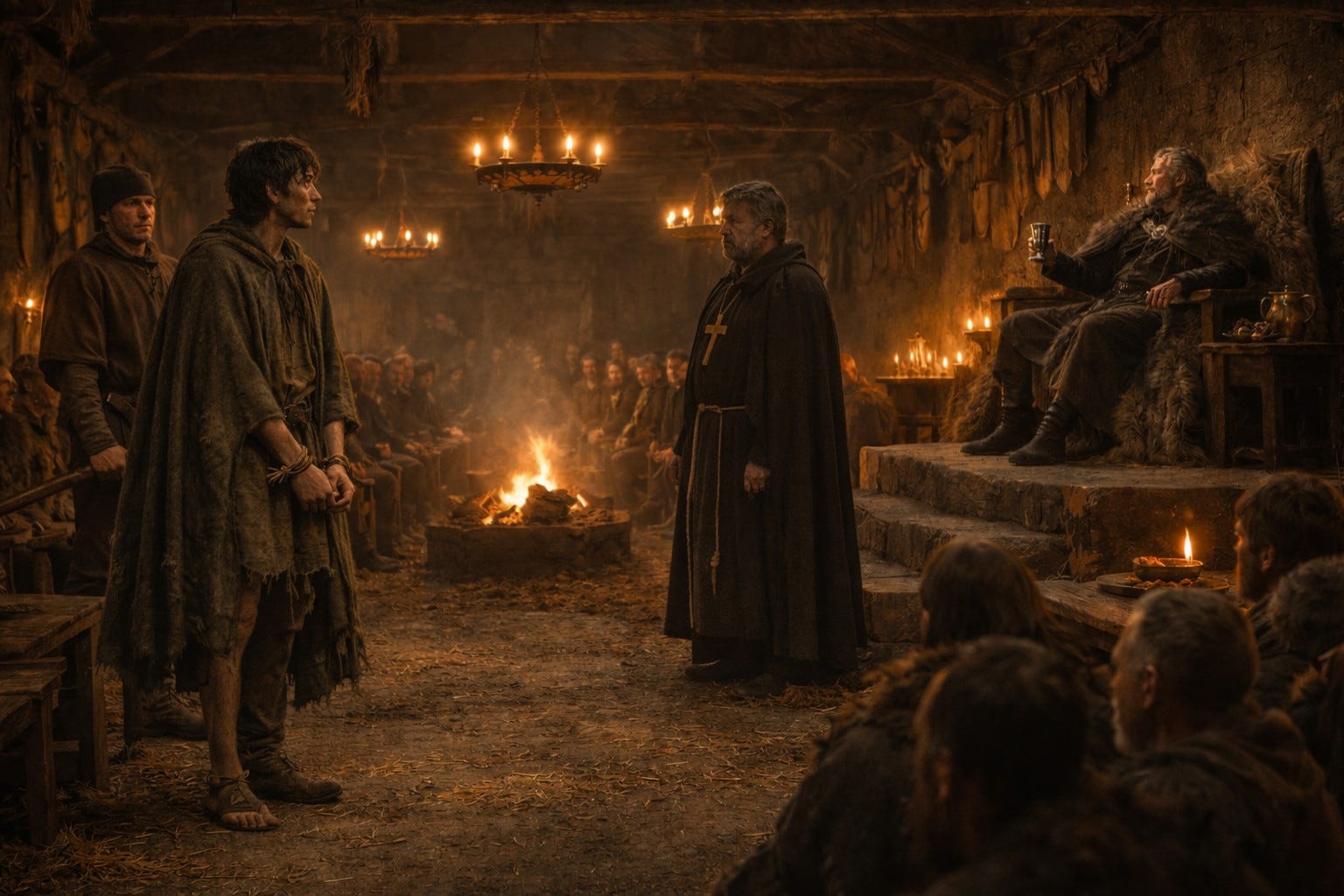
Then he saw the lord’s hall as it was, a long room, benches, a central hearth, weapons hanging from pegs, faces turned toward him like dogs’ noses catching scent. At the far end, slightly raised, sat the local lord, cloak pinned, rings on his fingers, a cup in his hand. He was not crowned. He did not need a crown. His authority sat in the way everyone’s bodies leaned subtly toward him, waiting.
Beside him stood a presbyter.
Not the one from the village. Another, older, with sharper eyes, a small writing-board in his hands as if he were ready to trap words before they could escape. And when this presbyter spoke to the man at Patrick’s side, he spoke in Latin so clean and fluent that Patrick’s heart jolted:
“Who is this?”
The sound of it, proper Latin, alive and effortless, hit Patrick like a thrown rope from a ship, something to grab, something that might pull him toward understanding.
But the lord’s gaze slid over Patrick and hardened, and Patrick realized with a sick twist that fluent Latin did not mean mercy.
It meant scrutiny.
It meant someone could question him without barriers.
The older man answered in Welsh first, then turned and offered a few Latin words, enough to convey the fear: Irish clothes, coastal smuggler, runaway, captive.
The presbyter’s eyes narrowed. He looked directly at Patrick and spoke in Latin, precise as a knife:
“Nomen.” Your name.
Patrick swallowed, feeling the whole hall watching.
“Patrick,” he said, then added quickly, because he had learned that half-truths become traps, “Paternus filius Calpornii.”
The presbyter’s brows lifted slightly at that, a flicker of interest he could not quite hide. The lord leaned forward. He spoke in Welsh, and the older man at Patrick’s side translated roughly into broken Latin:
“He asks, are you Irish?”
Patrick’s mouth dried. He could feel his own accent betraying him before he spoke.
“No,” he said. “Non Hibernicus. Britannus.”
The presbyter didn’t blink. “From where in Britannia?”
Patrick’s mind raced, Clyde, Old Kilpatrick, Alt Clut, names that meant nothing here yet, names that might sound like lies in the mouth of a barefoot fugitive.
“Near the sea,” he said. “Near a river. Clyde.”
The presbyter’s eyes held his. “And you were taken to Ireland?”
“Yes.”
“By whom?”
“I don’t know,” Patrick said, and hated how weak it sounded. Then he forced the truth into shape. “Raiders. Then Miliucc.”
A murmur ran through the hall at the Irish name, some recognition, some contempt. Not because Miliucc mattered here, but because Irish slave-taking was not unfamiliar even on this side of the water.
The lord said something sharply. The older man translated with a grim little satisfaction, as if pleased to have the words in his mouth:
“He says, if you are a captive, you are property. Whose property are you now?”
Patrick’s chest tightened.
There it was. The question that turned men into cargo.
Patrick opened his mouth. Closed it. He could feel Cadoc somewhere outside, fined and emptied because of him, and he could feel Siger’s ship already gone like mist.
He had no protector left but his words, and his words, even in Latin, were a thin shield.
He swallowed and said the only thing he could say that was true and dangerous:
“I fled.”
The hall went quiet.
The lord’s eyes sharpened.
The presbyter’s voice came soft, which was worse.
“Why?”
Patrick’s tongue stuck to his teeth. Thirst made the room swim. Hunger made his hands shake. He heard himself say it anyway, because the day in the dark cell had burned away the desire to be clever.
“Somnium,” he whispered. A dream. “Deus mihi in somnis imperavit.” God commanded me in a dream.
A ripple ran through the hall, amusement, scorn, the restless interest people have when a story might become entertainment. Someone laughed once, sharp and quickly smothered.
The presbyter did not smile.
“What dream?” he asked, and his Latin was clean enough to make the question feel like judgment.
Patrick’s throat tightened. He thought of the shout in the night. He thought of the ship. He thought of the name spoken like a command. He lifted his eyes.
And the hall waited for him to speak the thing that might save him… or condemn him.
“It called me Patrick,” he said.
The lord’s fingers tightened on his cup. Not anger. Something colder. A calculation wearing fear. His gaze flicked to the presbyter, then to the guards, then briefly, briefly, toward the door as if measuring the distance between this story and his own land.
He spoke in Welsh, low and fast, and the older man beside Patrick translated with a grim relish:
“He says, if a god is speaking to you, he will not have you speaking in my hall.”
The benches murmured. A few men shifted as if relieved. Others leaned forward, disappointed, wanting blood or spectacle.
The lord leaned in, eyes hard on Patrick.
“If you lie,” the presbyter translated in Latin, quiet now, “he will correct you.”
Patrick’s mouth dried. “I am not lying.”
The lord said one word. The club-man stepped forward.
Patrick didn’t flinch. He surprised himself with that. He only lifted his bound hands slightly and said, to the presbyter, to the lord, to whatever was listening:
“I will not be owned again.”
The hall went very still.
Then the club came down, not to kill, not to cripple, to teach. Pain flashed white behind Patrick’s eyes. He tasted blood. His knees buckled and the guards held him up, not out of kindness but because the lord wanted him standing for the lesson. The lord watched without expression until Patrick caught his breath.
Then he spoke again, a longer sentence in Welsh that made the room exhale all at once, as if a decision had been made that everyone wanted made quickly.
The presbyter’s face tightened as he translated, Latin precise and spare:
“He banishes you.”
Patrick blinked, dizzy, his head throbbing. “Banished… where?”
The presbyter’s eyes flicked toward the door, toward the night beyond it.
“Away,” he said. “Off his land.”
The lord spoke again, clipped, impatient. The presbyter’s voice went flatter as he translated the rest.
“You have until dawn,” he said. “If you are found on his land after dawn, he will sell you, back across the water, into rope.”
Patrick’s stomach turned to ice. Back. Back to Ireland. Back to Miliucc.
The threat did what the club had not. It reached inside him and grabbed the part that still remembered the scream, the empty bedroll, the taste of grass and humiliation.
He forced himself to stand straighter, even as the world swam.
The lord leaned back, as if finished with him, as if Patrick were no longer a man but a problem to be thrown out before it spoiled the house. He said one final line in Welsh, short and hard.
The older man translated with a cruel satisfaction that felt like a personal victory:
“He says, if your dream is true, let your God keep you. If it is not, let the night take you. Either way, you will not curse us here.”
The guards hauled Patrick toward the door.
Cadoc stood near it, held in place by two men, his face gray with fear and shame, his eyes flicking once to Patrick’s bound wrists and then away as if he couldn’t bear to look too long.
Patrick’s mouth tasted of blood and smoke.
The guards marched him to the end of the lane and shoved him hard. He hit the ground, breath knocked out, dirt in his mouth. For a heartbeat he wanted to stay there, small, finished, unseen.
Then Father Ciarán’s voice rose in him, quiet and merciless: Go.
Patrick forced himself up, head throbbing, wrists burning under the cord, and turned his face into the wind. And the dark waited to see whether God’s dream could outrun a man’s fear.
Wind at His Back
By dawn he was no longer on any road.
He had fled the lord’s lane in darkness until the ground stopped being familiar even in its hostility, until the fences thinned and the land opened into rough pasture and scrub. The cord had cut his wrists raw. He stopped long enough to worry it against stone until it loosened, then until it gave, then until his hands were his own again, trembling, swollen, free.
He continued to walk without direction the way a man walks out of a burning house, only away. The wind became his compass. It came off the sea behind him, cold and wet, pressing at his back like a hand. As long as it stayed there, he told himself, he was moving inland, moving away from the coast, away from the lord’s land, away from the word Hibernicus thrown like a stone.
He kept the wind at his back and the fear in his ribs. The night took its payment anyway. His head throbbed where the club had struck. His mouth tasted of old blood. Hunger gnawed with renewed cruelty, as if it had been waiting politely until the danger eased. He had not eaten since the ship’s crust and fish. He had not drunk since before the holding place. Every swallow scraped his throat like dry straw.
When the first light finally lifted the horizon, it didn’t feel like mercy. It felt like exposure. He reached higher ground, no ridge he recognized, only a rise where the scrub thinned and he could see farther. The land rolled away in gray folds, dotted with trees, broken by stone outcrops. Somewhere far to his left the air still tasted faintly of salt, but he didn’t look that way.
He didn’t want the sea to feel like a magnet. He stood with his cloak flapping weakly and realized, with a sudden hollowness, that he did not know where he was. Not truly. Wales behind him, Wales ahead of him, and no familiar river, no Clyde, no watchfires, no Rock. Just wind. Just day.
He whispered, more to keep himself human than because he expected an answer. “Jesus.”
Then, after a beat, because the night’s banishment still burned in him like a brand: “Not back.”
He did not have to say the rest. His body said it for him, memory of Ireland like a bruise that never healed. The scream. The rope. The grass between his teeth. Miliucc’s voice in his ear: mine. Not back.
He began walking again, keeping the rise to his right, moving toward a line of darker trees that promised cover. His bare foot, still wrapped, caught on stones. He limped and hated the limp. He pushed anyway. Pride was a luxury; movement was not.
Midmorning, he smelt smoke before he saw it. Not the straight dark plume of raid-fire, but the thinner, domestic thread that meant hearth and habit. It rose from within the trees, steady, unhurried.
A cottage, then. Or a forester’s hut. Or a charcoal-burner’s shelter. Or a trap.
Patrick slowed at the tree line, listening. No shouted voices. No dogs barking in alarm. Only the small noises of wood and wind.
He edged closer, keeping to shadow, and saw it: a low timber cottage with a rough fence, a small byre attached, a stack of cut wood under a lean-to. A patch of ground had been cleared for something like a garden. A pot hung outside over a low fire, and steam rose faintly from it. Food.
The thought hit him so hard it made him dizzy. Beside the fence, on a line of cord, hung clothing, washed, dripping, heavy with water. A tunic. A cloak. Wool, coarse but clean. Welsh cut, not Irish. A belt. Patrick stared as if the clothes were an answer to prayer.
His feet moved without permission. One step. Another.
His hands lifted, already imagining the feel of dry cloth, the way it would hide the Irish cut of his own cloak, the way it would stop strangers from deciding what he was before he spoke.
He could take it. He could take bread from the pot, he could take water from whatever vessel lay inside, he could vanish back into the trees before anyone saw. He could.
His fingers brushed the wet hem of the tunic. And something in him recoiled, not holiness, not yet, but the stubborn memory of being treated like property. Of being taken. Of having his name twisted. If I take, he thought, I become what they already think I am.
A thief. A raider. A story they tell themselves so their fear feels righteous. His throat tightened. He let the tunic fall back against the line. He stood in the shadow of the trees, shaking.
Then he did the more terrifying thing. He stepped into the open. His voice came out rough as gravel, but it came out. “Ho!” he called, Brittonic first, the closest bridge he had. “Is anyone here?” Silence.
Then a scrape inside the cottage. A moment later the door opened a crack, and a woman’s face appeared, older, hair bound back, eyes wary. Behind her, a boy of perhaps twelve hovered, clutching a stick like a weapon. The woman’s gaze took Patrick in, the ash-stained cloak, the wrapped foot, the bruised mouth, the hollow cheeks. Her eyes narrowed at the cut of his clothing, and fear sharpened her posture.
“I’m not Irish,” Patrick said at once, too quickly, as if speed could keep the label from landing. He lifted his empty hands to show he carried no weapon. “I’m from Britannia. I… I’m lost.”
The boy shifted, stick lifting. The woman didn’t move much, but her voice came hard. “Why are you dressed like them, then?”
Patrick swallowed. Thirst burned his throat. He forced the words anyway. “Because they took me.”
Her eyes flicked to his wrists, raw marks there, refreshed after the cord. That, at least, was a language she understood.
Patrick pointed, awkward. “Water,” he said, and hated that the plea sounded like weakness. “And… I can work. I can cut wood. Anything. I don’t want trouble.”
The woman stared at him a long moment, weighing risk the way poor people weigh bread. Then she spoke to the boy in Welsh, quick, sharp. The boy darted away.
The woman opened the door wider, but not wide enough to invite him in. “Stay there,” she said. “Where I can see you.”
Patrick obeyed at once, standing like a man under judgment. The boy returned with a wooden cup, half-filled. He held it out at arm’s length as if offering it to a dog that might bite. Patrick took it with both hands and drank so fast it hurt. Water spilled down his chin. He didn’t care.
When he lowered the cup, the woman was still watching him. “Name?” she demanded.
“Patrick,” he said. Then, because the older name still mattered in him, “Paternus, son of Calpornius.”
The woman blinked at the Latin cadence, not understanding the words but hearing the difference, he didn’t sound like a raider shouting. He sounded… educated, or at least not feral. She looked toward the clothes on the line, then back at him.
“You’ll catch your death,” she said finally, and the hardness in her voice made room for something else, practicality. “If you run around in that.”
Patrick didn’t move. “I won’t take,” he said hoarsely. “Not without leave.”
The boy made a noise like disbelief. The woman’s mouth tightened, as if she didn’t want to be impressed and couldn’t help it.
She jerked her chin toward the line. “That tunic’s my husband’s,” she said. “He’s dead. It’ll hang there until it rots if I don’t give it to someone.”
Patrick’s chest tightened. “I—”
“Work first,” she cut in. “You want it, you earn it. Split and stack the wood. Fill the bucket. Then you eat.”
It wasn’t kindness dressed as kindness. It was kindness dressed as survival. Patrick nodded once, too grateful to speak.
He took the axe she handed him, its handle worn smooth by someone else’s years and began to split wood with arms that shook from hunger and the night’s flight. The first swing nearly missed. He corrected. The second landed true. The log cracked with a satisfying sound that felt like the world admitting he still existed. He worked until sweat and rainwater mixed on his skin.
When he finished, the woman handed him a heel of bread and a bowl of thin broth. He ate slowly this time, forcing himself not to be an animal. The woman watched him eat as if watching a moral test. When he was done, she tossed him the tunic and a rough belt.
“Change,” she said. “Then go. I don’t want guards asking why I’m feeding strangers.”
Patrick took the clothes with hands that trembled. He stepped behind the byre and changed quickly, stripping off the Irish-cut cloth and folding it tight, unsure why he couldn’t bring himself to leave it behind. The wool tunic scratched, but it was dry. The belt held him together. He looked, if not Welsh, then less like a story people were already afraid of.
He came back around the byre, and the woman met his eyes. “Northeast,” she said abruptly, pointing. “If you’re going anywhere that isn’t back to the coast, keep the sun on your left as it climbs.”
Patrick’s throat tightened. “Why help me?”
The woman’s gaze flicked to his wrists again. Then to his bruised mouth. Then away. “Because I know what men do,” she said flatly. “And because you asked before taking.”
Patrick swallowed. He wanted to say thank you in Latin the way he had with Cadoc, but the word snagged on something deeper. He bowed his head instead, half habit, half prayer, and whispered, barely audible: “Deo gratias.” Thanks be to God.
He looked up, and the woman pretended she hadn’t heard. She only waved her hand as if shooing smoke. “Go,” she said. “Before someone decides you’re trouble.”
Patrick stepped back into the trees with food in his stomach and wool on his skin and the wind still pushing at his back. He didn’t know where he was.
He only knew where he wasn’t going. And that was enough to keep him moving.
The Days of Ash and Salt
He left the western country the way a man leaves a burning house, without looking back, without knowing if he was safe until the salt air thinned and the land stopped sounding like the coast.
For a time he kept the sun on his left as it climbed, like the widow had said, and the wind at his back when it would allow it. He avoided the shore as if the sea were a mouth that could call his name and swallow him again. When he saw gulls turning in the distance, he turned inland. When he smelled salt, he changed his line. When he heard dogs, he froze until the sound passed.
He learned to walk without being noticed. Not on the hard roads where men and carts moved, not through the clean centers of villages where strangers become questions, but along hedgelines and tree-shadow, through wet pasture where sheep watched with dull indifference, through low woodland where every snapped twig felt like a shout. He slept in ditches, in the lee of stone walls, under thorn and gorse that clawed his cloak. He woke with frost stiffening his hair some mornings, and with rain in his mouth on others.
The days began to blur into a single long hunger.
He had a little bread at first, then berries and bark kept him upright. When there was nothing to trade but his own body, he traded labor; splitting wood, carrying water, mending a fence, hauling a bundle for men who didn’t ask his name. He learned which eyes might help and which eyes were already deciding he was Irish no matter what he said. He learned to keep his Brittonic short, his Latin shorter, his mouth closed unless he had to open it.
He walked with his wrists smeared in mud to hide the rope’s memory. He walked with his skull still remembering the club. He walked because dawn had promised slavery if he stopped. He walked because the next rise promised home.
Somewhere along the way the fear changed. It stopped being only fear of capture and became fear of what lived inside him. Anger. Bitterness. The desire to imagine Miliucc’s face under his boot. The desire to imagine the lord’s hall burning. The desire to see Cadoc safe and everyone else punished. Those desires came easiest at night.
When the wind sounded like raiders whispering. When his stomach cramped with emptiness. When the sky pressed low and he could not remember the color of his mother’s hands. He would lie in the dark and feel the old boy in him wake, the boy who wanted adventure, who wanted stories, who wanted to win. This is what the world is, the boy would say. Take what you can.
And then another voice, quieter, would answer, sometimes so quiet he almost missed it. Not a thunder voice. Not the shout that had driven him from Ireland. A whisper grown familiar as breath. Forgive.
The word offended him at first. Forgive Miliucc? Forgive the men who dragged children through mud? Forgive the lord who would sell him back across the water? He couldn’t.
Not cleanly.
So he did the only thing he could do, the only honest discipline left to him: he chose forgiveness the way a man chooses a direction in fog. Not because he felt it. Because he needed it, the way he needed water. He would speak the words through clenched teeth, not as a saint, as a starving fugitive who didn’t want to become a beast.
“Jesus,” he would whisper, and then, like forcing a wound open so it could heal: “Help me not hate.”
Some nights he failed and lay shaking with rage. Some nights the rage thinned, and what remained was only grief.
He walked through England like that, ash and salt, hunger and prayer, until the land began, slowly, to change. The trees grew familiar in their shape. The stone in the soil looked right under his feet. The wind carried a different memory. Hills rose in lines he had seen before, not in daylight perhaps, but in the bones of childhood.
One morning he crested a low rise and stopped, breath caught, because the world ahead of him felt like a half-remembered psalm. Home-adjacent. Borderland. The kind of place where men spoke like his father and swore like soldiers and prayed like people who lived close to danger.
He found a small settlement near a stream, huts clustered, smoke curling, dogs barking not in alarm but in the ordinary way of dogs. He hesitated at the edge of it for a long moment, and realized he was more afraid now than he had been on the ship.
If they said “no,” if they looked at him and didn’t see him, there would be nothing left to walk toward. He stepped forward anyway.
A man with a weathered face looked up from tying a bundle. His eyes ran over Patrick, lean, travel-worn, beard shadowing his jaw, a stranger’s clothes, a stranger’s gaze.
“What do you want?” the man demanded, not unkindly, not kindly either.
Patrick swallowed. His voice came out rough. “Old Kilpatrick,” he said, and the name tasted like a door. “Do you know it?”
The man frowned, then jerked his chin north-east. “Aye,” he said slowly. “Down by the Clyde. Why?”
Patrick’s throat tightened so hard he couldn’t answer at first. He managed, finally, the smallest truth. “I’m going home.”
The man studied him a moment longer, then spat to the side as if spitting out suspicion. “Keep to the higher ground,” he said. “And don’t go near the shore. Raiders still take what they want.”
Patrick nodded as if he hadn’t learned that lesson with his whole body. He turned away before the man could ask his name or see his tears. He walked.
And as he walked, the landscape began to speak to him in the old language of memory: a bend in the land, a familiar line of trees, the way the light lay on water. The closer he came to the Clyde, the more his chest ached with something that wasn’t fear. It was anticipation, and grief, braided together.
When he finally saw the river, it was like seeing a face you had dreamed too many times to believe was real. The Clyde River did not ask permission to keep moving.
It slid past the land with the same stubborn patience it had always had, carrying reeds and silt and the occasional dead branch down toward the sea.
Patrick stood on its bank and shook. Not from cold. From the knowledge that he had crossed an ocean and a wilderness and had not died. From the knowledge that returning did not undo what had been done.
He followed the river as if it were a guide, feet heavy, breath shallow. The settlement came into view, smoke, huts, the familiar scatter of life, and for a heartbeat he stopped, suddenly terrified.
Not of raiders. Of being seen.
He kept to the edge first, moving like a man who had learned to live in margins. The riverbank grass was trampled where children had run. A dog nosed the mud and lifted its head at his scent, then lost interest. Ordinary life moved around him like water around a stone.
Then he saw them. His mother, nearer the hearth-smoke, a basket on her hip, her hair threaded now with gray. His father in the yard speaking to two men, posture still rigid with the habit of command, but thinner through the shoulders, as if waiting had carved him down.
For a moment Patrick could not breathe. They were so real it felt like pain. And they did not look toward him. Not once.
He took one step forward, then stopped again as if an invisible cord had tightened around his chest.
Because home was not only warmth. Home was questions.
Home was names. Aedan’s mother. Marc and Brigid’s kin. Little Nia. Nia’s empty place at someone’s fire. What would they see when they saw him?
A son returned. Or a reminder that others did not.
His throat tightened with guilt so sharp it tasted like iron. He swallowed it down and stayed in the shadow of a wall, watching the life he had crossed water and wilderness to reach.
He was home. And he had never felt farther away.
He turned and retraced his steps before anyone could notice the stranger lingering at the river’s edge. He walked until the smoke thinned and the sounds of the settlement dulled into the ordinary hush of night insects and wind in grass. He found a shallow hollow under a thorn bush, a place that could hide a body from eyes and questions.
He sat there with his back against cold earth and listened to the Clyde moving, steady as ever, as if it had never carried his childhood away.
Patrick did not know what to do. It had been so long since he was anything but a slave.
In the dark, for the first time since the rope, he missed his chains, because chains had told him what tomorrow was. And they absorbed all the blame.
Author’s Note (on Part X)
Patrick has crossed water and wilderness and made it back to the river that raised him. But coming home is not the same as being home.
Part X opens where Part IX ends: at the edge of the familiar, with guilt in his throat and a name he isn’t sure he deserves. The next steps aren’t about distance anymore, they’re about courage, being seen, being forgiven, and learning what freedom asks of a soul that has lived too long in chains.