Becoming Patrick: Sinner and Saint - Part 16
The continuation of the multipart historical novelette that imagines the lost years of Saint Patrick’s youth, the terror of abduction, the grind of slavery, and the quiet awakening of faith that changed everything. Because the historical record says little about his formative years, much of this story is fictional and meant to entertain and edify. Where sources fall silent, I’ve chosen plausible details; where Patrick speaks in his own writings, I’ve tried to honor his tone and faith.
If you haven’t read the previous releases here are the links:
[ Part 1 ] [ Part 2 ] [ Part 3 ] [ Part 4 ] [ Part 5 ] [ Part 6 ] [ Part 7 ] [ Part 8 ] [ Part 9 ] [ Part 10 ]
[ Part 11] [ Part 12 ] [ Part 13 ] [ Part 14 ] [ Part 15 ]
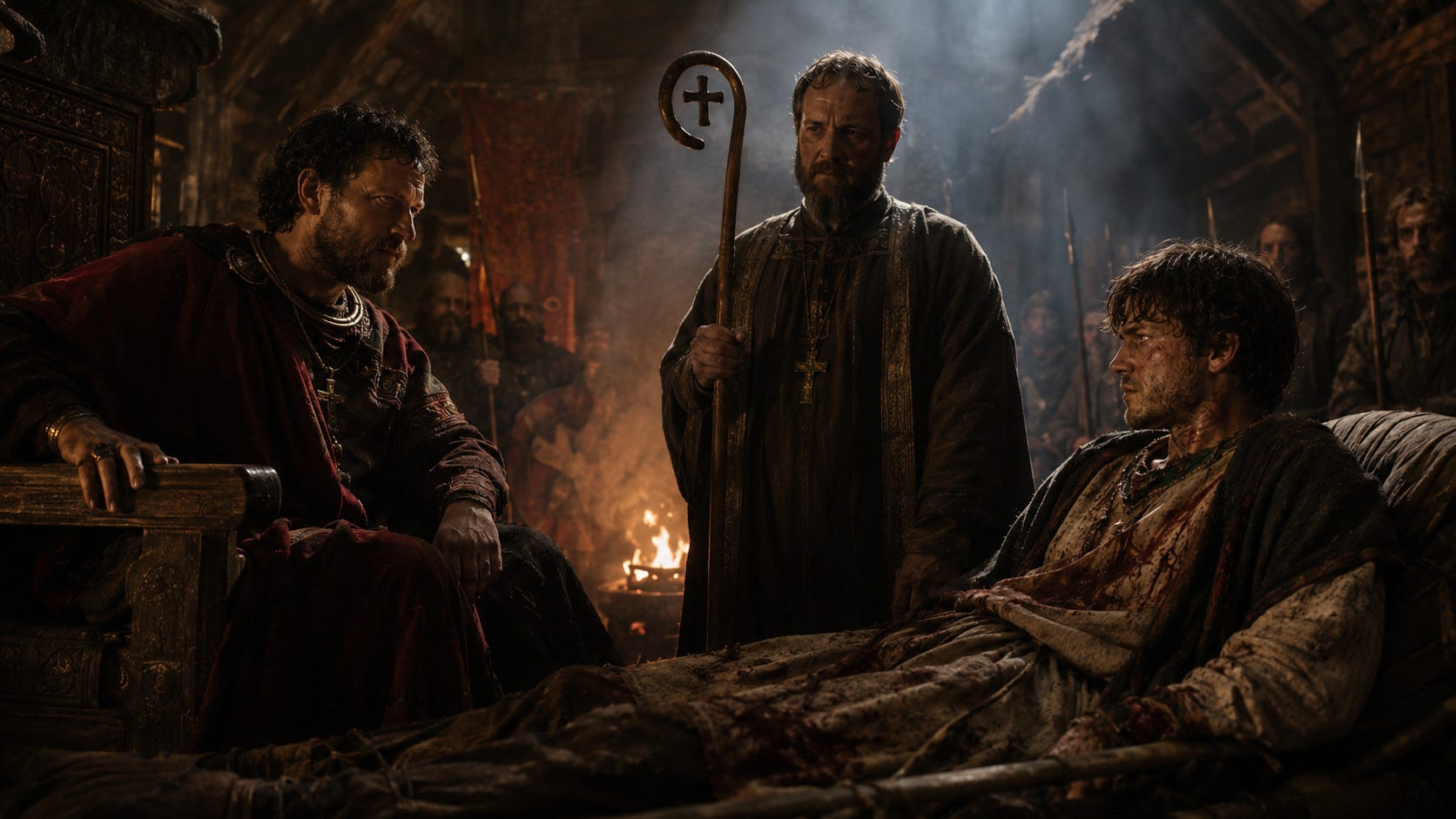
The Hall of Coroticus
Coroticus did not keep a quiet hall. The sound reached them before the door opened; men talking and yelling over one another, benches scraping, a burst of laughter too loud to be innocent, the clatter of cups, the hard crackle of a central fire being fed well past what comfort required. Power liked heat. Power liked noise. Power liked to make men enter already smaller than they had been outside.
Patrick felt the litter shift as the bearers took him over the threshold. Smoke met him first. Then light.
The hall opened around him in red and gold and shadow, high-beamed, crowded, thick with the smell of meat, wool, sweat, ale, wet leather, and men who had ridden hard and not washed before eating. Spears leaned against posts. Shields hung darkened from smoke and blood. Dogs slept under tables until someone dropped a bone. Along the walls stood men who looked like servants until one noticed their hands stayed near knives.
At the far end, beneath a beam carved with old patterns half-buried in Christian marks, sat Coroticus of Alt Clut.
He was not old. That surprised Patrick.
He had expected age to sit in judgment, gray and heavy, because fear had a way of giving rulers old faces in the imagination. But Coroticus was still in the force of his strength, broad through the shoulders, dark-haired, close-bearded, his eyes bright with the restless intelligence of a man who missed nothing because missing things got men killed. A small cross hung at his throat, gold worked finely enough to shame the rough cross carved into Patrick’s crook.
Coroticus wore his Christianity like he wore his torque: visible, costly, and not to be mistaken for weakness.
The bishop entered first. Patrick felt the weight of that.
He carried Patrick’s crook himself, the blood-dark cross facing outward. Father Ciarán came beside him, face grave. Calpornius walked near the litter with one hand close enough to catch Patrick if the bearers stumbled. Aelia did not enter; she remained with the girls under the bishop’s protection, and Patrick felt her absence like a missing wall.
The hall quieted unevenly. Not at once. Men at the edges kept speaking until others elbowed them. Cups lowered. A dog lifted its head and sneezed in the smoke.
Coroticus leaned back in his chair. “My lord bishop,” he said. “You bring me theater.”
The bishop did not bow deeply. “I bring you witnesses.”
Coroticus’s gaze moved to Patrick. “That one looks more like evidence.”
A few men laughed. Father Ciarán’s jaw tightened.
The bishop laid the crook across both hands. “Evidence bleeds. Witnesses speak. Sometimes they are the same.”
Coroticus smiled slightly, as if amused by a move well made. Then his attention fixed fully on Patrick.
“So,” he said. “This is the man who walks into raiders’ fires and walks out with captives.”
Patrick tried to answer. His mouth had gone dry.
The bishop spoke before him. “Patricius son of Calpornius.”
Coroticus’s eyes flicked to Calpornius. “Your son?”
“Yes,” Calpornius said.
“Your son has expensive habits.”
Calpornius’s face hardened. “Mercy is not expense.” That won a low murmur from some corner of the hall.
Coroticus’s smile widened, not warmly. “Everything is expense. Mercy most of all.”
He looked back to Patrick. “Can you sit?”
Patrick swallowed. “I can try.”
“Do not try,” the bishop said. Coroticus looked at him, brows lifting.
The bishop held his gaze. “He has been struck hard enough already by men who enjoyed seeing whether he would stand.”
Something in the hall shifted. A few men glanced toward Patrick with new interest. Coroticus tapped one finger against the arm of his chair. “Then let him lie. It is not the posture that concerns me.”
Patrick hated the mercy of that. He hated needing it. The litter was lowered near the front of the hall. Not too close to the fire. Not too far from Coroticus. A place where everyone could see him without having to rise.
The bishop remained standing. Father Ciarán stood beside Patrick’s head.
Coroticus looked at the crook again. “Is that his?”
“Yes,” the bishop said.
“A shepherd’s staff.”
“Yes.”
“With a cross.”
“Yes.”
“And blood.”
“Yes.”
Coroticus laughed softly. “Well. That is almost too neat, isn’t it?”
Patrick’s eyes opened fully.
Father Ciarán sensed the movement and said under his breath, “Careful.”
Coroticus heard. Of course he heard.
“Let him speak,” the ruler said. “If God sends men into my raiders’ camps, I would hear what sort of voice He gives them afterward.”
Patrick forced himself to breathe slowly. “They were not your raiders,” he said.
The hall quieted more completely. Coroticus leaned forward. Patrick realized too late that he had stepped into danger.
The ruler’s voice softened. “No?”
Patrick’s ribs burned with each breath. “They moved along your river. That is not the same as belonging to you.”
A few men looked down into their cups. The bishop’s face did not change. Father Ciarán closed his eyes briefly, perhaps in prayer, perhaps in pain.
Coroticus watched Patrick for a long moment, and then, unexpectedly, laughed. Not kindly. But genuinely. “You are half-dead and still splitting hairs over sovereignty.”
Patrick said nothing.
“I begin to understand why they struck you twice,” Coroticus said.
Calpornius took one step forward. The bishop turned his head only slightly. Calpornius stopped.
Coroticus saw that too. “Good. At least one man here understands order.”
Calpornius’s face flushed dark.
The ruler looked back at Patrick. “Tell me what happened.”
The bishop said, “He has been examined.”
“By you,” Coroticus said. “For his soul. I ask for my land.”
The bishop inclined his head. “Then ask.”
Coroticus’s gaze stayed on Patrick. “How many?”
Patrick did not understand. “My lord?”
“How many raiders?”
Patrick shut his eyes briefly, placing the camp back in his mind. Fire. Trees. Men’s shoulders moving in smoke. Captives in the far dark.
“Perhaps twelve,” he said. “Perhaps more in the trees.”
“Armed?”
“Yes.”
“Mounted?”
“Some. I heard horses. Saw at least three near the bank.”
“Cattle?”
“Yes.”
“Whose mark?”
Patrick hesitated.
Coroticus smiled thinly. “You noticed everything else. Did holiness blind you to cattle?”
“No,” Patrick said. “I did not know the marks.”
Coroticus looked to Calpornius. “Two cows taken from south pasture two nights ago,” Calpornius said. “One red, one dark. If they were ours, the dark would have a torn ear.”
Patrick’s brow tightened. “One had a torn ear.” A mutter moved through the hall.
Coroticus’s amusement dimmed. Now the matter had teeth.
“Direction?” he asked.
“Downstream when I found them. But the leader spoke of home across water.”
“Name?”
Patrick shook his head. “None given.”
“Tongue?”
“Irish.”
“That tells me almost nothing.”
Patrick’s mouth tightened. “It told me enough when I was bound.”
Silence. Coroticus’s eyes rested on him. Then he said, less sharply, “So it did.”
He turned to one of his men. “Send riders at first light. Quietly. Not boys. Men who can count tracks and return with their heads still attached.” The man nodded and left.
Coroticus lifted a cup, drank, set it down. “Now,” he said, “tell me why I should not be angry.”
Father Ciarán spoke. “At raiders?”
“At all of you.”
The priest did not move. Coroticus pointed toward Patrick. “A man from a river settlement walks alone into a raiders’ camp, speaks in the name of God, and walks out with captives. By morning every widow, fool, and hungry-eyed mother along the Clyde will have made him into a sign. By next week raiders may hear that Christian villages think themselves protected by wounded saints with sticks. Or worse, they may hear that my river can be entered, robbed, and bargained upon by anyone with enough nerve and superstition.” His voice had grown harder, but not louder.
That made the hall listen. “Do you know what happens when power appears uncertain?” Coroticus asked.
Patrick answered before wisdom could stop him. “Men test it.”
Coroticus looked pleased despite himself. “Yes.”
The bishop said, “Then you understand why the matter came here.”
“I understand why you wanted it contained,” Coroticus said. “That is not the same as approval.”
“No one asked your approval of mercy,” Calpornius said. The hall went still. Coroticus turned his head very slowly. Calpornius held his gaze, but Patrick could see the pulse beating hard in his father’s throat.
“No,” Coroticus said. “Men rarely ask rulers before doing things that may cost rulers blood.”
The bishop stepped between them with only his voice. “Three captives were returned.”
“And more left behind,” Coroticus said.
Patrick flinched. Coroticus saw it and did not apologize. “Painful?” he asked. “Good. Pain can keep a man honest if he does not worship it.”
Father Ciarán’s eyes lifted sharply. For the first time since entering the hall, he looked almost surprised.
Coroticus leaned back. “Do not mistake me for a man without prayers, priest. I have prayers. I also have borders.”
The bishop said, “Both are under God.”
“Everything is under God,” Coroticus replied. “That does not make everything simple.”
The bishop gave the smallest nod. For one thin moment, Patrick saw them not as enemies, but as men carrying different weights badly. Then Coroticus looked at him again. “Why three?”
Patrick’s throat tightened. The hall seemed to wait with a child’s cruelty. “Because he offered one.”
Coroticus’s brow lifted. “Generous of him.”
“And I asked for three,” Patrick continued.
“Why?” Coroticus asked, searching Patrick’s face for deception.
Patrick felt the bishop’s gaze. Father Ciarán’s. Calpornius’s. He could lie by making it cleaner. He could speak of doctrine as if he had stood there calmly, a teacher among barbarians. He could say *Trinity* in Latin and let the hall admire the shape of the word. Instead he saw the raider’s eyes, the mockery, the flicker of fear when pattern touched superstition. “Because they feared signs,” Patrick said. “And because my God is three and one.”
Someone in the hall snorted. Coroticus did not. Patrick continued, voice rough. “They mocked it. But they listened. Not because they believed. Because they were afraid not to.”
Coroticus stared at him a long time. Then he said, “You used their fear.”
Patrick’s mouth dried. “Yes.”
Father Ciarán looked at him.
The bishop’s face remained stern.
Before Coroticus could answer, the hall door opened. Not loudly. Not with the careless force of soldiers. A young cleric slipped inside, pale from haste, a wax tablet held tight against his chest as he approached the Bishop with haste.
The bishop turned his head. The cleric stopped at once, caught between obedience and terror. His eyes moved to Coroticus, then back to the bishop. “My lord,” he said.
Coroticus leaned back, amused. “Does every holy man in Alt Clut interrupt rulers, or only the young ones?”
The cleric flushed, not understanding the joke. The bishop held out his hand. “Bring it.”
The cleric crossed the hall under the eyes of armed men and placed the tablet in the bishop’s hand. “From the women’s house,” he said quietly. “The oldest girl has spoken.”
The hall changed. Only slightly. Enough.
Patrick’s eyes opened fully.
The bishop read. His face did not soften, but something in it grew still.
Coroticus watched him. “Well?”
The bishop looked first at Patrick. That made Patrick uneasy. Then the bishop read aloud, not loudly, but the hall carried his voice.
“She says Patrick did not choose the three. The captives chose.”
A murmur moved through the benches. Patrick closed his eyes. The bishop continued.
“She says he spoke first to the men and made them understand that mercy would have to cost someone, and they gave forward the youngest, the ones whose innocence would be broken first, in their own place.”
The murmur died. No one laughed. Not even the men who had laughed before.
Patrick felt the words strike the hall harder than any defense he could have made for himself. He hated hearing them aloud. Not because they were false, but because they were too near the wound. He had not wanted that part brought into firelight.
Calpornius looked at him as if seeing another bruise. Father Ciarán’s lips parted slightly.
Coroticus’s face lost its amusement.
The bishop lowered the tablet. “You did not tell me this,” he said.
Patrick opened his eyes. His voice came rough. “It was not mine to claim.”
The bishop’s gaze held him.
Then Coroticus spoke, quieter than before. “No,” he said. “But it was yours to answer for.”
Patrick turned his head toward him.
Coroticus’s eyes were sharp now, not mocking. “You put the knife in their hands,” the ruler said. “Not iron. Worse. Choice.”
Patrick swallowed. “Yes.”
“And they chose mercy.”
Patrick could barely speak. “Yes.”
Coroticus sat back slowly. For the first time, he looked not entertained, but troubled.
The bishop placed the tablet beside the blood-marked crook. Now there were two witnesses on the table: wood and words.
Coroticus looked from the crook to the tablet, then back to Patrick. “That,” he said at last, “is the first dangerous thing I have heard from you.”
Patrick felt no pride at the praise. Only unease. “I did not want to move them like that.”
“No?” Coroticus said. “Then you had better learn what it means when you do.”
The bishop’s voice hardened. “Careful.”
Coroticus ignored the warning. “Men are moved by fear, hunger, honor, greed, lust, shame, grief, and sometimes God. A ruler learns which door opens. A missionary had better learn too, unless he wishes to die pure and useless.”
Patrick’s eyes sharpened. “I do not wish to use men.”
“Then men will use you.” The words struck too near old wounds. Patrick’s hand curled on the blanket.
Coroticus noticed. His gaze flicked to the movement, then back to Patrick’s face. “Ah,” he said softly. “That one you know.”
Calpornius’s hand went to his knife.
“Enough,” the bishop said.
This time the word carried force. The hall remembered the bishop was not merely an ornament. Coroticus sat back, amused but not dismissive. “Enough, then.”
For a moment the fire was the only voice. Then, from somewhere along the side of the hall, a man spoke in a language Patrick’s tired mind took half a breath to place. Not Latin. Not Brittonic. A rougher trading tongue first, then Irish beneath it. “He always did have poor sense near water.”
Patrick went cold. His eyes moved toward the sound. A man stood half in shadow near one of the posts, a cup loose in his hand, his sea-cloak stained with salt and travel. His beard was fuller now, threaded with gray. A scar pulled at one side of his mouth when he smiled, making the expression look like mockery even when it might not have been.
Patrick knew him. The ship. The hunger. The long days of work. The shore of Wales. A choice that had felt like freedom and abandonment at once. Siger!
The captain lifted his cup slightly. “So,” he said, looking at Patrick as if no years had passed at all, “the runaway learned to walk back into chains after all.”
Patrick’s breath caught. Father Ciarán looked between them.
Coroticus smiled. “You know him?” the ruler asked.
Siger’s eyes did not leave Patrick. “I hauled him out of Ireland once,” he said. “Or stole him from it. Depends who tells the tale.”
The hall stirred. Patrick found his voice with difficulty. “You left me on Welsh sand.”
Siger’s smile thinned. “Alive.”
“That was mercy?”
“That was shore,” Siger said. “Men have done worse with less.”
Patrick stared at him. Something old and salt-bitten moved through the room, a memory of waves and hunger and the terrible uncertainty of freedom. Coroticus watched the exchange like a man watching two blades test their edges.
“Well,” he said at last, “God does enjoy bringing inconvenient men to the same fire.”
The bishop’s gaze had sharpened. “Captain Siger.”
Siger inclined his head just enough to be respectful and not enough to look submissive. “My lord bishop.”
“You trade from Alt Clut now?”
“I trade where men pay and storms permit.”
Coroticus laughed once. “He means yes.”
The bishop looked at Siger. “You know Ireland.”
“I know coasts. Harbors. Men who lie. Men who lie poorly. Prices for cattle. Prices for silence.”
“And raiders?” Father Ciarán asked.
Siger’s eyes flicked to him. “Every coast knows raiders.”
Coroticus gestured toward Patrick. “Our wounded saint believes he is called back.”
“I am not a saint,” Patrick said.
“No,” Father Ciarán and the bishop said together.
For the first time, Siger laughed. A real laugh, short and surprised.
Patrick closed his eyes briefly. Coroticus enjoyed that too much.
“He says he hears Irish voices calling,” the ruler said. “He walks into camps. He argues with armed men about his three-one God. He returns with captives. The bishop wants him formed. The priest wants him humbled. His father wants him alive. I want my river secured.” He leaned forward. “What do you want, Siger?”
The captain looked into his cup as if the answer might be floating there. “Profit,” he said.
The hall relaxed into chuckles. Siger looked up. “And not to be cursed by the God of stubborn fools.”
The chuckles died unevenly. Patrick stared at him.
Siger’s face had changed. Only slightly. Enough. “I have seen men run from chains,” the captain said. “Most keep running even after the rope is gone. This one…” He nodded toward Patrick. “He runs the wrong direction.”
Coroticus tapped the chair-arm again. “Can you carry men to Ireland?”
The room seemed to narrow around that question. Patrick’s breath stopped.
The bishop answered before Siger could. “Not now.”
Coroticus smiled. “I did not ask when.”
The bishop’s gaze held. “Then ask more clearly.”
For a moment, ruler and bishop measured one another. Then Coroticus spread his hands in false innocence. “In God’s proper season, of course.”
Siger snorted. The bishop ignored him.
Coroticus looked to Patrick. “You want Ireland.”
Patrick’s body hurt too much for lies. “I fear Ireland.”
“Not what I asked.”
Patrick swallowed. “I want what God wants.” The answer sounded thin in the hall.
Coroticus looked disappointed. “That is the sort of answer men give when they do not want to say what they want.”
Patrick’s eyes lifted. “I want the captives free,” he said.
That landed differently. Coroticus’s expression cooled into something almost serious. “All of them?”
Patrick saw faces in firelight. Too many. Too bound. Too far. “Yes.”
“Then you want impossibility.”
Patrick said nothing. Siger watched him.
The bishop said, “He wants mercy beyond his strength. That is not the same as impossibility.”
Coroticus leaned back. “Spoken like a man who does not have to feed warriors.”
The bishop’s voice was calm. “Spoken like a man who knows warriors also die and stand before judgment.”
The hall chilled. Coroticus’s smile did not vanish, but it lost warmth. “My lord bishop,” he said softly, “you are in my hall.”
“And you are under Heaven.”
No one moved. Patrick could hear the fire eating wood. Then Coroticus laughed.
It broke the tension, but did not erase it. “Good,” he said. “Good. Let no one say Alt Clut lacks holy entertainment.”
The bishop did not smile.
Coroticus looked at Patrick again. “Here is my judgment, since everyone seems determined to bring me matters of soul and border tangled together. The girls remain under the bishop’s care until kin are found or proper protection arranged. Riders go at dawn after the raiders’ track. Your settlement will receive warning-men for a season, because frightened raiders sometimes bite backward.”
Calpornius inclined his head stiffly. “That is welcome.”
“It is expensive,” Coroticus said. Calpornius said nothing.
Coroticus continued. “As for Patricius son of Calpornius, he is not to preach himself into Irish knives under my river’s shadow without leave of Church or king.”
“I do not belong to you,” Patrick said. The words were out before he could stop them.
Father Ciarán muttered something that might have been a prayer or a curse.
Coroticus’s eyes glittered. “No,” he said. “You do not. That is what makes you troublesome. Owned men have handles.”
Patrick held his gaze. Coroticus smiled. “But roads, gates, ships, and armed men often belong to someone. Remember that when God next tells you to move.”
The bishop said, “He remains under ecclesial discipline.”
“Good,” Coroticus said. “Keep him. Teach him. Beat learning into him if books fail.”
“They often do,” Father Ciarán said.
Patrick looked at him, betrayed. Father Ciarán did not look sorry. Siger laughed again under his breath.
Coroticus pointed at him. “And you, captain. When the bishop says this man is fit to cross the water without mistaking every campfire for Pentecost, perhaps you will carry him.”
Siger’s humor faded. “Perhaps.”
“That was not a request.” Siger looked at Coroticus, then at the bishop, then at Patrick. Patrick remembered the ship’s deck under his feet, the day Siger had offered him a choice on the Welsh shore, the terrible freedom of not being dragged. The captain’s face closed over whatever thought had moved beneath it. “When the time comes,” Siger said, “if the sea permits, I’ll take him.”
Coroticus nodded, satisfied.
The bishop’s expression did not change, but Patrick felt something settle into the room like a distant bell struck once. Not permission. Not yet. A shape of a future.
Father Ciarán leaned near Patrick and said quietly, “Do you see?”
Patrick’s throat tightened. “What?”
“Doors open under authority too.”
Patrick looked at Siger. Siger lifted his cup, but there was no mockery in it this time. Only recognition.
Coroticus waved one hand. “Take him away before he bleeds on my floor and gives the poets more material.” The hall laughed, relieved to be given permission.
Patrick was lifted again. Pain flared so sharply he nearly cried out. He gripped the blanket instead, jaw clenched, eyes fixed upward on the smoke-blackened beams. As they carried him toward the door, the hall’s noise swelled behind him, already changing the story, sanding it, sharpening it, making it useful.
At the threshold, he turned his head enough to see Siger one last time.
The captain stood where shadow met firelight. For a moment Patrick saw him not as rescuer, not as deserter, not as trader, but as a man placed somehow along the road God was building beneath Patrick’s feet.
A hard road. A salt road. A road that would return to the sea.
Then the door opened, cold evening air struck Patrick’s face, and the hall of Coroticus fell behind him, loud with Christian men discussing mercy as if it were a thing to be measured, taxed, and carried by ship.
Author’s Note (Part XVII)
In Coroticus’s hall, Patrick learns that mercy does not move through the world untouched.
The bishop sees the soul. Coroticus sees the border. Father Ciarán sees the danger of zeal without obedience. Calpornius sees his son bleeding beneath the weight of a call no father would choose for his child. And Siger, salt-worn and half-mocking, sees something else: a man who escaped chains and yet keeps turning back toward them.
This chapter does not send Patrick to Ireland. Not yet.
Like so many of us, Patrick must learn that a call from God does not excuse him from the slow duties of formation. The dream remains, but it must pass through obedience, patience, discipline, and time. In Patrick’s case, waiting is not avoidance. It is preparation, God’s forge for his formation. Courage has to be purified into patience, and mercy has to become more than one brave act. It has to become a mission.
The final chapter will carry Patrick forward but not perhaps in the way you expect.