Becoming Patrick: Sinner and Saint - Part 8
Fear and Loathing

The continuation of the multipart historical novelette that imagines the lost years of Saint Patrick’s youth, the terror of abduction, the grind of slavery, and the quiet awakening of faith that changed everything. Because the historical record says little about his formative years, much of this story is fictional and meant to entertain and edify. Where sources fall silent, I’ve chosen plausible details; where Patrick speaks in his own writings, I’ve tried to honor his tone and faith.
If you haven’t read the previous releases here are the links:
[ Part 1 ] [ Part 2 ] [ Part 3 ] [ Part 4 ] [ Part 5 ] [ Part 6 ] [ Part 7 ]
The Man in the Cleft
The shadow between the stones smelled of wet lichen and old tide. Patrick pressed himself against rock, knees locked, and listened so hard his ears hurt. A hand closed on Patrick’s wrist. Not Siger’s, smaller, callused, urgent, and shaking with the effort of being quiet.
Patrick spun, teeth bared, and met eyes in the dark: a man in a short cloak, breath coming fast, face half-hidden by the stone. He said something in a low rush, Welsh, Patrick thought, or near enough, and then pressed a finger to Patrick’s lips so hard the gesture hurt.
High above them, boots scraped rock that showered down in front of them. A dog snuffled and whined. Men’s voices moved like wind through a narrow place, too close, too sure.
The stranger gripped Patrick’s wrist again and pulled, not up toward the path, but down, deeper into the split between stones where the sea had chewed the rock into a hidden throat.
Patrick stumbled into the tighter dark and caught a flicker of the man’s bundle, oiled cloth, tightly wrapped, and the faint clink at his belt: a leather pouch, weighted, secretive. Not a farmer. Not a fisherman. A trader. A rendezvous.
The man glanced once toward the inlet, toward where the Dolus Misericordis crouched half in shadow, half in surf, and Patrick understood without words: this was the contact Siger had come to meet.
And now the patrol had ruined it. The dog barked again, above, on the rock and the sound shivered down into the cleft. Patrick’s breath stopped on instinct. He pressed his free hand over his mouth, tasting salt and mud, willing his lungs to become stone.
The trader, his eyes adjusting, studied Patrick quickly: ash-streaked cloak, Irish cut, bare foot, the exhaustion carved into his face. Fear tightened the man’s jaw, but he didn’t let go. He whispered another sentence, slower, and made a small gesture, two fingers walking. Then he pointed inland. Come. Quiet.
Patrick hesitated. The old lesson flashed: when men decide in fear what you are, they don’t wait for you to speak. And he still couldn’t speak fast enough in this tongue to defend himself. Still he saw no other choice.
He nodded once.
The trader’s grip loosened just enough to guide instead of drag, and he led Patrick through the cleft where rock narrowed and then opened again behind a curtain of scrub. The ground there was higher, drier, strewn with shells and slippery weed. A small hollow lay tucked beneath an overhang, dark as a mouth.
The trader pushed Patrick into it, then dropped down beside him, shoulder to shoulder, both of them pressed against cold stone.
Above, the patrolmen’s voices grew louder. One man shouted, words that struck Patrick like stones because he understood the shape even if he didn’t understand the speech: accusation, claim, command.
The dog snuffed and barked, impatient with not knowing. Patrick’s heart hammered so hard he feared it would speak for him.
The trader hissed something, short, fierce and Patrick felt the man’s hand clamp on his forearm again, not to restrain him from running, but to restrain him from breathing. A spear point appeared briefly over the lip of the overhang, testing shadow. Then withdrew.
Boots scraped down a rock face. Gravel fell. A shadow passed near the hollow’s mouth.
Patrick closed his eyes. Jesus.
He didn’t say it aloud. He didn’t dare. He only thought it with the same intensity he’d once used for rebellion. The word filled his chest like a held breath.
Then, somewhere below and behind them, came a different sound: wood groaning, men grunting, surf slapping harder as hands shoved a hull into water.
The Dolus Misericordis. Siger was moving, fast. A sudden shout cut across the inlet. Another. The patrol had seen the boatmen at last, or the boatmen had dared them into seeing.
The dog barked wildly and lunged, its leash jerked taut. The patrolmen’s voices split, uncertain now, who to chase first, the ship or the shore? The decision was made for them when the boat scraped free and the sea took it like an accomplice.
From the hollow, Patrick could not see the boat, but he could hear it: the quick slap of oars, the creak of strain, the rough chorus of men hauling away from capture.
The trader risked a glance outward.
Patrick followed, just enough to see between scrub and stone: figures moving in the dim, a sail line yanked, the mast shifting against the sky. For one heartbeat he saw Siger, broad in the stern, turn his head as if he could feel Patrick’s gaze across distance.
Siger’s eyes met the shadow where Patrick hid.
The captain lifted his hand. Not a wave. A gesture like a cut rope. Then he pointed, briefly toward the inland path. Go.
Patrick’s throat tightened. Gratitude and terror rose together, because Siger was leaving him, and because Siger was leaving him.
The boat slid farther out. The mist swallowed its shape. The patrolmen shouted and splashed in the shallows, but the sea did not negotiate.
The sounds thinned: curses, then only surf, then only wind. The dog’s barking became frantic, then distant, then scattered. At last the trader exhaled like a man breaking the surface of deep water.
He looked at Patrick in the hollow’s darkness, eyes wide, and spoke in low, urgent phrases. Patrick caught almost nothing. But the trader’s hands spoke clearly enough: danger, danger, danger.
Then, hesitantly, the trader made the sign he’d seen Christians make, awkwardly, not practiced, and tapped his own chest as if to say: I am not your enemy.
Patrick stared. The trader swallowed and tried another language, broken Latin, rough as gravel, but recognizable. “Non… Hibernicus,” the man said, pointing at Patrick. Then pointed inland. “Vicus. Milites.”
Not Irish. Village. Soldiers.
Patrick’s throat worked. He managed one word in Latin that felt like a child’s first prayer: “Gratias.”
The trader blinked, then gave a tight nod, as if thanks were dangerous too.
He reached into his pouch and pulled out a small piece of bread, dense, dark, and a cloth and pressed it into Patrick’s hand. Then he pointed at Patrick’s foot, grimacing, and tore a strip from his own cloak.
He didn’t bind it carefully. He didn’t have time. He wrapped the cloth around once and tightened it once and that was all. Then he pointed again inland, sharper now. Move.
Patrick rose, joints protesting. He followed the trader along a narrow track that climbed between stones, keeping low, avoiding open sky. The land here smelled different from Ireland, not sweeter, just different: more rock, less bog, a dryness under the damp that felt unfamiliar.
After a time they reached a shallow dip where scrub grew thick and a few stunted trees leaned together like conspirators. Beyond it, Patrick could make out the dim shape of huts, low, clustered, smoke beginning to thread up into the morning air.
A village. The trader slowed and looked back at Patrick with a face that held both fear and decision. He pointed at himself. “Cadoc,” he said, his name this time, offered not as a threat but as a fact.
Patrick swallowed. “Patrick.” Cadoc flinched slightly at the sound, at the name’s foreignness, or at its weight and then motioned Patrick forward again.
They slipped toward the huts while the morning sharpened around them. For a few minutes, only a few, Patrick felt something close to relief. Not joy. Not safety. But the loosening of immediate pursuit.
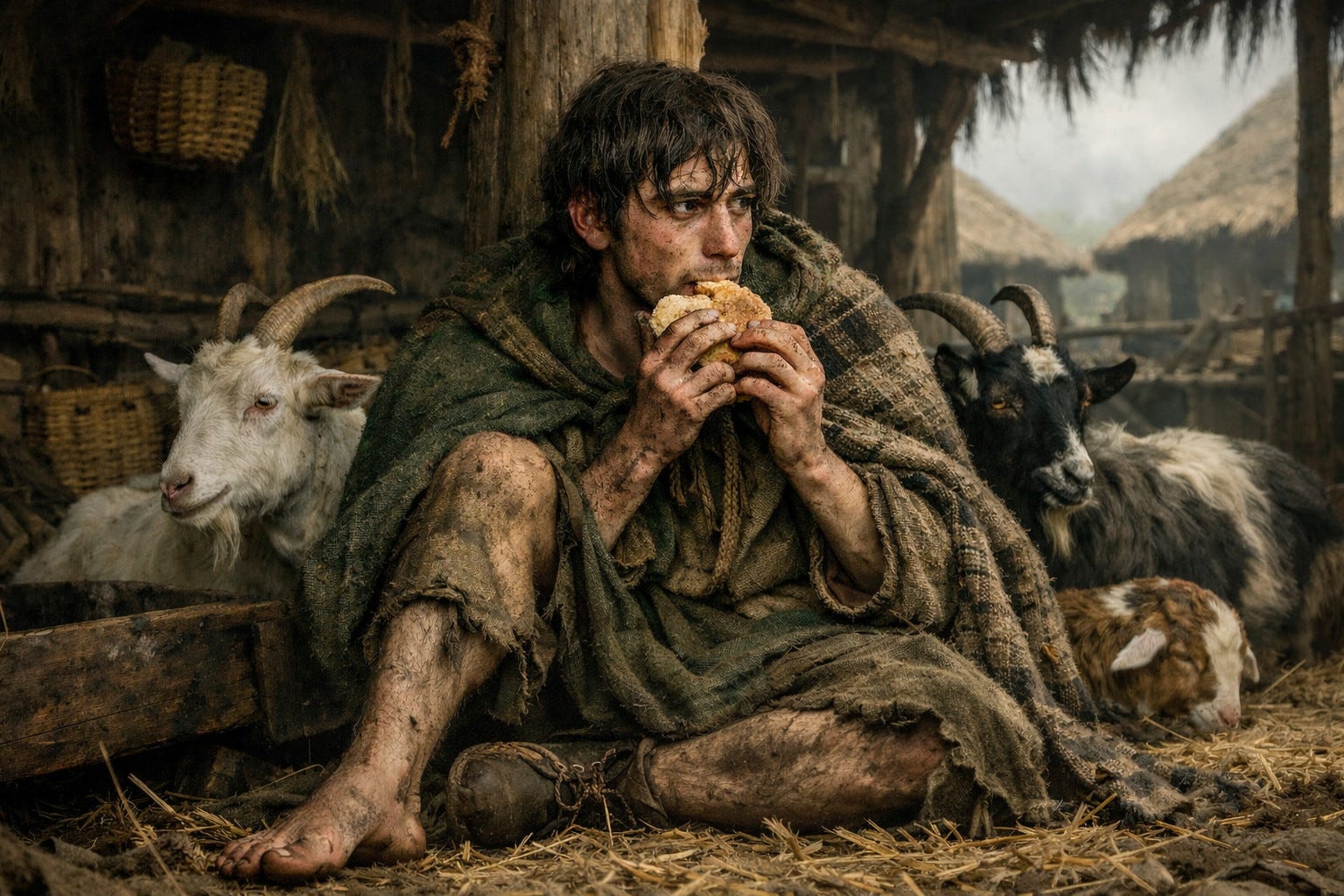
Cadoc led him behind a low wall and into a small byre where the smell of animals covered human scent. Inside it was dark and close. A goat shifted. A chicken rustled. Cadoc gestured for Patrick to crouch.
Patrick obeyed, heart still hammering, but slower now. Cadoc spoke quickly, low, pointing: stay, quiet, wait. Then he left, slipping out like a man who knew how to become unseen.
Patrick sat in the byre’s shadow with bread in his fist and the taste of seawind still in his mouth. He had obeyed the dream. He had reached the shore.
He had been spared again, by a smuggler’s hands, by a captain’s gesture, by a God who used crooked tools. Patrick bowed his head until his forehead touched his knuckles.
“Thank You,” he whispered in Latin, barely a sound, afraid even of his own voice. “Thank You.”
Outside, the village woke fully. Footsteps. Voices. A child crying. A dog barking, not frantic now, but ordinary. Ordinary was dangerous too.
A shout rose suddenly, different from the morning noises, sharp, official.
Cadoc’s voice answered, too quickly.
Then another voice, harder, carrying the tone of command, cut through it.
Patrick’s blood cooled. He heard boots at the byre door. A hand lifted the latch. Light spilled in.
And Cadoc stood there, not alone, his face tight with helpless apology, while two armed men behind him scanned the shadow like they already knew what they would find. Patrick’s fingers closed around the bread until it broke. He rose slowly, empty hands visible. And in the clean light of day, he saw what night had hidden:
Cadoc had not betrayed him. Cadoc had been caught with him. And now fear would decide what Patrick was before he could speak.
In the Gray Light
They did not bind Patrick right away. That was the first mercy and the first warning.
The two armed men in the byre doorway stood with the calm of people who believed the outcome belonged to them. One carried a spear; the other held a short club more like a tool than a weapon, the kind a man used when he wanted bruises instead of blood. Behind them, morning widened. A strip of sky showed pale through the roof slats, and dust floated in the light like ash.
Cadoc remained in the doorway, shoulders tight, eyes fixed somewhere just past Patrick’s face as if he could not bear to watch what his own help had summoned.
Patrick stood perfectly still, empty hands visible, broken bread crumbs stuck to his palm. He opened his mouth to speak, Brittonic first, the language closest to home, and found that his voice came out thin. “I am not—” he began.
The spear tip lifted a fraction. A command without words: quiet.
One of the men spoke Welsh, quick and clipped. Patrick caught almost nothing, only the tone: accusation wrapped in certainty. The other answered in a different cadence, and Patrick’s stomach turned. Not Irish, no, but not quite the Welsh he’d just heard either. Border speech, perhaps. A local tongue that made sense to itself and shut strangers out.
Cadoc finally forced himself to look at Patrick. His face held a helpless, angry apology. He spoke to the armed men fast and low, as if trying to bargain with air. The club-man cut him off with a sharp phrase and a wave of his club. Cadoc flinched.
Patrick watched the exchange and understood with cold clarity: Cadoc had tried. It hadn’t been enough.
The spear-man stepped into the byre and hooked the spear tip against Patrick’s ribs, under his arm, not stabbing, just guiding, pushing him toward the door the way you push a reluctant animal. Patrick stumbled once, barefoot on packed earth. The club-man caught his elbow, not kindly, not cruelly, and held him upright. They did not want him to fall.
They wanted him to be seen. Outside, the village had fully woken. A woman with a pail froze mid-step, eyes widening as she took in Patrick’s Irish-cut cloak and ash-streaked hair. A boy stopped chewing something and stared. A dog barked once, then snapped its mouth shut as if scolded.
Voices rose, questions, assumptions, fear doing its quick work. “Irish,” someone said again, and the word traveled like a spark. Patrick felt it strike him. Not a name. A verdict.
He tried again, louder, forcing Brittonic into his throat as if volume could carry truth. “I’m from Britannia,” he said, pointing east as if pointing could pull the sea back. “I was taken, servus—”
The spear-man’s jaw tightened. He said a single word Patrick recognized clearly in the midst of everything: “Hibernicus.” Irish.
Then another word, Latin again, worse because Patrick understood it fully: “Captivus.” Captive.
Patrick’s chest tightened. So they could speak Latin, enough to label him. Not enough, perhaps, to listen.
Cadoc spoke again, urgently now, stepping forward as if to put his body between Patrick and the men. The club-man turned and shoved Cadoc back, hard enough to humiliate, not hard enough to break.
Cadoc’s face flushed with rage. For an instant Patrick thought the trader might swing, might do something foolish and brave. Instead Cadoc swallowed it down and lowered his eyes, because he lived here. Because he would still be here after this morning ended. Because this village had a long memory, and long memories punished.
A third man pushed through the gathering: older, broader through the shoulders, cloak pinned high, hair shot with gray. Not quite a lord, no crown here, but the posture of someone used to being obeyed. The yard quieted around him the way grass quiets when a boot steps down.
Authority. He spoke to the guards in Welsh. They answered quickly, eager to prove they had acted first. The older man’s eyes flicked from Patrick to Cadoc and back, taking in more than he was being told.
Someone muttered in Brittonic, quick and urgent, “Fetch the lord’s man.” Another answered, “The maer will know what to do.”
The older man’s gaze settled on Cadoc’s pouch, weighted, half-hidden and on the remnants of oiled cloth peeking from Cadoc’s bundle. Cadoc’s jaw tightened.
The older man spoke one word in Welsh, sharp as a snapped twig. The club-man stepped to Cadoc and held out his hand. Cadoc hesitated. just a heartbeat, then unclasped the pouch and placed it into the man’s palm. A fine, paid in silence.
The club-man added, curtly, another gesture: the bundle too. Cadoc’s shoulders rose with the reflex to argue, and then fell. He surrendered the bundle.
Patrick watched, throat tight. Cadoc wasn’t only being scolded. Cadoc was being stripped of goods, of standing, of the small shield his trade had given him. And still Cadoc did not point at Patrick. He did not say, He forced me. He did not throw Patrick to the dogs to save himself. He simply stood there, swallowing humiliation like medicine.
The older man stepped closer to Patrick. He spoke again, not Welsh this time, but Latin, slow, deliberate, the kind used by men who wanted their authority understood:
“Whose slave are you?” Patrick’s mouth went dry.
The honest answer was: I don’t know anymore.
The dangerous answer was: No one’s.
He swallowed and forced out what he could, Latin broken, but real. “Britannus,” he said. “Captivus… Hibernia.” Then, desperate, he added, “Non Hibernicus.” Not Irish.
The older man’s expression did not soften. But something in his eyes shifted, not belief, not yet, interest. The way a man looks when a story refuses to fit the simple shape he prefers.
He turned and spoke to the guards. A short command. Then he pointed toward the low outbuilding near the edge of the huts, a stone-and-timber place with a door heavy in its frame and an odor of old damp. “A holding place,” Cadoc had called it with his face earlier, without words.
A warning place. The spear-man nudged Patrick forward. Patrick walked, because fighting here would only confirm what they feared. As they reached the door, the older man’s gaze cut once more to Cadoc. He said something in Welsh that made the onlookers murmur.
Cadoc’s shoulders tightened. A second penalty, promised if not yet delivered. Then the door opened and Patrick was pushed inside.
Dark swallowed him. The smell of rot and old straw rose up like a hand. The door closed with a sound that felt final.
From outside, he heard the older man’s voice again, Welsh now, issuing orders.
Not about Patrick. About summoning someone who could judge properly. The maer. The lord’s man. A priest. Someone who could decide what he was.
Patrick sank onto the straw and pressed his forehead to his hands, breathing. He had escaped Ireland. And he had been caught before he could even say his name in daylight.
In the dim, he whispered the only truth he could hold without breaking: “Jesus…”
Then, after a beat, thin, ashamed, and real, “Help me speak.”
The Reading Man
The holding place had no window, that was the point.
It was not a prison built for long sentences, nothing here was built for long anything, but it was a place to keep a man until the village decided what to do with him. The air tasted of damp wood and old straw. Somewhere in the dark a mouse scratched, bold as hunger.
Patrick sat with his back to the wall, knees drawn in, listening. Outside, the village moved on. Voices rose and fell. A pot clanged. A child cried and was hushed. A dog barked twice, ordinary, not frantic. Ordinary was what frightened him most.
Because ordinary meant the world was comfortable with deciding his fate, it meant they weren’t even thinking about him. He pressed his forehead to his hands and breathed again, slower. “Help me speak,” he had whispered.
Now he waited to find out what speaking would cost. No one brought him water. No one slid bread under the door.
The day passed in the body first, not in the mind. Thirst came like a dull heat behind his tongue. Hunger followed, smaller but steady. His mouth dried until even swallowing hurt. He licked his lips and tasted nothing but salt from the sea and dust from the straw.
He tried to pray, the words came and went, some stuck like burrs, some fell apart before he could finish them. He told himself this was punishment, he told himself it was precaution, he told himself it was simply how frightened villages behaved when a stranger arrived with the wrong clothes and the wrong story.
He shifted once, and the straw sighed. The sound felt loud as a shout. He lay still again.
Hours later, when the air cooled and the sounds outside changed, when the village’s ordinary day began to fold into evening, he knew dusk was near even without light. Men’s voices carried differently. Fires were being fed. The smell of smoke seeped in through cracks.
Then footsteps came, several sets, not hurried.
The door scraped open and a band of dim light slid across the floor, not bright day now but dusk, gray and thin. Patrick blinked, squinting.
The two guards stood first, spear and club, faces set like stone. Behind them was the older man with the pinned cloak, the one they deferred to. And beside him, new, unmistakable, stood a man in a darker cloak with a narrow cord at his waist, hair cut shorter than most, hands clean in a way hands rarely were here. A cleric.
Not a monk from the stories of deserts and lions, there were no deserts here, just a local presbyter, a man who had learned letters and carried them like a quiet weapon.
The older man spoke quickly in Welsh, gesturing toward Patrick as if presenting a troublesome fact, a thing found where it shouldn’t be.
The presbyter listened without interrupting. His eyes stayed on Patrick, steady, measuring, not hostile, not soft. Then he stepped forward and spoke in Latin.
Not trade-Latin, not a barked label, proper Latin shaped carefully, as if each word mattered because each word was accountable.
“Surge,” he said. Rise. Patrick’s body moved before his pride could argue. He stood, swaying slightly, thirst making him light-headed, the room tilting around him like a deck.
The presbyter’s gaze went to Patrick’s cloak, ash-streaked, Irish cut. Then to his bare foot, wrapped clumsily. Then up to his face.
“Nomen tuum?” Your name?
Patrick swallowed, his throat burned. “Patrick,” he said, and then, because he still felt the old name under the new one like a bruise, he added, quieter, “Paternus, filius Calpornii.”
The older man frowned at the sound of the names as if they were stones in his mouth. One of the guards snorted. The presbyter’s eyes sharpened, not in anger, in attention.
“Calpornius,” he repeated, testing whether it was true Latin or a captive’s invention. Then he asked, slowly, “Unde es?” From where are you?
Patrick forced breath into his chest. “Britannus,” he said again, and pointed east, helplessly. “Prope flumen… Clyde.” He hesitated, then corrected himself with what he could. “Prope mare. Prope rupem.” Near the sea. Near the rock.
The older man cut in, Welsh spilling fast. He pointed at Patrick’s clothing, mimed a boat, mimed running. A guard added a harsh phrase and said again clearly enough for Patrick to catch the shape: “Hibernicus.”
The presbyter lifted a hand. Not dramatic. Just enough to stop the noise.
He turned back to Patrick and asked a question that made Patrick’s throat tighten.
“Esne Christianus?” Are you a Christian?
Patrick’s mouth went dry, he thought of his mother at vespers, of Father Ciarán by the Clyde River, of Aífe in the lean-to, shaking under the edge of a borrowed cloak, of the shout that had woken him, Patrick! Go now!
He nodded once. “Sum.” he said. I am.
The presbyter’s gaze held him. “Ubi baptizatus es?” Where were you baptized?
Patrick closed his eyes for a heartbeat, dragged memory up like a bucket from deep water. “In Britannia,” he said. “In ecclesia.” He stumbled, then added, because truth mattered more than pride. “Sed puer neglexi.” But as a boy I neglected it.
The presbyter’s expression didn’t change. But something in the set of his mouth softened, almost imperceptibly, like a man recognizing confession rather than performance.
The older man spoke again in Welsh, impatient now, the village didn’t care where a boy had been baptized, it cared whether he was danger.
The presbyter answered in Welsh, briefly, firmly. Patrick understood none of it, but he understood the effect, the older man’s jaw tightened, he stepped back half a pace.
A new shape of authority had entered the room.
The presbyter turned to Patrick again. “Cuius servus es?” Whose slave are you?
Patrick felt the question in his ribs, he had rehearsed it in dread.
“I was taken,” he said, Latin roughening. “Hibernia, Miliucc.” He swallowed. “Servivi sex annos.” I served six years.
The presbyter’s brow flickered, a small reaction, controlled. A number that matched the weight in Patrick’s voice. “Et modo?” And now?
Now. Patrick’s tongue stuck. Because the honest answer was still: I don’t know anymore.
He glanced past the doorway and saw Cadoc in the yard beyond, shoulders held too still, pouch gone, bundle gone, face bruised by humiliation rather than blows, he didn’t meet Patrick’s eyes. Patrick’s chest tightened with an unexpected ache. Cadoc had risked something real and was paying for it.
The presbyter followed Patrick’s glance. His eyes narrowed slightly. He said a sentence in Welsh to the older man. The older man answered with a short, irritated reply.
Then, to Patrick, the presbyter said in Latin, quieter now, almost private:
“Dic veritatem.” Tell the truth.
Patrick’s hands trembled once and he forced them still. He could lie, say he’d been freed, say he’d been sold, say anything tidy. But lies were a kind of rope, he had lived too long in rope.
“I fled,” he said.
The older man barked something in Welsh at that. The spear-man’s posture stiffened. Patrick didn’t stop. He couldn’t. If he stopped now, fear would speak for him.
“I fled because… a voice,” he swallowed, the sentence dangerous even in Latin. He tried again, safer. “Somnium.” A dream.
The presbyter didn’t laugh. He didn’t sneer. He only watched.
Patrick’s throat tightened. “It said, ‘Your ship is ready.’” He hesitated, then added the most terrifying part because it was the part that made it real. “It called me, Patrick. I found the ship that brought me just as the dream had shown me.”
Silence held for a beat, not holy silence, practical silence, men weighing whether this was madness or truth. Then the presbyter turned and explained in Welsh what Patrick had said.
The older man scoffed, a quick harsh sound. The club-man’s mouth twisted as if he’d heard enough. But the presbyter’s eyes stayed on Patrick’s face, and in that steady gaze Patrick felt a strange possibility: that someone, finally, might listen long enough for words to matter.
The presbyter spoke to the older man in Welsh, longer this time, measured, like a man laying stones in a wall.
The older man answered sharply. They went back and forth. Patrick caught nothing, only cadence: the presbyter insisting on procedure, the older man insisting on fear.
At last the older man spat a short phrase and made a slicing motion with his hand, as if cutting off any argument.
He pointed at Patrick. Then pointed toward the lane beyond the yard, toward somewhere out of sight. The presbyter’s mouth tightened.
He turned back to Patrick and spoke in Latin, low enough that only Patrick would hear:
“Non hic iudicabitur.” He will not be judged here.
Patrick’s stomach dropped. The presbyter added one more phrase, quiet, grim:
“Te ducent.” They will take you.
The spear-man motioned to the other guard. The club-man produced a length of cord, ordinary cord, the kind used for goats and bundles ,and looped it around Patrick’s wrists with quick efficiency. Not tight enough to cut, tight enough to make the point.
Patrick flinched anyway. The guard gave a sharp tug. Rope was a language his body understood too well. They left him enough slack to walk, not enough to run.
Patrick looked past them once more and saw Cadoc standing in the yard, stripped of pouch and bundle, shoulders held too still. The trader lifted his eyes at last, and in them was no betrayal, only the helpless ache of a man caught doing one risky kindness in a world that punished risk.
The cord jerked again. A silent command. Patrick stepped forward.
The sky at the horizon was already darkening, the air cooling toward night, and the village, so ordinary a few hours ago, watched him the way men watch a spark near dry thatch.
Patrick drew one breath, then another. He had escaped Ireland by obeying a voice.
Now, in Wales, he was being led away by men who could speak enough Latin to name him, and enough fear to bind him.
And as he crossed the yard, the cord tugging him into the lane, Patrick realized with a cold clarity that made his mouth go dry:
Whatever waited at the end of that road had already decided what he was.
He just didn’t know if he was walking toward judgment…or another kind of captivity.
Author’s Note (on Part IX)
So far we’ve watched a boy become a captive, and a captive begin, almost against his will, to pray.
Part IX begins in the gray light of judgment: Patrick must speak for himself, and the world will decide what he is before it decides what to do with him.
excellent. Still a mystery
This book needs to be in the hands and minds of teens and others. The text is compelling and engaging and full of story-to-truth power. With ample illustrations it would be irresistible to those seeking truth and wanting to develop courage. The example of Patrick's journey to faith through challenges comes alive for the reader and will accompany him on his own path. I encourage you to make this available to youth starving for such relatable, compelling literature.