Becoming Patrick: Sinner and Saint - Part 11
Hard Reality on the Road to Heaven

The continuation of the multipart historical novelette that imagines the lost years of Saint Patrick’s youth, the terror of abduction, the grind of slavery, and the quiet awakening of faith that changed everything. Because the historical record says little about his formative years, much of this story is fictional and meant to entertain and edify. Where sources fall silent, I’ve chosen plausible details; where Patrick speaks in his own writings, I’ve tried to honor his tone and faith.
If you haven’t read the previous releases here are the links:
[ Part 1 ] [ Part 2 ] [ Part 3 ] [ Part 4 ] [ Part 5 ] [ Part 6 ] [ Part 7 ] [ Part 8 ] [ Part 9 ] [ Part 10 ]
First Lessons
Father Ciarán did not stay long enough for the village to wake. That was part of the mercy.
He sat with them only until the lamplight looked foolish beside the growing morning, until the kettle began to sing, until Aelia’s hands stopped trembling enough to pour without spilling.
Then he rose. “After prime,” he told Calpornius quietly, naming the hour the Church kept even when the borderlands didn’t. “Bring him.”
Calpornius nodded once, as if receiving an order that felt like relief.
Fr. Ciarán turned to Patrick, eyes steady. “Wash,” he said. “Eat again. Then come.”
Patrick blinked, startled by the simplicity of it. Not explain, not prove, not perform. Wash. Eat. Come. Obedience that healed instead of hollowed.
When the priest left, the house exhaled. The silence that followed was different now, less haunted, more purposeful, as if the air had been sanctified in some way.
Aelia set another bowl before Patrick and this time he ate slower, forcing himself to remember manners that weren’t survival tricks. Darerca watched him openly now, no longer hiding behind the blanket. She didn’t smile. She didn’t cry. She studied him the way a child studies a wound, fascinated, frightened, wanting it to heal.
Calpornius fetched water from the back, then paused at the door as if listening for the village’s breath changing into speech. He came back and set the basin down without a word.
Patrick washed his hands. The water ran brown at first, then clearer. He scrubbed under his nails and felt shame flare, shame at the filth, shame at the marks on his wrists, shame at being touched by kindness and not knowing how to answer it.
Aelia stood behind him and laid a hand on his head once, brief, steady.
Darerca finally spoke, voice small. “Do you… still remember?” she asked.
Patrick didn’t pretend he misunderstood. He nodded. “Yes.”
Darerca swallowed. “Do you remember me?”
The question hit harder than any accusation the village could make. Patrick turned and looked at her properly. Her face was familiar and not familiar, the way a sapling is familiar to the tree it once was. “I remember you by the hearth,” he said slowly. “And hiding under Mother’s cloak when Father raised his voice.”
Darerca blinked fast, fighting tears like a soldier. “I wasn’t hiding,” she muttered.
Patrick’s mouth twitched. The closest thing to a smile. “You were,” he said gently. “But it was clever hiding.”
That was enough to make her shoulders loosen a fraction. She looked down quickly, ashamed of being seen.
Calpornius watched the exchange with a tight jaw and eyes too bright, then cleared his throat as if to call them all back to the hard world. “You’ll come with me,” he said to Patrick. Not command. Not request. A father deciding what must be done next.
Patrick’s chest tightened. “To the church.”
Calpornius nodded once. “Before the lane wakes fully.”
Aelia’s hands tightened around the cloth she was holding. “And after?” she asked.
After. The word sat in the room like an unfamiliar tool. Patrick realized, with a sudden hollow shock, that he had never imagined after. There had only been escape, then home. Home had been the finish line in his mind.
But a finish line is where a man collapses, not where he lives.
Calpornius didn’t answer immediately. He looked at Patrick as if weighing what to say in front of Darerca, weighing what truths should be spoken where children can hear them. Then he said, low: “After, we will decide what we can carry. Together.”
Patrick swallowed. “They’ll ask.”
“Yes,” Calpornius said. “And we will answer what we can, and we will refuse what we cannot.”
Patrick’s throat tightened. “They’ll want names.”
Aelia’s face pinched. Calpornius’s voice went flat with steadiness. “Then we will grieve with them, and we will not let grief turn into a blade.”
Patrick nodded, but inside him something recoiled. He still carried the old fear, being blamed, being measured, being found guilty simply for standing. He looked down at his clean hands and saw, as if the water had only made the memory sharper, Aedan’s eyes, Marc’s bloodied mouth, Brigid dragged between men, Nia’s tears cutting clean tracks through dirt.
His disobedience had opened the edge.
He had not swung the rope, but he had stepped away from safety, and the step had swallowed them all.
Freedom demanded a man be accountable, he understood that now. Chains had not absorbed the blame, they had only muffled it.
He drew one breath, then another, and the thought came; not as comfort, but as a hard direction he could cling to:
Disobedience had led him into sin, perhaps obedience would be the road back.
Readings
They went to the church while the light was still new. The lane was quiet, smoke just beginning to thread from a few roofs. A dog watched them pass with sleepy eyes. No one called out. No one noticed the miracle moving under a cloak. Or if they did, they pretended not to, the way borderlands pretend not to see what would cost too much to name.
Inside the church, the lamp still burned. The air smelled of wax and damp stone and yesterday’s prayer. Father Ciarán met them near the altar, sleeves rolled up as if he’d been mending something, because priests in small places were always mending something.
He nodded to Calpornius and Aelia, then fixed his gaze on Patrick. “Sit,” he said.
Patrick sat.
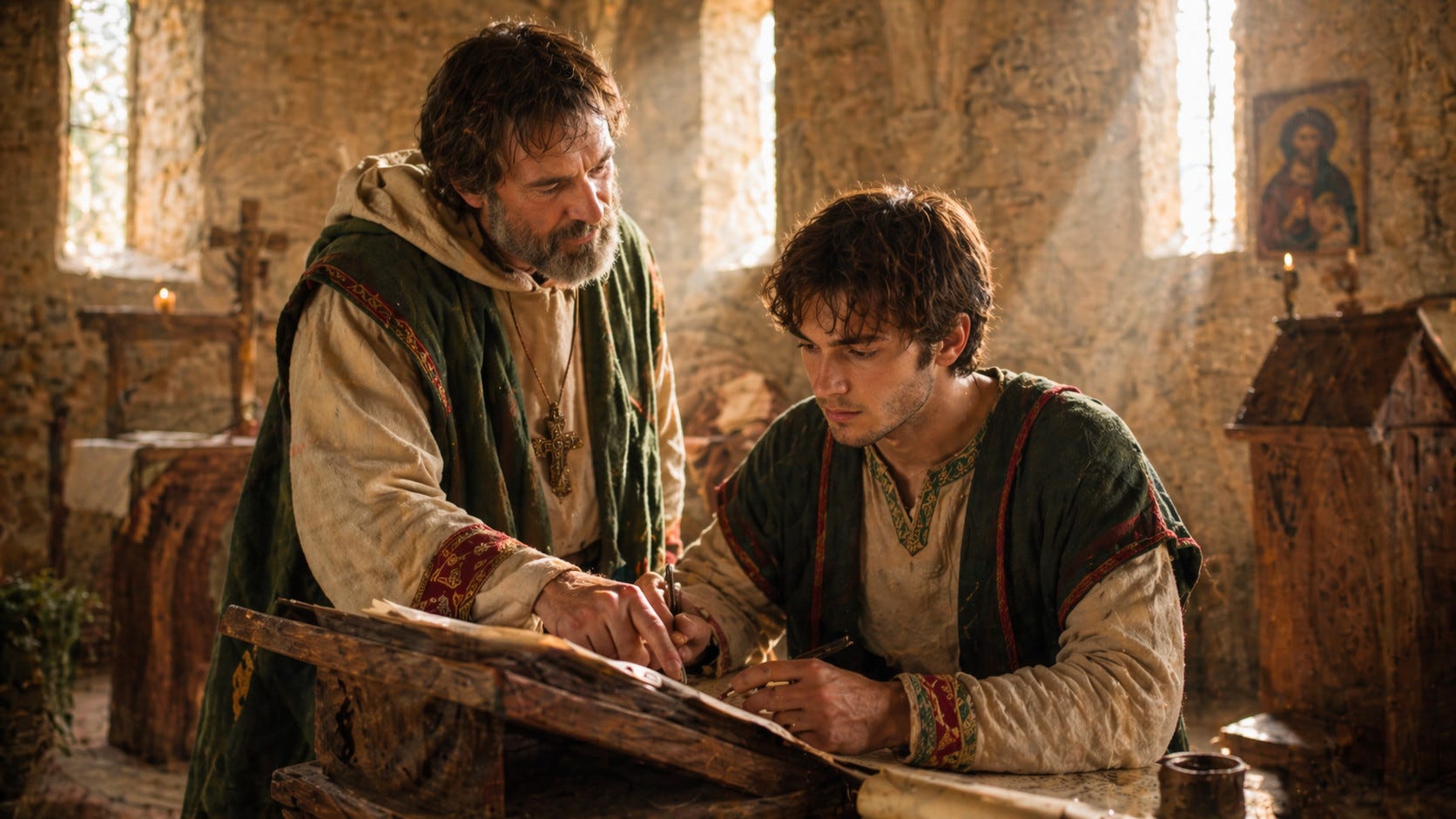
Father Ciarán opened a worn book, parchment, precious, and began without preamble, as if beginning were itself a form of mercy.
He spoke Latin, slow and clear, and Patrick felt the old schooling stir like a muscle that had atrophied. He stumbled over endings. He corrected himself. He felt heat rise in his face at each mistake.
Father Ciarán didn’t mock him. He didn’t praise him either. He simply kept going, as relentless as the Clyde.
After a time, Father Ciarán closed the book and looked at him. “You want to learn,” he said.
Patrick nodded, throat tight.
“Why?”
The question wasn’t academic. It was surgical. Patrick’s mouth went dry. He could have given a holy answer. He could have performed. He remembered Father Ciarán’s warning: Do not turn mercy into a story about yourself. So he gave the ugly truth.
“Because I’m afraid,” Patrick admitted. “Of being empty again. Of becoming… less.”
Father Ciarán studied him. “Less what?”
Patrick swallowed. “Less human.”
For the first time, something like approval flickered, not warmth, not praise, just the acknowledgment of a man hearing honesty. Father Ciarán nodded once. “Good,” he said. “That fear can become wisdom, if you don’t let it become vanity.”
Patrick blinked.
Father Ciarán leaned forward slightly. “You learned obedience under a stick,” he said. “Now you will learn obedience under grace. One makes slaves. The other makes saints.”
Patrick’s throat tightened. “I’m not—”
“I didn’t call you a saint,” Father Ciarán cut in, dry. “I called you a student.” Then, quieter: “And students begin with small and simple obedience.”
He slid the book across the table. “Read.”
Patrick stared at the lines. Letters swam. His eyes burned. He put his finger to the page like a child. And began.
Outside, the village was waking fully now, rumor stretching in its bed and preparing to stand. But inside the church, in the thin early light, Patrick’s world narrowed to ink and breath and the strange, steady work of becoming someone who could remain home without chains.
And somewhere deep under that work, like a tide under calm water, something waited, patient and inevitable: the voice that had called him out of Ireland once already, and would not be quiet forever.
The Slow Work
The first year passed, not cleanly, not as healing should, but as borderland time always passed: with weather, with rumor, with the steady labor of trying to live as if loss were not sitting at every hearth.
The rumor that Patrick had returned did what rumors do. It grew legs. It crossed the lane in murmurs and in errands invented for the sake of listening. Men came to Calpornius’s threshold under the pretense of borrowing tools. Women lingered too long at the well. Children stared and were shooed away, only to return and stare again, drawn by the idea that something impossible had happened in a house they walked past every day.
Most of them took something from his return, a stubborn kind of comfort: if one came back, perhaps another could. If God had opened one door, perhaps He had not shut them all.
A few could not bear that comfort. Aedan’s mother did not weep when she saw Patrick. She stared at him as if he were a ghost that didn’t belong in her reality, a returned son standing where her own child should have been. Her mouth moved once, as if forming a name, then closed. She walked away with her hands clenched, not cruel, wounded and raw.
Marc and Brigid’s kin asked their questions without raising their voices, and that quiet made the questions worse. Did you see them alive? Did they have bread? Were they kept together? Did they speak? Did they cry? Their wishes showed through every word, the desperate need to believe their children were somewhere warm, somewhere safe, somewhere not suffering.
Patrick answered what he could. He did not embellish. He did not make himself brave in the telling. When he did not know, he said so. When pain sharpened toward accusation, Calpornius ended the exchange with a hand on Patrick’s shoulder and a voice that allowed no further tearing.
There were days Patrick left those encounters hollowed out, shaking with anger he did not want, anger at the world, anger at himself, anger at the cruel arithmetic of survival.
On those days, he found Father Ciarán, not because he wanted comfort, but because Father Ciarán would not give it cheaply.
“Obedience,” Father Ciarán would say, like a man naming a tool and placing it into Patrick’s hands. “Not to their grief. Not to your pride. To God.”
Patrick hated how often the word tasted like a stone. He obeyed anyway.
During this first year turned and the seasons came back around, he began to study in earnest, slowly, stubbornly, like a man rebuilding a tool he’d once taken for granted.
Not like the indifferent youth by the river, skimming prayers the way he once skimmed stones, hoping for applause from the world. He studied now the way he had herded sheep: steadily, in all weather, because the day demanded it.
Father Ciarán made no grand program. He had no schoolhouse, no polished syllables, no ivory. He had a few books, a slate, a piece of charcoal, and a stubborn belief that God used small places to build large souls.
Patrick sat with parchment and fought for every line. He had lost years. He felt it in every ending he couldn’t parse, in every sentence he had to read twice, in the humiliating slowness of it. His mind, trained by captivity to measure wind and hunger and threat, resisted the patience of learning. He was a doer. His hands wanted tasks that finished: wood split, bucket filled, fence mended, proof that the day had been conquered.
Words did not finish. Words waited.
More than once frustration rose in him like bile and he wanted to shove the book away, to find something real to lift, something that could not slip through his fingers like meaning. Father Ciarán watched those moments with the same unhurried gaze he’d once turned on him at the Clyde.
“You want to conquer it,” Father Ciarán said, tapping the page. “Like you wanted to command stones.”
Patrick’s face heated. “I’m trying.”
“Yes,” Father Ciarán agreed. “And you are still trying to win.”
Patrick clenched his jaw. “Is that a sin?”
Father Ciarán’s mouth twitched. “Not always. But it is a temptation. Holiness is not winning, Patrick. It is yielding to truth.”
Patrick lowered his eyes and returned to the line. And read again.
Obedience became his second labor. Not the obedience that kept him alive under a stick. A different obedience, harder in its own way, because it asked him to choose it when no one forced him.
He rose early to pray, not always with feeling, but with discipline. He tried to fast sometimes, not because anyone required it, but because hunger no longer frightened him and he wanted mastery over what had mastered him. He served his parents without being asked, because service steadied him when the village’s looks made him feel like a stain.
He remained obedient, if still a little willful. When Father Ciarán corrected him, Patrick didn’t sulk. He stiffened like a young man who had learned to survive by not yielding, and then, after a breath, he yielded anyway.
The ache remained: unfinished preparation.
He knew just enough Latin to understand how little he understood. The gap between what he was and what he wanted to be felt like a distance he could not cross by will alone.
Some nights he doubted he could. Some nights he doubted God even wanted him to.
Those nights were worse, because they felt like Ireland again, wind and emptiness, memory pressing in like weather.
Father Ciarán noticed the drift. One evening, after a lesson that had gone badly, Patrick sat outside the church with his head in his hands, staring at the ground as if it might tell him what he was supposed to become.
Father Ciarán came and sat beside him without asking. “You’ve learned to survive,” Father Ciarán said. “Now you must learn to live.”
Patrick’s throat tightened. “I don’t know how.”
Father Ciarán looked out toward the darkening fields. “You already began,” he said. “You came home. You stayed.”
Patrick swallowed. “Right now, staying feels harder than running.”
Father Ciarán nodded. “Because running only asks your legs. Staying asks your heart.”
Patrick stared toward the west, toward the invisible water that still felt like a mouth. “I keep thinking,” he admitted, voice low, “that God brought me back for a reason.”
Father Ciarán didn’t answer quickly. He didn’t like quick answers to holy things. At last he said, “Then be careful. Reasons from God do not always feel like gifts.”
Patrick’s skin prickled.
“Sleep,” Father Ciarán added, rising. “Tomorrow we continue.”
Patrick went home under a sky too clear, the stars sharp as nails. He tried to pray, and the words snagged on faces, Aedan, Marc, Brigid, Nia, until prayer felt like swallowing stones.
He lay awake long after the house had settled, staring at darkness.
Then he whispered into it, not a prayer for comfort, but a vow that frightened him with how real it sounded: “I will not waste the life I was given.”
Children of the Border
Years did what years do. They wore down sharp edges and left deeper ones.
Patrick’s learning came slowly, and everyone saw it. Father Ciarán taught him anyway, Latin in steady doses, Scripture like a mirror, prayer like breath. Patrick could read well enough to be corrected, well enough to correct himself, but he would never be what the old Roman households prized: quick, polished, impressive. He remained a doer in a world that asked him to become a learner, and the struggle stayed visible, like a limp you can’t hide no matter how straight you stand.
The adults noticed that limp first. They watched him as if he were always half-returned, the escaped slave with rope-marks under his sleeves, the young man who came back when others did not. Most spoke kindly, careful. A few spoke too carefully. Some carried their grief like a knife and kept it sharp.
Aedan’s mother could look at Patrick now without flinching, but her eyes still slid past him as if refusing to let her heart believe in miracles that came unevenly. Marc and Brigid’s kin stopped asking their questions aloud, but the questions lived in their silence.
Patrick learned to accept that. He learned not to demand absolution from people who were still bleeding. And he learned, quietly, that the adults would always see his history before they saw him.
The children did not. They saw a young man who listened when they spoke, who didn’t laugh at their small fears, who could climb a low wall without showing off, who knew how to make a game fair even when he could win. They saw a man with a scarred patience and a strange gentleness, as if he understood what it meant to be vulnerable.
It began with Darerca. She grew into quickness, quick hands, quick tongue, quick temper, and she tested him the way siblings do, as if trying to find the brother she had lost beneath the man who returned. “Race me,” she demanded one morning, chin up, daring him in front of the younger ones.
Patrick snorted. “To where?”
“To Mother,” Darerca said, pointing to Aelia by the doorway, and the children laughed at the simplicity of it, at the boldness of declaring Aelia the finish line.
“Run to Momma,” one of the little boys cried, and suddenly the name stuck as if it had always belonged to the game.
Patrick should have refused. A man his age should not have been sprinting in the lane with children like a fool. But when Darerca ran, hair flying, feet slapping mud, something in Patrick loosened.
He ran too. Not to win. Not to prove anything. Just to feel, briefly, his childhood spontaneity, to remember fun.
Aelia watched them come pounding toward her, breathless and laughing, and her hand went to her mouth as if laughter itself was a miracle she didn’t trust.
Darerca reached her first, triumphant. Patrick arrived half a breath later and bent over, hands on his knees, smiling in a way he had forgotten about.
Aelia’s eyes shone. She didn’t speak. She only put a hand on each of their heads, a silent blessing disguised as scolding. “Not in the mud,” she murmured, and the children scattered, delighted.
After that, the younger ones began to gather near Patrick as if he were a warm stone in a cold stream. They played “hide and find” among the huts, Patrick counting aloud with exaggerated solemnity while giggles betrayed the hiding places. They played “caught you” in the grass, chasing until someone fell and the rest piled on in harmless violence. In winter they played board games near the hearth, Nine Men’s Morris scratched into a plank with charcoal, small stones for men, and tables, backgammon on a borrowed board when a trader passed through and left it behind.
Patrick taught them the rules carefully, not like a master showing off, but like a brother making sure no one was cheated. He let the smallest win sometimes and pretended not to notice when Darerca cheated and then argued she hadn’t. “Liar,” Patrick told her, grinning.
“Scholar,” she snapped back, and the children laughed because calling Patrick a scholar still felt like teasing him with a future he was slowly earning.
The adults watched all this with complicated eyes. Some shook their heads. He’s still half a child, their looks seemed to say. The sea stole his manhood.
Others softened, pity cutting through suspicion. In their minds Patrick became a figure both sad and safe: the returned captive who played games with children because he had lost his own childhood and never truly caught up.
Patrick let them think it. He did not correct their pity. Because their pity gave him something he wanted without admitting he wanted it: permission to hover near the children.
To be there. Always. He lingered when the children ran to the river. He walked the edge of the lane when they chased each other toward the dip where grass fell away. He kept his body between them and the places where the world could reach in.
He told himself it was nothing. Habit. Restlessness. But the truth was sharper. He had tested the edge once, and the test had cost him and his friends everything. He would not watch it happen again.
Power of Prayer
It was late spring when the river called them out. The Clyde ran bright that day, sun breaking on its surface like scattered coin. The children begged to go, and Aelia, after long hesitation, allowed it, on one condition: “Stay where you can be seen,” she said, and her voice carried the strain of every mother on the border.
Patrick heard the condition like a command meant for him. “I will,” he said.
They went down in a noisy flock, Darerca at the front, a few little boys racing each other, a girl carrying a basket of crusts meant for ducks that didn’t exist. Patrick followed last, staff in hand, his small crucifix tucked inside his tunic where it rested against his chest like a secret.
They played along the bank, “caught you” in the grass, stones skipping, laughter rising and falling with the wind. Patrick let them scatter only so far, always herding them back with a word, a new game, or a look that made them obey because they trusted him.
The Clyde rushed hard over stones, loud enough to drown the smaller sounds, the wind in reeds, the distant bark of dogs, even the children’s own shouting when they were close to the water. The day felt clean, almost foolish in its brightness. Stones skipped. Feet slipped. Someone squealed and laughed and called it an injury when it wasn’t. Patrick let himself smile without measuring it.
A new round of “caught you” had just begun. Patrick was resting, watching as one of the older boys was chasing Darerca. Darerca froze mid-step, the boy grabbed her arm in victory. But she didn’t react. She stayed still the way a hare goes still in open grass. Her eyes fixed on something beyond the bend, across the field, near the trees, and the look she turned on Patrick was older than her years. Patrick’s smile died.
He didn’t see what she saw yet, so he rushed toward her while the other children still shouted, still careless. His stomach dropped anyway, cold and certain, because he had learned to read faces faster than landscapes.
“Dar—” he started.
Her mouth opened and no sound came at first, as if fear had stolen her breath. Then she whispered, thin as a thread, “Men.”
Patrick followed her gaze to the woodline.
And in the same heartbeat the world changed: dark shapes moving where no neighbor should be moving, the quick glint of metal, a crouched figure stepping from tree-shadow onto their bank as if the river were only another road.
Raiders.
The Clyde was their entry, offering the children no protection. Not announced by wind. Not warned by birds. Just there, like a hand appearing out of darkness.
And the nearest one was already close enough that Patrick could see the wet shine on his blade.
Author’s Note (on Part XII)
Up to now, Patrick’s return has been a quiet kind of battle: learning to stay, learning to speak, learning to let grace rebuild what captivity tried to hollow out. The borderlands do not stop being dangerous simply because the hearth is lit, and innocence is never as safe as we want it to be.
Part XII shifts the pace. The river that once tempted Patrick toward the edge becomes the place where he must stand at it, not as a hero, but as a guardian. What follows is not triumph, but a glimpse of vocation: the slow schooling of obedience turning suddenly into protection, and a young man discovering that obedience doesn’t tame the dark, it only teaches you where to stand.