Becoming Patrick: Sinner and Saint - Part 12

The continuation of the multipart historical novelette that imagines the lost years of Saint Patrick’s youth, the terror of abduction, the grind of slavery, and the quiet awakening of faith that changed everything. Because the historical record says little about his formative years, much of this story is fictional and meant to entertain and edify. Where sources fall silent, I’ve chosen plausible details; where Patrick speaks in his own writings, I’ve tried to honor his tone and faith.
If you haven’t read the previous releases here are the links:
[ Part 1 ] [ Part 2 ] [ Part 3 ] [ Part 4 ] [ Part 5 ] [ Part 6 ] [ Part 7 ] [ Part 8 ] [ Part 9 ] [ Part 10 ]
[ Part 11]
Standing Still
Patrick’s voice cracked the game in half. “Run,” he said, low and hard. “Up the bank. Now.”
For a heartbeat the children only stared, stones forgotten in their hands, still half-laughing as if he had invented a new rule. Then Darerca’s face, white, older than her years, made the danger real. The laughter died. Feet slipped. Breath caught.
“Go!” Patrick barked, and the sharpness in him did what the river could not. “Run to the village. Don’t stop. Don’t look back!”
They scattered. Not gracefully. Not bravely. Like children, arms windmilling, knees knocking, terror arriving late and then all at once. One of the smallest stumbled in the wet grass, and Patrick snatched him up by the back of his tunic, shoved him forward, practically throwing him into motion.
Darerca didn’t move. Her eyes stayed locked on Patrick, fierce with a love that didn’t know what to do with fear. “Darerca,” Patrick snapped, and the use of her full name was its own whip. “Go!”
She shook her head once, lips trembling. “Patrick—”
“Go!” he shouted, and his voice broke on it. “Do you hear me? Go!”
That did it. Darerca’s face crumpled for a heartbeat, then hardened. She spun and ran after the others, hair flying, not looking back because he had told her not to.
Patrick turned to the riverbank. He was standing between the children and the men. He hadn’t decided that. His feet had. For a heartbeat he felt small, absurdly small, one young man in wool and mud against blades and hunger. Fear rose in him like bile. The old instinct screamed: run, hide, live.
But if he ran, the raiders would follow the easiest prey. The children. Patrick’s hand went to his chest as if something there could stop the world. His fingers found the crucifix. He pulled it free and held it out in front of him, arm straight, the small wooden cross suddenly too light, too simple, too inadequate. And yet it was the only thing he owned that the raiders did not. The nearest raider slowed, confused.
They were used to screaming and scrambling. Used to mothers pleading. Used to men fleeing or fighting with spears. They were not used to someone standing still, holding their ground.
One of them laughed, a sharp sound, and said something in Irish that made the others snort. Patrick’s mouth was dry. His heart hammered so hard it hurt.
He held the crucifix higher. Not as a charm. Not as a weapon. As a line. “In the Name of Christ,” he said in Latin first, because Latin was what he had learned to cling to when everything else was stripped away. Then he forced the words into Irish, rough, imperfect, but enough to be understood:
“Leave. Now.” The men exchanged glances.
The leader stepped forward, broad-shouldered, hair braided back, a scar shining pale at his cheek. His eyes flicked from Patrick’s face to the crucifix, then to Patrick’s hands, empty, no spear, no knife.
He spoke in Irish, slower than the others, as if speaking to an animal that might bolt.
“You,” he said. “Why are you here?”
Patrick swallowed. His arm trembled, but he did not lower the cross. “Because the children are here,” he said, and the Irish scraped his tongue. He tried again, stronger. “Because this is my Father’s land and those are my Father’s children.”
A laugh from one of the men, disbelieving.
The leader’s gaze narrowed. “Your Father’s land,” he repeated, and it wasn’t a question. It was an accusation.
Patrick felt the old shame rise, slave, runaway, captive. He shoved it down.
He lifted his chin. “Leave,” he said again, and this time he put weight behind it, not because he felt brave, but because he needed the words to become true. “Leave now, or face the judgment of God, God the Father, who sees you even in the woods.”
The leader’s mouth twitched. Not fear. Calculation. He glanced up the slope.
Patrick heard it then, faint, distant, the beginning of alarm: a shout from the village, a dog barking in answer, another voice joining, thin as smoke at first but growing.
The children had reached help. The raiders heard it too.
Their bodies shifted, impatience waking. One of them took a step as if to rush Patrick, to seize him and make profit of his stubbornness.
The leader lifted a hand. Stop.
He looked at Patrick again, and his voice came lower, dangerous with interest.
“Are you a slave?” he asked in Irish. “Who owns you?”
Patrick’s stomach clenched. The question was a hook thrown from the past. For a heartbeat he saw Miliucc’s fence. The wet grass of Ireland. Rope cutting into wrists.
He held the crucifix tighter. “I am Christ’s,” he said, and the words surprised him with how steady they were.
The leader stared. Then he smiled, small, sharp. “Christ doesn’t buy cattle,” he said. “Men do.”
Behind the leader, the others shifted, scenting the moment where advantage could still be taken. Patrick’s feet wanted to slide back. His fear wanted to make space. He didn’t move.
He couldn’t tell if the raiders were hesitating because of the cross, or because the village was waking, or because a lone young man standing still was an unknown kind of trouble.
The leader took one slow step closer. Patrick’s arm shook. He kept it raised.
The shout from the settlement grew louder. A horn sounded, one blast, then another.
The leader’s eyes flicked toward that sound, then back to Patrick, annoyed now.
He measured the bank, the river, the slope, the time. A man who lived by raids lived by arithmetic. Profit versus risk. Children were profit. A fight was risk.
A stubborn young man with a cross was… inconvenient. The leader spat into the mud.
He leaned close enough that Patrick could smell him, wet wool, sour breath, river water.
“Tell your Christ, he will pay,” he murmured in Irish, soft as a promise. “When we come again, he pays.” Then he stepped back.
Not fleeing. Withdrawing. A gesture to his men. Quick, sharp. They melted toward the trees like smoke pulled by wind, the way raiders vanish when the advantage turns.
Patrick stood there, crucifix still raised, until the last shadow disappeared. Only then did he realize his legs were trembling so badly he could barely stay upright. He lowered the cross and pressed it hard to his chest, as if holding it there could keep his heart from breaking out of his ribs.
Behind him, voices were coming, running feet, shouts, men with spears. The village, awake at last.
Patrick felt sick, fear washing over him in delayed waves. Then the first villagers ran past him with spears; shouting, cursing, too late for a fight but loud enough to make the raiders keep moving, and something in Patrick’s chest loosened.
The children were safe. He had survived.
Yet the leader’s promise still lodged under his skin like a thorn, because Patrick knew, with the cold certainty of someone who had been taken once already, this would not be the last time the dark tested whether he would stand.
And for the first time since the rope, he understood something that steadied him more than courage ever had: he was not alone.
Aftertaste of Mercy
They talked about it for days.
In a border settlement, stories were a kind of fence. They kept fear where it belonged, outside, at the edges, in the woods and along the water, and they kept people breathing when the night had tried to take their breath away.
So the story grew legs.
Some said Patrick had stood like a pillar while the children ran, and the raiders had turned as if struck by an unseen hand. Others swore the men had looked past Patrick’s shoulder, eyes widening, and had backed away from something they would not name. A few, older women with strong opinions and stronger prayers, said outright that God had sent a guardian, and if it wore Patrick’s face, then thanks be to God.
They praised him openly.
They pressed food into Aelia’s hands with averted eyes as if generosity might erase old suspicions. Men clapped Patrick’s shoulder too hard, too quick, the way men touch something holy and hope it doesn’t burn. Even those who had once looked at him with grief-sharpened blame spoke more carefully now, as if a young man who guarded children might be allowed, at last, to belong.
Patrick accepted none of it easily. He stood at the edge of their congratulations like someone listening from outside a door. He nodded. He thanked. He did not argue. He did not correct their words. Because when he closed his eyes, he did not see a hero.
He saw the wet shine of a blade. He saw how close the nearest raider had been. He felt again the tremor in his arm as he raised the crucifix, not in triumph, but because he did not know what else to do. And there was something else, something that would not sit still in his mind.
When the leader had stepped back, Patrick had seen it, quick as a blink: the raiders’ hands lifting in a pagan sign to ward off evil, fingers bent like horns while they spat, as if something unseen had made them cautious.
Not prayer. Not the sign of the Cross as the Church taught it. A pagan reflex dressed in stolen shapes. As if they had not been halted by Patrick at all. As if they had been halting something they thought stood behind him.
Patrick told no one. Not his mother, who would have wept and called it mercy and never slept again. Not Calpornius, whose eyes would have sharpened into strategy and whose mind would have turned it into a border problem to solve. Not Darerca, who already looked at him with a new fierce reverence that made him uncomfortable.
He carried it alone until he couldn’t. Then he went to Father Ciarán. The priest was mending something, as he always was, wax, a torn cloth, a cracked hinge in the church door, small repairs for a world that broke in large ways. Patrick waited until Father Ciarán finished tying off a cord and looked up. “You didn’t come to boast,” Father Ciarán said, dry.
Patrick’s mouth tightened. “I didn’t come to be thanked either.”
Father Ciarán’s eyes narrowed. “Then speak.”
Patrick swallowed. His throat felt raw with unsaid things. “They stopped,” he said finally. “And everyone thinks it was… because of me. Because I held the cross.”
Father Ciarán waited. Patrick forced himself to keep going. “But when they backed away, Father…” He hesitated, the words catching like thorns. “They made pagan warding signs. Not ours. Like men who fear a curse.”
Father Ciarán’s face changed, only slightly. Not fear, not fascination. Attention.
Patrick stared at the floorboards. “It was as though they saw something,” he said, and the admission came out hoarse. “And I don’t know what they saw. I don’t know if it was… nothing. If it was my imagination. Or…”
Father Ciarán held up a hand. “Stop,” he said quietly.
Patrick froze, breath caught. Father Ciarán stepped closer, not looming, just present. “Do not chase shadows,” he said. “And do not make yourself the measure of God’s work.”
Patrick clenched his jaw. “Then what was it?”
Father Ciarán’s gaze held his. “It was mercy,” he said simply. “And mercy is not always explainable to those who receive it.”
Patrick’s hands curled. “So I should not wonder.”
“You will wonder,” Father Ciarán corrected. “You are human. But you will not feed wonder until it becomes pride or fear.”
Patrick’s throat tightened. “I wasn’t brave.”
Father Ciarán’s mouth twitched, almost a smile. “No,” he said. “You were obedient.”
Patrick flinched at the word, obedience, again, always obedience.
Father Ciarán went on, calm as stone. “You did not perform. You did not bargain. You stood between the weak and the dark and named Christ. That is enough.”
Patrick swallowed. “It didn’t feel like enough.”
“It rarely does,” Father Ciarán said, and returned to his mending as if the matter were settled, as if Patrick’s heart were something that could be repaired with thread and patience.
Then, without looking up, Father Ciarán added, “Tell no one of the signs. Not because it is forbidden. Because people make idols out of mysteries when their fear is hungry.”
Patrick’s chest loosened with relief. The priest had given him permission to let it be what it was: mercy, not spectacle. Patrick nodded once. “I won’t.”
Father Ciarán finally looked up. “Good,” he said. “Now go and be ordinary again. That is harder than standing still.”
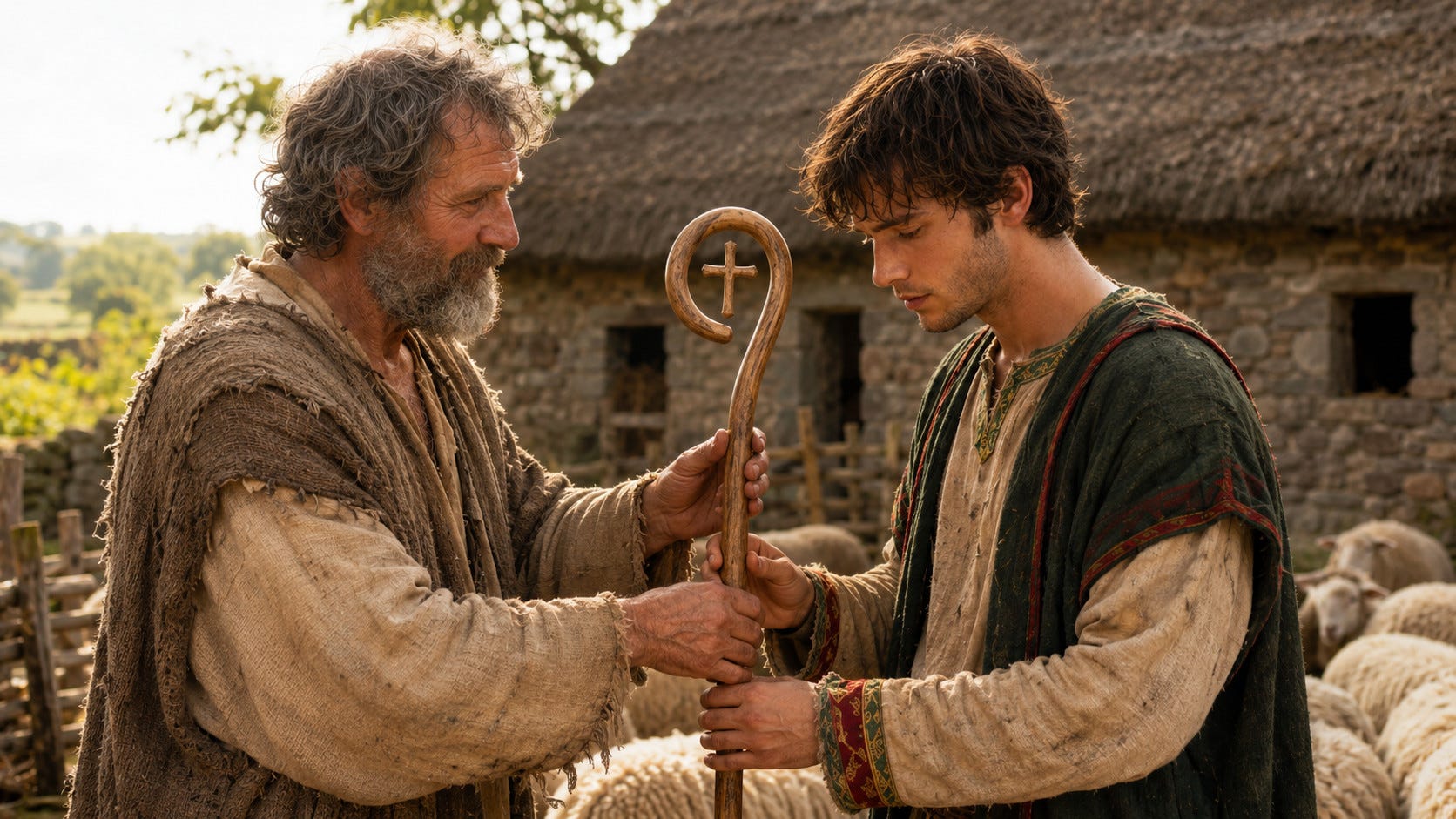
A few months later, after the river-green had deepened and the days had lengthened, a villager came to Calpornius’s yard with a gift. Not gold. Not praise. A thing made by hands that smelled of sheep and smoke. A shepherd’s crook.
It was plain wood, sanded smooth where palms would grip it, but the top had been carved into a simple cross inside the hook. Not ornate. Not Roman. A rough borderland cross, honest in its austerity.
The man offered it with eyes down, as if giving something to Patrick felt too close to prayer. “In thanks,” he muttered. “For the children.”
Patrick took it and felt the weight settle into his hand. He should have refused. He didn’t. Because he understood the gift for what it was: not a trophy, but a trust.
From that day, people began to see him walking with it. Along the lane. Near the river. At the edges where children ran.
Some smiled when they saw him, soft, grateful smiles. Some looked away, as if the sight reminded them too sharply of who hadn’t returned.
Patrick let them look. He kept walking. He told himself the staff was only wood. He told himself the cross was only a carving. But he could not deny the strange steadiness it gave him, like a boundary drawn in his own hands.
And at night, when the house slept and the river moved unseen beyond the walls, Patrick would sometimes wake with the taste of fear in his mouth and the feel of the crucifix against his chest, and he would lie very still, listening for something he could not name.
Because after the riverbank, something in him had shifted. Not outwardly. Outwardly he was still the returned captive, the slow student, the young man who played games with children and took correction like a discipline.
But inside, the silence had changed. It no longer felt empty. It felt… waiting.
A Call in the Night
Patrick woke like a man pulled upward by the throat. Not gently. Not gradually. One moment darkness held him, and the next his eyes were open and his body was rigid, breath caught in his chest as if the room itself had shouted his name.
Silence.
The house lay silent around him, Aelia’s soft exhale from the sleeping corner, Calpornius’s deeper rhythm, Darerca turning once and settling again. No one else stirred. No feet. No latch. No raiders. Only the Clyde beyond the walls, moving unseen in a steady rhythm.
Patrick lay very still, listening hard enough to hurt. His heart beat like a fist against his ribs. He tasted iron on his tongue as if he’d bitten it.
Then he realized what had woken him. Not sound in the room. Sound inside him. A pressure, like a hand on the mind. He closed his eyes and the darkness behind them was not empty.
It was crowded.
Voices brushed the edge of his hearing, layered and urgent. Not Latin. Not Brittonic. Irish, rawer than the Irish he’d heard on roads, not the casual tongue of traders, but something that carried grief like a weight.
Patrick’s breath hitched. He tried to dismiss it the way he had dismissed the first faint warnings days ago. Fatigue. Memory. Guilt finding a voice because guilt always wants to be heard.
But the feeling did not fade. It tightened. As if whatever was calling had patience, and was done waiting for him to find courage.
The shepherd’s staff leaned beside the bed, its carved cross just visible in the thin wash of moonlight. Patrick’s fingers found it without thought. He wrapped his hand around the wood and felt the steadiness of it travel up his arm.
A ridiculous comfort. A piece of wood. And still he held it as if it could anchor him to the world.
The voices rose again, closer now, clearer, pressing through him like wind through reeds.
He heard names. Not names he recognized, but names spoken with the cadence of lament, of calling out across distance, of mothers searching the dark. Then one phrase came cleanly through the murmur, a line that seemed to be spoken directly into his chest.
“We are the voice of the Irish.” Patrick’s stomach clenched.
He sat up, too fast, blanket falling from his shoulders. Cold air hit his skin. He did not feel it. He pressed the staff upright, knuckles white.
“Jesus,” he whispered, not as performance, not even as prayer, but as instinct, the first word that had ever steadied him.
No answer came the way a boy might want an answer to come. No explanation. Only that same pressure, that same insistent nearness.
And then, different now, another voice, single-threaded within the chorus, not loud, not dramatic. A voice that did not plead. A voice that commanded.
Patrick held his breath, because he knew it. He knew the tone. The calm certainty of the God who did not bargain. The words formed slowly, as if being written in him:
“Go back.”
Patrick’s throat tightened until it hurt. Back?
The word brought Ireland like a blade into the room: rope on wrists, wet grass, Miliucc’s fence, the smell of sheep, the scream in the roundhouses, the empty bedroll, the way a boy’s name had been broken and made into something smaller.
Back meant danger. Back meant the sea. Back meant the possibility, nay, the likelihood, of being taken again and made an example.
His body reacted before his mind could argue. His hand tightened on the staff. He fought the urge to curl in on himself like he had done in the holding place, like he had done as a captive, making smallness into shelter.
He forced himself to breathe. The house was still asleep. If he woke them, Aelia would cling to him and beg. Calpornius would demand reasons and plans. Darerca would cry and call it unfair and be right.
And the voice, whatever it was, would still be there when the tears were done.
Patrick swallowed hard. He tried to speak into the dark, voice low so it would not carry. “Lord, Why?” he whispered.
No answer. Only the chorus again, faint now, like water behind a door, names, cries, an ache that was not his and yet pressed against his ribs as if it had moved in. Patrick squeezed his eyes shut.
And then he saw, not with his eyes, but with the same inward sight that had shown him the ship, the shape of a coastline, the black line of water, and beyond it, fields he knew too well.
He saw children. Not faces. Shapes. Small bodies moving in the dark the way his friends had moved. He saw hands reaching and rope.
He jerked his eyes open with a gasp, hand flying to his mouth to keep the sound from waking the house. His whole body trembled.
This was not a story he could turn away from by pretending. This was the same kind of call that had driven him out of Ireland. Only now it did not offer escape. It commanded: return.
Patrick sat in the dark, gripping the shepherd’s staff like a lifeline, listening to his family’s sleeping breaths, and felt something in him split open, fear on one side, obedience on the other.
He wanted to stay, to be a son. He wanted to be ordinary.
The voices did not care what he wanted. They waited. And the waiting itself felt like a test.
Patrick lowered his head until his forehead touched the wood of the cross carved at the staff’s top.
In a whisper that was almost nothing, he said the only honest words he could find, words that did not pretend he was brave: “If this is You,” he breathed, “you will have to make me able.”
The house remained still. The night remained dark and the pressure in his chest did not leave. It settled, patient and inevitable, like a hand that would not let go. Patrick understood with cold clarity that the next journey would not begin with a plan.
It would begin the way the first one had begun, with a command that refused to be ignored.
And while he still trembled, the first pale light began to thin the darkness, the house shifting as sleep loosened its grip as daybreak approached.
Author’s Note (Part XIII):
Patrick has heard the call, now the Church must weigh it. Part XIII turns from escape to obedience: not “go,” but “wait,” not impulse, but formation.
In the next part, the question isn’t whether Patrick can return to Ireland, it’s whether he can bear what returning will demand.
can't wait till the end. Although I think I know what is going to happen. Excellemt