Stand, Don't Bend
It isn't if you win or lose but how and why you fight the fight.

This is a fictional story inspired by my recent philosophical essay Bullies Everywhere — how they operate, why they thrive, and what it truly costs to stand against them. “Stand, Don’t Bend” follows one man across the stages of life as he faces those who wield power through fear, yet he chooses, again and again, not to bow. It’s not a story about victory, it’s a story about refusing to become like them.
There is a kind of war that never ends. Not a war with guns. But with laughter, whispers, orders barked from behind polished desks, and laws passed in hushed chambers. It starts on playgrounds, festers in break rooms, and blooms beneath parliamentary lights. This is the war of the weak against the wickedly powerful. But every war finds its saints.
The Schoolyard
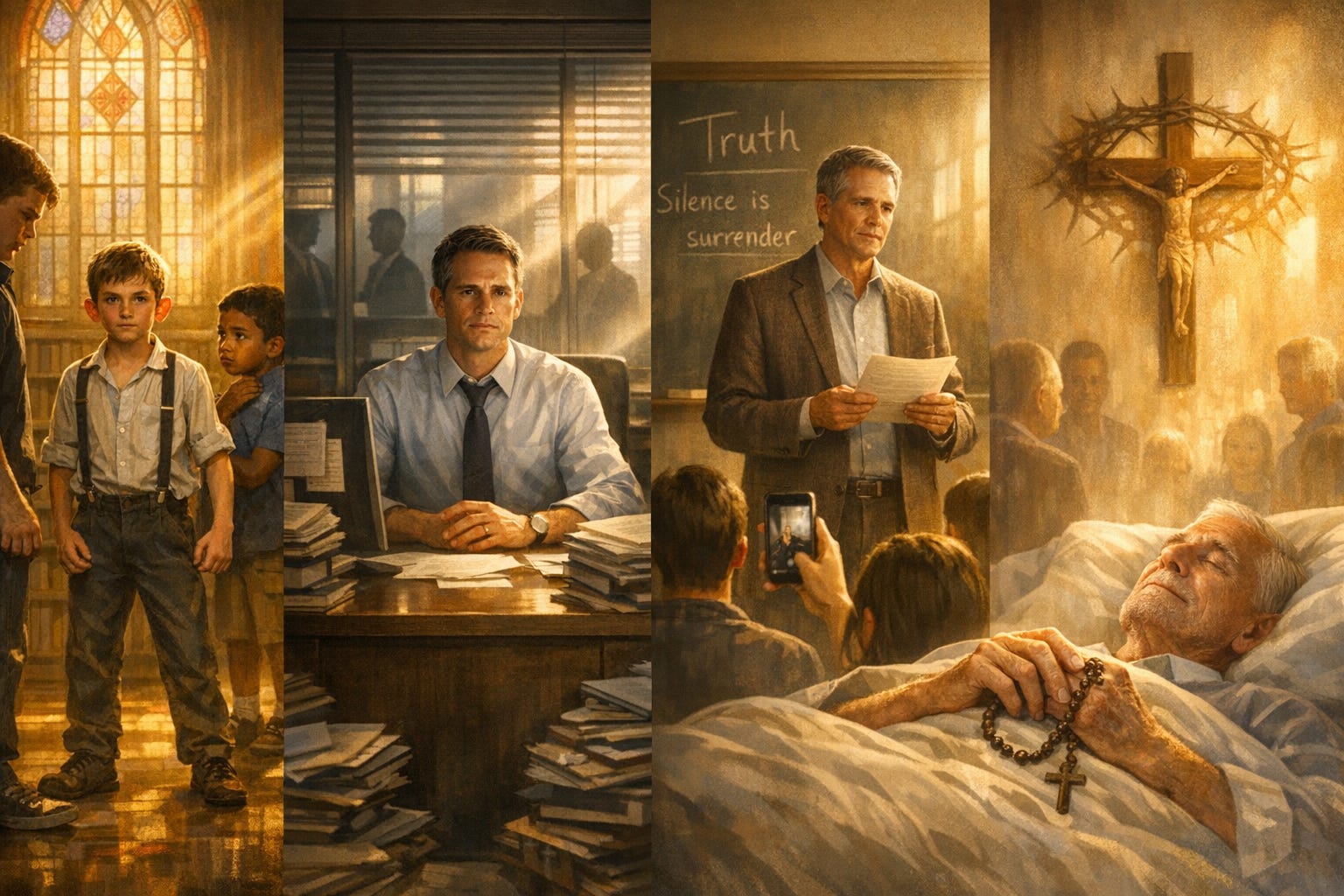
It began with Thomas Reilly, age ten, shoes scuffed, faith freshly inherited from his mother’s lips each morning at Mass. A wiry boy with too-large ears, Thomas learned early that quiet wasn’t protection. The bigger boys smelled different. They hunted the meek like it was a sport God had forgotten to outlaw.
At St. Michael’s Primary, bullying wasn’t loud. It was systematic. Brian Trent, the son of the school board’s chairman, ruled like a boy-king. He never threw punches, he delegated them. The teachers turned their eyes to heaven, pretending blindness.
Thomas could have stayed safe. Lowered his head. Laughed when they mocked Lucy Fields’ stutter. Let them smear chalk on David Mendez’s locker, knowing he wouldn’t speak up. Just go along.
But one Tuesday, with sunlight piercing the old church windows like God’s own fury, Thomas refused. Brian Trent had cornered David in the library and told him he wasn’t “Irish enough” for a Catholic school. Told him brown boys belonged somewhere else.
Thomas could have walked away, let David take the punishment for a change. He could have been safe. But he knew that would make him an accomplice, not of Brian’s, but of David’s suffering. With an internal sigh, Thomas walked over and stood between them.
Thomas didn’t swing. He just stood. That was worse. Because it was defiance without desperation. In that moment, by the look in their eyes, Thomas realized that made them afraid.
David took the opening and fled. Brian and his follower’s laughter curdled into venom. Thomas walked away with bruises and a week’s detention, but David walked free.
That night, Thomas knelt by his bed and said, “God, don’t let me be afraid to bleed. Not for what’s right.” His mother kissed his forehead and whispered, “There’s no crown without thorns.”
The Office
Years passed. The playground gave way to cubicles.
Thomas Reilly, 29, now wore ties instead of hand-me-downs. He worked at Valent & Rook, a banking firm with glass walls and hollow smiles. Promotions went not to the capable, but to the compliant. He watched Mark from Compliance get the corner office after “adjusting” a few spreadsheets; Thomas got a new stack of pointless quarterly reports and a pat on the back that felt like a punishment. He’d grown tired, but not broken.
The firm had a quiet policy. They encouraged employees to “correct inconsistencies” in client reporting. It was fraud with a PowerPoint presentation and an espresso machine.
The day eventually came when Thomas was asked directly to adjust the numbers for their accounts. Thomas refused. His supervisor, Lena Sharpe, smiled like a dagger in silk.
“You’re a good man, Thomas,” she said, sweet as cyanide. “But good men don’t win.”
He was “promoted”, no raise, just a new title and a colder windowless office. The demotion was subtle. His projects were reassigned. His workload tripled. He’d been here before: ostracized and alone. So he complied, because he needed the job, but he withdrew. Quiet. Steady. Invisible.
Like all bullies, Lena and the others mistook retreat for surrender. They judged everyone by themselves, misunderstanding his silence for weakness and fear. Not knowing it was the strength to wait.
But Thomas came in early. Stayed late. Giving them more reason to ignore him. Thomas kept a journal of everything. Not to win, he wasn’t naïve, but because truth has weight, even if no one lifts it with you. And most importantly, the Truth is a protection of its own.
Then came the day a whistleblower hotline opened. He gave them everything, dates, files, instructions in Lena’s own hand.
The fallout was nuclear. Lena disappeared one day, a memo explained Lena had resigned “to pursue other career interests” for “personal reasons”. Other Executives fell too. Thomas never got a raise or praise, no one even suspected his involvement.
But when the auditors called him in, one of them, a young woman with tired eyes, took his hand and said:
“Thank you, Thomas. Without you, so many more people, people without a voice who would have lost everything. You gave it back.”
That night, he sat alone in the pews of St. Cecilia’s and wept, not in grief, but in relief.
Not all crosses are visible. Some are carried in silence with no relief, others until their cross splinters and bloom into justice.
The Nation
His second career, Thomas Reilly, 58, a high school teacher of history and civics at St. Augustine’s, was used to losing small fights. He’d spent close to thirty years teaching teenagers about the Constitution, about truth, about standing in resistance to any form of tyranny even when it’s hard. He’d been mocked, ignored, sometimes hated for it by many students and staff. But he never strayed.
Then came the law. His state was pushing through a new law: the Unity in Education Act.
It was sold to the public as a “neutrality measure,” wrapped in a Back to Basics campaign that, like the word Unity, meant the opposite of what it claimed. The Bill required teachers to avoid “divisive topics,” including faith-based morals, historical injustices, and “personal ideological stances”. In truth, it muzzled conscience, even in religious schools.
Teachers were told to avoid mentioning saints, quoting Scripture, or delving into why some wars were unjust or some acts evil. Of course, exemptions were promised. But in practice, it was the antithesis of patriotism. Clean. Hollow.
His diocese advised and encouraged compliance “until things were sorted”. His colleagues looked away. Thomas refused.
He stood in front of his students and read a letter he wrote the Governor night before:
“If Truth makes you uncomfortable, it is Truth that must remain.
Silence is not neutrality. Silence is surrender.”
His students filmed it. It went viral.
Within a week, he was suspended for dragging the diocese into politics, they called it damage control. The media painted him either a hero or a fanatic. Students protested in quiet. A few teachers followed his example. A group of parents tried to sue.
He knew even if he won he would personally lose. But winning was rarely the point, standing when others won’t or can’t was the point.
The Law was vetoed and failed.
The Final Hour
In the hospice room, decades later, Thomas lay with his rosary clutched between his fingers, worn down to wood grains and whisper-marks.
He had not lived an easy life.
He had not become rich.
He had not been universally loved.
Around his bed, his family sat and prayed with him. And as he drew near the veil, he thought he could see them, the men and women once scorned, once broken, whom he had stood for when no one else could, or would. Not as a hero, but as someone willing to bear the cost of doing what was right.
His godson, a priest, gave him last rites.
“Was it worth it?” someone asked.
Thomas smiled through cracked lips. “It was never about winning. It was about not becoming what they wanted me to be.”
Then, in a whisper, his last words:
“We have to live in the world... but we shouldn’t be of the World.”
The crucifix above his bed caught the light of the setting sun.
Wounds in hands. A crown of thorns. Victory, not in survival, but in standing to the last.
And somewhere beyond the veil, a voice said,
Well done, my good and faithful servant.
The End.