In the Dark Happiness Comes
A fictional story of persecution, prayer, and the presence of God.

The following is a fictional story, inspired by a real saint and a real priest. The saint will be revealed in time. As for the priest, I want to thank him for his strong homilies; especially his homily on happiness, which inspired me to write what follows. I hope you enjoy it as much as I enjoyed that homily.
When the letter came from the chancery, it arrived in an envelope too thin to carry the weight Joseph imagined. The paper was cheap, the seal ordinary, the language practiced, obedience, availability, the needs of the Church. But his hands shook as if he’d been handed a stone from the tomb.
He knew what it contained. He knew he had asked for it; volunteered, even. But now that it was here, he felt a swarm of emotions he couldn’t name cleanly: eagerness braided with dread, gratitude with a strange, childish desire to be spared. The letter felt less like a summons than a mirror, showing him how small his courage still was; how easily his willingness to serve could turn to fear.
He was twenty-nine, a priest less than three years, still learning the geography of other people’s grief. In his first parish assignment back home, he’d grown familiar with quiet sins: the kind that wore clean shoes and arrived early to Mass. He’d learned that boredom could be a venom, and that loneliness often disguised itself as competence.
Now the bishop wanted him in northern Nigeria.
Father Joseph Desiderio read the letter twice, then a third time, as if the words might rearrange themselves into something safer. He set it on the small table by his window and looked out at the city’s autumn trees, their leaves falling without panic, accepting in bright colors what they could not prevent.
He had wanted holiness the way a thirsty man wants water: urgently, even selfishly. He wanted it clean, too; heroic without being humiliated, sacrificial without being helpless.
In seminary, he’d loved the saints with a scholar’s affection. He’d memorized their dates, their patronages, their battlefields. He’d admired the clean lines of their courage. But he had not yet learned that God often draws straight lines with crooked tools, and that He sometimes uses fear as a chisel.
That evening Joseph went to the chapel and knelt until the silence stopped feeling like an empty room. The sanctuary lamp burned steadily, a small red witness.
“Lord,” he whispered, “I want to want this.” Then, softer, as if speaking to the tabernacle itself: “Make me happy in whatever You choose. Not numb. Not distracted. Happy.”
He waited for consolation. What he received instead was a memory: a sentence he’d once underlined in a spiritual classic: Joy is not the absence of suffering, but the presence of God.
He exhaled. “Fiat,” he said. ‘Let it be done’.
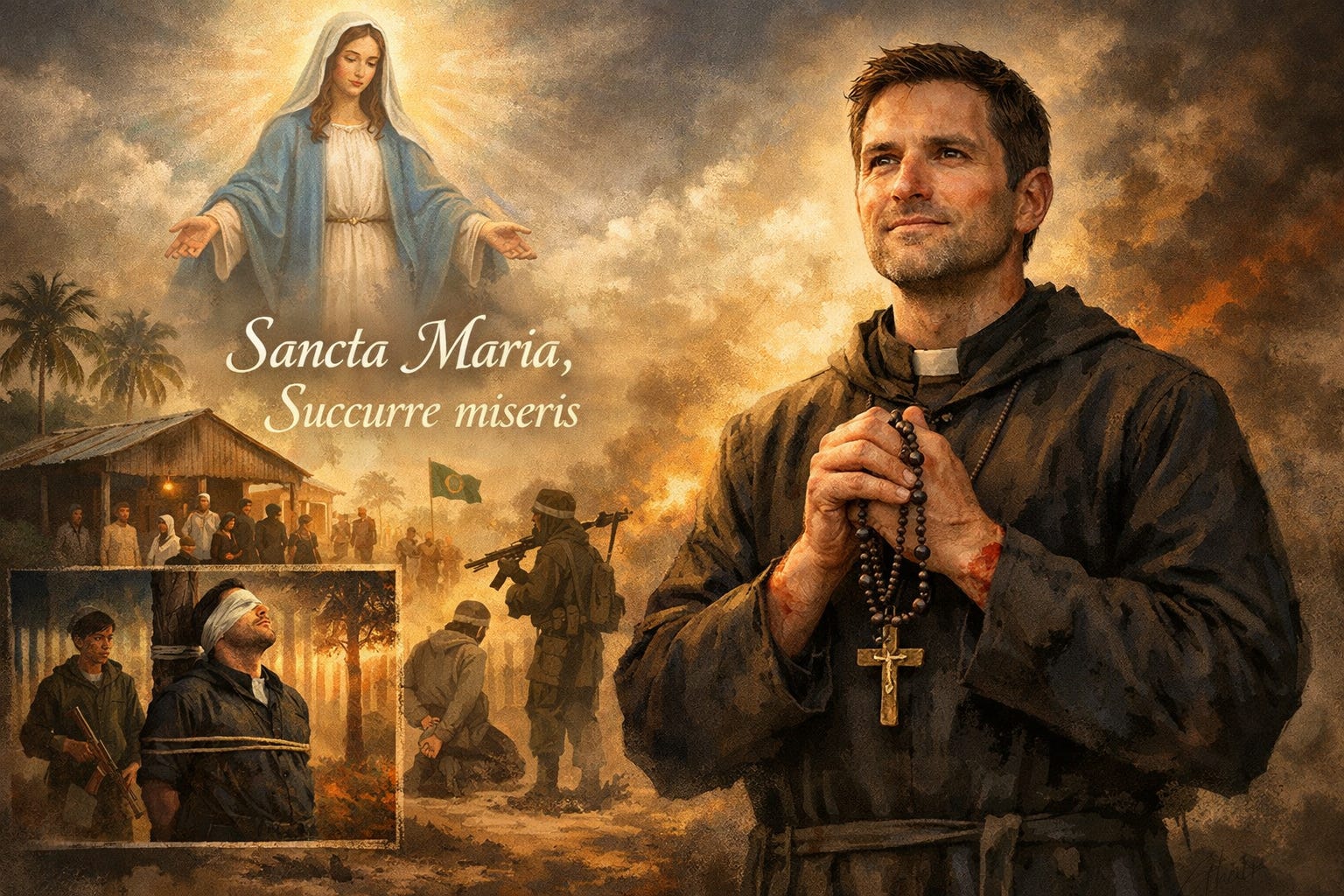
Nigeria smelled like sun-warmed dust and diesel and something green underneath; life insisting itself into every crack of the world. Joseph arrived at the diocese during Harmattan season, when the air carried a dry haze that made the sun look like it had been rubbed with ash. The bishop who welcomed him was small and wiry, with eyes that seemed to hold both fatigue and a hard-earned tenderness. He placed two hands on Joseph’s shoulders as if to test whether the young priest was real.
“You will be safe,” the bishop said, and then, after a pause: “As safe as any Christian can be.”
Joseph was assigned to a cluster of villages near the edge of the Middle Belt, where roads loosened into red earth and the nights grew so quiet he could hear his own breathing. The parish had no stained-glass windows, just open slats and a corrugated roof that sang in the rain. The tabernacle was simple, but people knelt before it with the solemnity of those who had seen what happens when the world forgets God.
His parishioners taught him how to live in scarcity without resentment. They brought him yams and cassava wrapped in leaves. They prayed with their bodies, hands lifted, foreheads pressed to the ground, shoulders swaying with psalms like trees in the wind. Their laughter came quickly, startling and bright. Their grief came quickly too.
At first, Joseph tried to be useful in the ways he understood: organizing catechism classes, repairing roof leaks, learning names, practicing greetings in Hausa until his tongue stopped tripping. He visited families, baptized infants, anointed the sick. He heard confessions by the light of a single candle when the generator failed.
The danger was a rumor that lived in the distance like thunder behind hills. Then one night, it moved closer.
It happened after a weekday Mass. Joseph had just extinguished the sanctuary candles and was locking the sacristy when he heard an unfamiliar stillness, the kind that comes when even the insects pause. A young catechist named Emmanuel stepped into the doorway, his face pale, his breath ragged. “Father,” he said, “they are on the road.”
Joseph’s heart ran ahead of his body. He followed Emmanuel outside. The sky was moonless, a dark bowl. Far away, along the dirt track, headlights appeared, two, then three, stuttering like eyes blinking open. People began to move, quietly at first, then urgently. Mothers pulled children into the shadows. Men murmured in tight circles, hands empty but shoulders squared.
Joseph wanted to say something priestly. Something brave. But his mouth felt full of cotton. He remembered the bishop’s hands on his shoulders. As safe as any Christian can be.
He took a breath and did the only thing that felt honest. “Into the church,” he said. “Bring the children. Bring everyone.”
The church filled quickly, bodies packed close, fear pressurized into a living thing. Someone began the Rosary, the words spilling out like water from a cracked pot. Joseph moved to the sanctuary. The tabernacle seemed to glow faintly, not with light, but with presence.
The trucks stopped outside. Voices, hard, quick, shouted in a language Joseph only half understood. Then banging. A door kicked. Someone cried out. In the back pew, a child began to sob. A mother hushed him, but her own hands trembled. Joseph stepped down from the sanctuary and walked the aisle. His collar felt suddenly like a target. He stopped beside the sobbing child and crouched.
“Look at me,” he whispered. The child’s eyes were wide and wet. Joseph forced his own face into calm.
“Do you see the candle?” he asked, nodding toward a small flame near the altar. The child nodded.
“That candle is telling the truth,” Joseph said. “Jesus is here. That is real. Everything else is a liar.” The banging at the door grew louder.
Joseph stood. In that instant he understood something he had never understood in books: that courage is not a feeling. It is a decision you make while you are still afraid. He turned and went to the door.
They took him without a word; fast, practiced, violent.
Three men with covered faces and rifles moved like they’d done this many times. Joseph saw Emmanuel step forward, mouth already forming a plea, and then a rifle butt snapped into his chest. Emmanuel hit the ground hard, the sound of his body on dirt louder than the shout that followed.
Joseph’s breath caught. He half-stepped toward Emmanuel, hand lifting, small, almost absurd, saying “Please Don’t” until a muzzle found his face.
The men grabbed Joseph’s arms and dragged him outside. The night air hit him cold. He tried to keep his feet under him, not to fall, not to give them the satisfaction of his clumsiness. Joseph looked back once. He saw faces in the doorway, a constellation of fear. He raised his free hand, palm outward, as if blessing them through darkness.
They twisted his arms behind him and bound his wrists. Dust rose around their boots. Emmanuel groaned once, trying to push himself up, and Joseph saw the catechist’s eyes, shocked, apologetic, as if he had failed. Then they blindfolded him.
“Father!” someone called from the church, a woman’s voice breaking on the word like glass.
Joseph was thrown into the back of a truck. He heard one of the men yell for everyone to hear, “If you follow,” he said, “we come back for the children since they are so brave.” The engine roared. The world jolted forward. Dust filled his mouth and nose. Joseph’s hands were tied behind him. His shoulder screamed where it had struck the metal. He began to pray, not elegantly, not in sentences, but in fragments that felt like clutching the edge of a cliff.
Jesus. Mary. Help.
The truck bounced along dirt roads, then onto something rougher. Hours passed without shape. Joseph’s body became a list of aches.
Eventually they stopped. He was pulled out, led by force over uneven ground. Voices around him. A smell of smoke. A baby crying somewhere far away, which made no sense in a place like this and yet made perfect sense in a world where suffering traveled freely.
They shoved him down onto the earth. The blindfold was ripped away. A camp emerged in the dim pre-dawn: makeshift shelters, scattered fires, men sitting in loose circles with weapons across their knees. To one side, under a torn tarp, Joseph saw what looked like a group of captives, women and men huddled together, some with wrists bound. One of them, an older man with a bloodied lip, lifted his head and stared at Joseph as if seeing an apparition.
Joseph’s throat tightened. Galley slaves, his mind supplied, absurdly, an image from history, chained men rowing under whips, bodies owned by cruelty. He had read about saints who went to them, who carried Christ into those human furnaces.
Now he was here, in a modern furnace, and his cassock might as well have been a flag. A tall man approached, his face uncovered. His eyes were sharp, watchful, not crazed. He looked Joseph up and down like one appraises a tool.
“You are priest,” the man said in English.
“Yes.”
The man smiled without warmth. “Then you will help us.”
Joseph’s stomach dropped. He knew the shape of the demand before it came: statements, propaganda, conversion theater, ransom leverage.
“I serve God,” Joseph said, and surprised himself with the steadiness of his voice.
The man’s smile vanished. “You will serve who is stronger.”
Joseph thought of the tabernacle. Thought of the candle telling the truth. “You are not stronger,” he said quietly. “You are only louder.”
A hand struck him across the face. The blow rang in his skull. The world flashed white.
He tasted blood. The tall man leaned in. “We will see.”
Days became a kind of dark liturgy. Joseph was kept with the other captives under guard, sometimes tied, sometimes not, but always watched. They gave him little water, little food. Sleep came in shallow waves.
But the camp held captives, and captives held stories, and stories drew Joseph like gravity.
When he could, he talked to them. At first they stared at him with suspicion, why would a priest be here unless he had collaborated? Joseph sat at a distance, hands visible, and waited. He let his silence do what words could not.
A young woman with a headscarf torn at the edge finally spoke. Her voice was rough. “Are you really a priest?”
Joseph nodded. She laughed once, bitterly. “Then God has come very far to be mocked.”
Joseph looked at her and saw the shape of his own fear in her eyes. “No,” he said. “God has come very far to be with you.”
That night, under the tarp, surrounded by bodies pressed together for warmth, Joseph heard confessions in whispers.
A man confessed rage so hot it frightened him.
A mother confessed despair.
A boy confessed that he had prayed for the kidnappers to die, and then felt ashamed because he remembered Jesus asking forgiveness for His own killers.
Joseph did not give speeches. He gave absolution when he could, and when he could not, when the danger of being overheard made it impossible, he gave the simplest thing he had: presence.
“Hold on,” he kept saying. “Hold on. Christ is here. Not because this is beautiful, but because He loves you.”
On the third night, the tall man returned, carrying a phone. “Record,” he ordered.
Joseph stared at the device.
“Say your church is weak,” the man said. “Say your God has abandoned you. Say you reject him.”
Joseph felt his heart slam against his ribs. The temptation arrived not as a promise of pleasure, but as a promise of relief. Just say the words, and maybe they would stop. Maybe they would let the captives go. Maybe you could bargain. He heard his own breath, harsh in the night.
Then he saw the child from the church, the one who had sobbed. The child was not here, but the memory was. The candle telling the truth. Joseph lifted his head. “I cannot,” he said.
The tall man’s eyes narrowed. “You are stubborn.”
Joseph swallowed, tasting iron. “I am held. But I am not owned.”
The man stared at him for a long moment, then nodded once to another guard.
They dragged Joseph away.
They did not kill him. That was the cruelty: not the finale, but the prolonging. The way a predator plays with prey. They tied his hands above him to a wooden beam between two trees, his feet barely touching the ground. His shoulders burned. The rope cut into his wrists. His arms began to numb, then to scream with returning sensation.
Hours passed. The sun climbed. Joseph’s mind, under the pressure of pain, began to offer him bargains.
Just say what they want. God will understand.
Just survive. You can repent later.
He remembered a line from the Gospel, What does it profit a man to gain the whole world and lose his soul? He laughed, a small broken sound, because what world did he have to gain here? A few more breaths? A few more heartbeats?
But then another thought arrived, quiet, persistent. Happiness is not the world behaving. Happiness is seeing God even when it doesn’t.
Joseph squinted at the sky. It was a hard blue, indifferent and beautiful. A bird passed overhead, its wings beating a simple rhythm. “Creator,” Joseph whispered, voice raw. “I see You. Even here.” He did not feel heroic. He felt weak, frightened, in pain. And yet, in the middle of that, something like peace pressed gently against him, not as an emotion, but as a presence, like a hand laid on his shoulder from behind.
His lips moved, almost without his decision. “Sancta Maria,” he breathed, dredging up Latin from childhood. “Succurre miseris.” Holy Mary, help the afflicted.
He repeated it again, slower. Again. Again.
As the sun lowered, his vision blurred. The camp noises dulled. Joseph drifted toward darkness. Somewhere, close by, he heard a voice, low, unfamiliar.
“Father.”
Joseph forced his eyes open. A young guard stood near, maybe sixteen, his face half-hidden by shadow. He looked terrified, not of Joseph, but of something else.
“What—” Joseph croaked.
The guard glanced back toward the camp, then leaned in. “My mother,” the boy whispered. “She was Christian. She prayed like this.” He touched his own chest awkwardly, as if the sign of the cross had once been carved into his muscle memory.
Joseph’s heart stuttered. “Why are you—” Joseph began, then stopped. There was no time for explanations.
The boy’s hands trembled as he reached for the rope knot. “They will kill you in the morning,” he whispered. “I cannot—” His voice broke. “I cannot have that on my soul.”
Joseph felt a strange tenderness, fierce and sudden. A boy with a gun, frightened of hell because he still believed in it. “Listen,” Joseph said, forcing clarity into his voice. “Your life is not over. Do you hear me? God is hunting you with mercy.”
The boy’s eyes filled with tears he wouldn’t let fall. The knot loosened.
Joseph dropped to the ground, knees buckling. Pain exploded through his arms as blood returned. He bit back a cry.
The boy grabbed Joseph’s shoulder. “Go,” he hissed. “Go that way now.”
Joseph staggered, half-falling, into the darkness between trees he had pointed him towards. The air smelled like earth and dry leaves. Every step lit a new ache.
Behind him, the boy whispered—almost inaudible: “Pray for me.”
Joseph turned, but the boy had vanished. Joseph kept moving until the camp sounds faded. He stumbled through brush, through gullies, through night. At one point he fell and lay face-down in dust, breath scraping his throat.
“Jesus,” he whispered into the earth, “You are insane. You love too much.”
He laughed again, and this time the laugh carried something lighter. Not because he was safe, he was not. But because, in that moment, he understood: love was real here. Mercy was real. God was real. And the world’s threats, however loud, were not ultimate.
He was found at dawn by villagers who recognized the torn collar at his throat and made the sign of the cross as if in greeting and disbelief at once. They carried him on a makeshift stretcher. They hid him when they heard distant engines. They fed him water with shaking hands, like giving a sacrament.
When Joseph returned to the parish almost a week later; bruised, thinner, eyes shadowed, people wept as if the dead had walked in. Emmanuel dropped to his knees and pressed his forehead to Joseph’s hand.
Joseph lifted him up. “No,” Joseph said, voice hoarse. “Don’t do that. Praise God.”
The bishop came, eyes full of restrained sorrow. He did not ask Joseph whether he would stay. He asked it differently. “Can you still love them?” the bishop said quietly. “The ones who did this?”
Joseph stared at the tabernacle, at the same small candle flame. His arms still hurt when he lifted them. His nightmares had begun like stray dogs circling the edge of sleep.
He thought of the boy’s trembling hands. The boy’s whisper. Pray for me. He felt the old desire rise up, desire for safety, for softness, for a life that didn’t require bleeding. Then he felt something else: a strange gratitude, like the aftertaste of honest medicine.
“Yes,” Joseph said slowly. “Not because I am strong. Because Christ is.”
The bishop nodded. “Then you will understand your mission.”
Joseph did not become fearless. He became faithful.
He learned how to celebrate Mass in a half-built room with a lookout posted at the window. He learned how to carry the Eucharist to the sick like carrying a hidden fire. He learned how to preach without romanticizing suffering, how to say, with a steady gaze, that God does not love pain, but He refuses to waste it.
He spoke often about happiness, but never as a slogan. He spoke of it the way a man speaks of water after surviving thirst. “Happiness,” he told the parish one Sunday, “is not the world giving you what you want. It is seeing God in the world even when it breaks your heart.”
He paused, letting the words settle.
“When you can say, ‘Jesus is here’ even in hunger, even in fear, then no one can steal your joy. They can take your comfort. They can take your plans. But joy… joy is anchored in heaven.”
A woman near the front began to weep. Joseph watched her, and his chest tightened. He did not know her story, but he knew its shape.
After Mass she approached him, holding out a small bundle wrapped in cloth. “For you,” she said.
Joseph opened it. Inside was a rosary, beads worn smooth by hands that had clung to them like lifelines. “I used this when my husband was taken,” the woman whispered. “I thought I would die from sorrow. But Mary… Mary held me. God held me.”
Joseph closed his fingers around the beads. For a moment he could not speak. He looked up at the sky beyond the church slats. Sunlight poured through dust like grace made visible. He thought of the camp. The tarp. The whispered confessions. The boy’s trembling hands.
“Sancta Maria,” Joseph whispered, more to himself than to her. “Succurre miseris.”
The woman nodded as if she understood. “Yes, Father,” she said softly. “Help the afflicted.”
Joseph tucked the rosary into his pocket.
Outside, children chased each other in the dirt, laughing, their feet kicking up small storms. Somewhere a rooster crowed, proud of the day. Somewhere a motorcycle backfired, and people flinched and then breathed again. Life continued, fragile, luminous, stubborn.
Joseph stood in the doorway of the church and watched his people. He felt the ache in his arms, the memory of ropes. He felt the ache in his heart, the memory of fear.
And beneath all of it, like bedrock beneath moving water, he felt God. Not as an idea. Not as a distant reward. As a presence.
He whispered, almost smiling through the ache: “Thank You,” he said. “Even this. Thank You.”
And then he stepped back into the heat and dust and danger, not because he loved suffering, but because he had learned where true love lived.
Not in the world’s temporary pleasures. But in the God who could be found anywhere, even in the dark, because He had already gone there first.
Author’s note:
This story is fictional, but it intentionally mirrors the reality in parts of Nigeria and key elements traditionally associated with Saint Joseph of Leonessa: a Capuchin priest sent on mission, his ministry to captives, imprisonment, and a deliverance understood as God’s intervention.
Fun Fact: Desiderio was Saint Joseph of Leonessa’s surname!
Sancta Maria, Succurre miseris