Hickory Lane
One Moment, One Choice.

Here’s a fictional story inspired by real case file from 2005, with names, places, and details changed to protect real people. It’s meant to explore the ideas of escalation, self-control, awareness, and the terrible cost of a single moment.
The Porch on Hickory Lane
The night it happened, the air had that late-summer bite, warm enough to keep the windows open, sharp enough to make every laugh sound louder than it should.
Hickory Lane was one of those roads that looked peaceful in daylight: clapboard houses, porches with tired steps, a few trailers tucked back where the trees thickened. At 2:00 a.m., though, it became a different world. A world made of porch lights, beer cans, and old grudges with fresh teeth.
Inside the Kettle House, Mara Kettle’s place, everyone called it that, music thumped like a heartbeat. Someone had put on a playlist that jumped from country to rap to rock with no warning, like it wanted to start a fight with itself. People drifted in and out of the doorway, half in the house, half in the night.
That’s where Jay Calder stood, quiet, thick-shouldered, thirty-something, the kind of man who looked like he’d learned long ago that words didn’t carry any weight unless you were willing to back them up with your fists. Jay didn’t dance. He didn’t sing. He watched and waited.
Across the room, Tess Larkin, twenty, fast-talking and sharp-eyed, poured drinks like she was dealing cards in a game she meant to win. She had the restless energy of someone who couldn’t stop moving unless she was asleep, and even then, you got the sense she argued in her dreams.
Outside, on the road, three young men walked by, their laughter bouncing off the trees. Two of them started in immediately, hoots and comments, the kind that weren’t jokes unless you were the one telling them.
The third, Eli Granger, lingered half a step behind, his hands up like he was trying to push the night back into calm. “Come on,” Eli told his friends. “Not here. Not tonight.”
But the words were already lit.
From the porch, someone shouted back. It wasn’t even a clever insult, just something mean enough to hook pride and drag it toward the door. The two friends bit hard. They slowed. They turned. They stepped closer.
And suddenly there was that invisible line, everybody knows it, nobody sees it. The line that says this can still be nothing, until somebody crosses it.
Tess stepped down from the porch with a beer in her hand, smiling like she could smooth everything over with a little friendliness. She held the bottle out toward Eli.
“Peace offering,” she said. “For the guy trying to keep his idiots on a leash.”
Eli laughed, relieved. “Thank you,” he said, and he reached for it. That’s the moment people argue about later. Some say Jay came out of nowhere.
Some say he’d been pulled outside, pushed outside, told to “do something” like he was a tool left in a drawer too long.
Some say Eli never saw him coming. Some say Eli did, just too late.
What’s certain is that the air changed. The porch light made everyone look harsh and yellow. The music inside kept going, ignorant.
Tess felt it before she understood it: the shift in the night that means this isn’t words anymore.
“Jay!” she snapped, because Jay was suddenly there, shoulder-to-shoulder with her, and his eyes were hard, not drunk-hard, but something colder, fear dressed up as anger.
Eli’s friends were now in the yard, and one of them said something about “teaching respect.” The other laughed like it would be funny if someone bled. Eli turned toward them, palms out. “Stop,” he said. “Both of you. Just stop.”
And then it was chaos. Not the cinematic kind, not choreography, not clean. The ugly kind. Shoves. Curses. Feet slipping on gravel. A shoulder slammed into Tess and she stumbled back, furious.
Jay got pulled into it like a jacket snagged on a nail. A fist caught him, whether it was meant for him or meant for someone else, no one could agree later. He staggered. Something hard clipped his shoulder. He heard himself grunt and hated how small it sounded.
He swung back. Somewhere in that tangle, Eli, still trying, still insisting on being the dam holding back a flood got struck. He didn’t fall, but his expression changed.
It’s a terrible thing, watching a peacekeeper become a fighter. Because when a person who doesn’t want to fight starts fighting, it’s rarely about winning. It’s about surviving the feeling of being helpless.
Eli stepped in, too close, trying to separate bodies with his own body, his chest and arms becoming the barrier. And barriers get hit from both sides. A blow landed on Jay’s throat. He coughed. Spit flew. Pain flashed white-hot and panicked.
Someone shouted, “He’s got a stick!”
Jay saw a shape rise, club-like, maybe a chunk of wood, maybe something else. His mind grabbed onto it the way drowning hands grab any rope: Weapon. Threat. Danger.
He shoved away, stumbled off the porch, landed hard in the yard. The world tilted. Gravel bit his palms. He got up and ran.
Behind him, footsteps, one set, maybe two. Shouts, laughter, anger, adrenaline.
Jay ran past the Kettle House, past the next yard, and ducked behind a trailer where the grass was tall and the shadows were deep. He pressed his back to the metal siding. His chest heaved. His throat burned. His arms hurt where something had struck him.
This is what you do, a voice inside him said, maybe his father’s, maybe his own. You leave. You get away. You live.
Then another voice arrived, louder. You can’t be hunted.
He found the knife in his pocket like it had been waiting there forever. He didn’t remember putting it there. He didn’t remember when his hand decided it.
In the darkness, Jay listened. Footsteps slowed somewhere nearby. A voice said something that might have been Eli’s, calm, frustrated, pleading. “Just go home,” Eli said. “Enough. Everybody go home.”
For half a breath, Jay’s fear loosened. He almost believed it was over. Then something hit the trailer. A loud slap, like a palm or a fist. Someone’s laughter cracked the air.
Jay gripped the knife. And then, because the world is cruel and fast, bodies shifted again, and Eli stepped into the wrong place at the wrong time.
Maybe he didn’t see Jay in the shadows. Maybe Jay didn’t see Eli as Eli anymore.
Maybe, in that blink of panic where thought collapses into instinct, Jay saw only someone coming closer.
The next part was over in less time than it takes to say don’t.
A lunge. A gasp. A bright, shocked silence, like the night itself couldn’t believe what had happened. Eli staggered back toward the porch, one hand pressed to his chest. Tess screamed his name. Someone yelled for an ambulance.
Jay stood frozen, the knife suddenly heavy, ridiculous, impossible. “I did it,” he heard himself say. Not proud. Not defiant. Just… stunned. Like confessing to gravity.
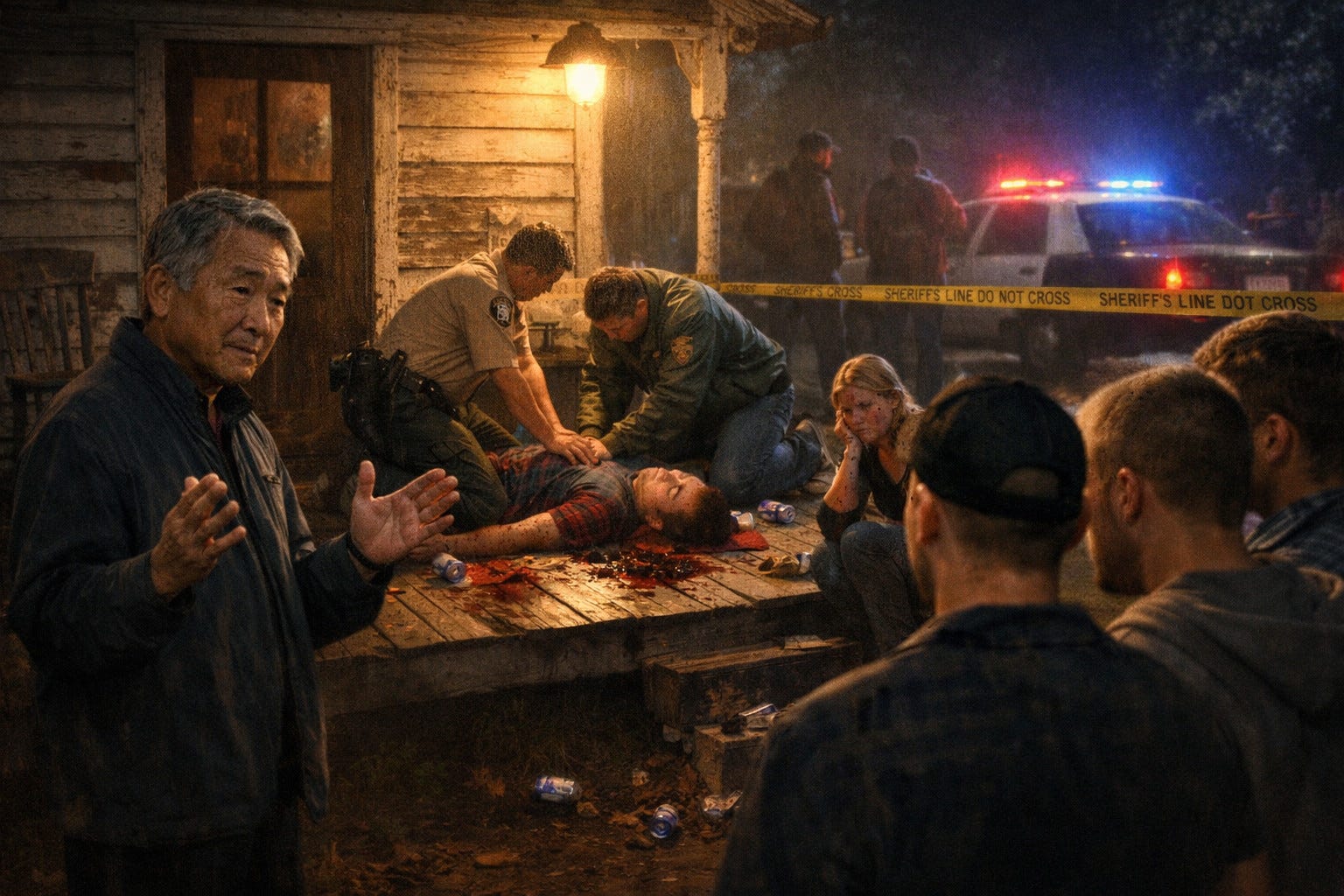
When the deputies arrived, the porch boards were slick with spilled beer and something far more precious. They tried to bring Eli back. They pushed air into him, pressed down on his chest, called him by his name as if naming him could anchor him to the world. It didn’t.
In the days that followed, the town split the way towns do:
Some said Eli was an innocent peacemaker, stabbed for nothing. Some said Jay was attacked, cornered, terrified, and did what any animal does when it thinks it’s about to die. Some said Tess had pushed Jay off the porch. Others said Tess was the only one trying to stop it. Some swore there were clubs. Others swore there weren’t.
Three stories. One porch. One dead boy. And the truth, whatever it was, sat somewhere between them, too heavy for anyone to lift cleanly.
At Eli’s memorial, Mr. Sato stood in the back row with his hands folded in front of him, the way he’d taught Eli to stand at the beginning of every class. He ran a small dojo behind the laundromat, mats that smelled faintly of soap powder, a bell over the door that always stuck in winter.
He didn’t speak during the service. He just watched the family, watched the grief move through the room like weather, and listened to the stories people told themselves so they could keep breathing.
Afterward, in the parking lot, a few of the younger guys from Hickory Lane hovered by the cars, the ones who’d been there that night, the ones still wearing the same hard faces like armor. They noticed Mr. Sato because Eli used to talk about him, because some of them had taken a class or two when they were kids and their mothers were trying to keep them out of trouble.
Mr. Sato walked up slowly, not cornering them, not challenging them, just entering their space the way you enter a ring: with respect for the danger.
“I can’t undo it,” he said softly. “But I can tell you where it started.”
They looked at him, suspicious and exhausted, still angry at the world for being the kind of place where someone dies on a porch. He lifted his hardened hands, open palms, no fists.
“Everyone thinks self-defense is what you do with your hands,” he said. “Most of it happens with your feet, whether you walk in, or walk away.”
He let the silence do its work.
“Control,” he went on. “First of yourself. Then your distance. Then your choices. If you can leave, you leave. If you must speak, you speak from a safe place. If you try to be the bridge between two fires, you will burn.”
One of the boys swallowed hard. “So what should Eli have done?” he asked.
Mr. Sato’s gaze softened. “He did what good people do,” he said. “He tried to make peace.”
He paused, and for a moment his voice went quieter, not weaker, quieter.
“But good intentions don’t replace awareness. And courage doesn’t cancel physics. Sometimes the bravest thing isn’t stepping between two people. Sometimes it’s stepping back, calling for help, and refusing to let chaos recruit you.”
“And the other guy?” someone asked, meaning Jay.
Mr. Sato exhaled. “Fear is real,” he said. “But fear doesn’t make you innocent. If you escape danger, you don’t return to it. If you hide and you’re safe, you don’t go looking for a final moment to prove something.”
He nodded once, toward the road, toward the invisible future already closing its fist.
“Now he’ll spend the rest of his life explaining one moment,” he said. “A life sentence can be a courtroom thing. It can also be what you carry. A debt you’ll never repay, years you’ll never get back, and sleep that never comes.”
He let that sit. “And everyone who was out there that night… you’ll carry a piece of it. That’s how it works.”
No one argued. Not then. Because even if the stories couldn’t agree, the ending was undeniable.
A porch light still buzzed over Hickory Lane. And one young man’s name had become something everyone spoke with regret.
Moral
A conflict doesn’t care who “meant well.” If you step into chaos without control and awareness, you become part of it—and sometimes you become its price.
The strongest move is often the one that prevents the fight: keep distance, keep clarity, and leave when you can.
A Valuable story for everyone to read and remember.