et Labora Response
A Christian Reflection on Work, Ambition, and Consecration

My friend’s poem ...et Labora wrestles with a question most people feel long before they can articulate it: what am I supposed to do with my life, and what is work actually for? Its answer is sharp, lyrical, and morally serious. But reading it, I found myself drawn to a question just beneath it, not what profession fits a man, but what kind of heart he brings to the labor placed before him.
That is where this reflection begins.
The poem asks what work is “fit” for a man, and the question itself already reveals a modern anxiety: our habit of measuring worth by occupation. We are always trying to justify ourselves by what we produce, earn, build, manage, or become. But for the Christian, labor is not the measure of life. It is one of the means by which life is lived and offered back to God. We work to live, not live to work. The dignity of work lies not in its prestige, nor in its results, but in the spirit with which it is received and given.
The man who digs ditches, the mother who tends children, the writer who wrestles with sentences, before God, these do not belong to separate moral worlds. Their tasks differ outwardly, but each is given the same hidden possibility: to sanctify ordinary hours through love, patience, fidelity, and gratitude.
The man who makes a god of career often sacrifices the living of life itself; his family, his prayer, and his interior peace, on the altar of ambition. But the one who keeps work in its proper place becomes free enough to find God in every task, whether it is praised by the world or utterly unseen.
That, at least, is the principle. The difficulty comes in the living.
It is easy to speak of offering our labor to God when the ditch gives way, the child is sweet, or the words come readily. It is much harder when the shovel strikes stone, when the child is impossible, or when the page goes cold and blank. In those moments, our instinct is rarely saintly. We do not naturally welcome the cross. We resent it. We tense against it. We mutter, complain, perhaps curse, and often turn our irritation upward, as though God Himself had wronged us by allowing the task to become hard.
And that is often the moment when the deeper work begins.
Because the stone in the ditch, the spoiled child, the writer’s block; these are never merely interruptions. They are revelations. They expose how much of our peace depended on comfort, how much of our patience depended on ease, and how much of our charity depended on things going our way. We discover, often painfully, that we were willing to offer our labor to God only so long as it remained manageable, fruitful, and agreeable.
Then grace, if we do not shut it out, does something humiliating and merciful at once: it lets us see ourselves. We see the selfishness in our anger, the childishness in our outrage, and the pride beneath our frustration. We hang our heads, ask forgiveness, and bend again to the burden we had just cursed. That moment, more than the smooth and successful hour, may be the more holy one.
Because the Christian life is not proved by never recoiling from the cross. It is proved by returning to it after we recoil, and taking it up with greater humility.
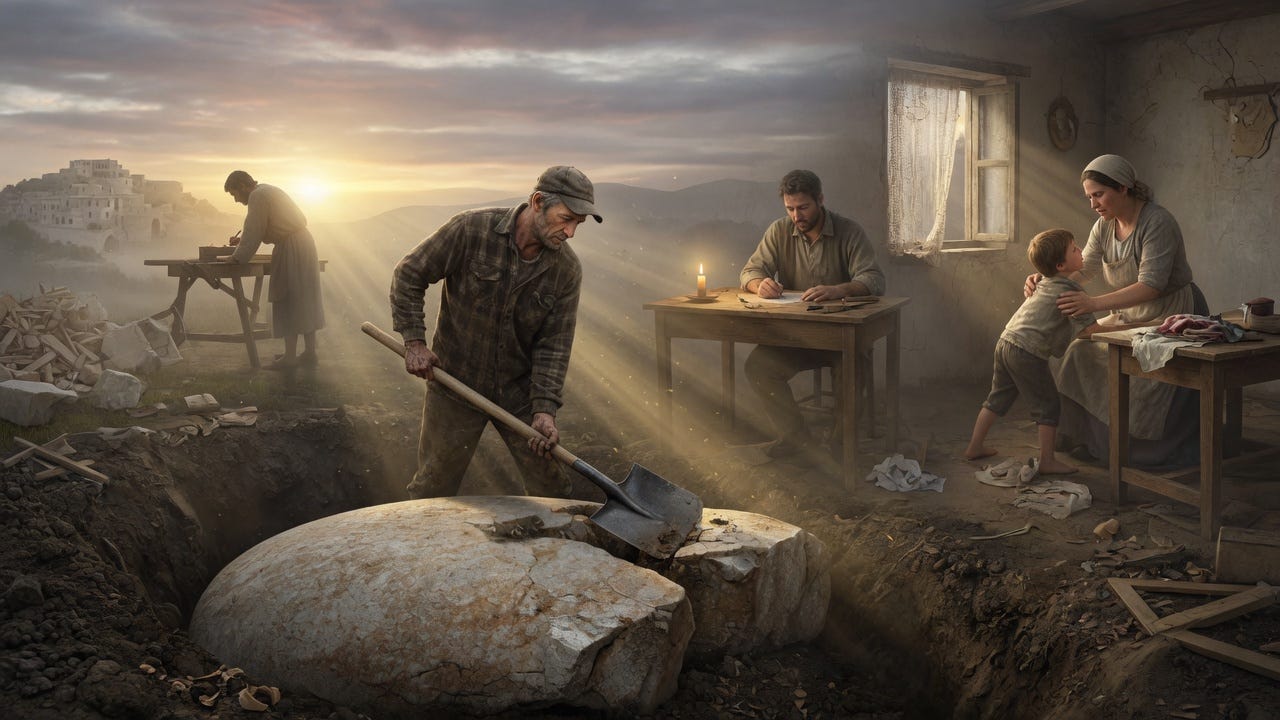
And from experience, this much is true: willing acceptance makes the burden lighter than rebellion ever will. Gnashing of teeth only leads to more gnashing. Resistance multiplies the weight of what must already be borne. But when a man stops fighting the task, when he receives it instead of raging against it, something changes. Not always the work itself, but the soul within it. Peace begins where resistance ends.
The world teaches ambition. The Gospel teaches consecration.
To labor in the right spirit is to join the carpenter of Nazareth at His bench. It is to let toil become prayer, interruption become purification, and burden become offering. No task is vain if it is given to God. No calling is trivial if it is filled with charity. And sometimes the holiest work a man does is not the work that succeeds, but the work he takes up again, chastened and quieter, after first refusing the cross.
It is important to distinguish vocation from talent. In the Christian sense, vocation is not an endless field of self-invented possibilities. Broadly speaking, it is a call to holiness lived through a concrete state of life: marriage, religious life, priesthood, or the celibate life in the world. Given this, a man’s vocation is not simply the sum of his abilities, ambitions, or professional possibilities, but his call to holiness through the life God has given him. Talents are real gifts, and they should be received with gratitude and used with responsibility. A profession may serve that vocation, and talents may enrich it, but neither is identical to it.
Nor can every talent be fully pursued, nor does every unrealized gift mean a life wasted. Duties, limits, sacrifice, family, poverty, illness, and circumstance often shape what can actually be done. Sometimes a talent is exercised directly; sometimes it is laid down for the sake of a higher fidelity, such as marriage and family. That matters, because once talent gets confused with vocation, people begin to think that if they are not fully developing every gift in some visible or impressive way, they must be failing God. That is a modern burden, not a Christian one. What the world calls lost potential may, before God, be a hidden offering.
The deepest question is not what profession I should choose for my life, as though my worth depended on it, but what kind of heart I will bring to the work, duties, and opportunities God has placed before me. Those things are not outside discernment, of course, but for many people necessity, timing, and circumstance shape much of them already. The deeper question is not what work will make me important, or even happy, but whether I will meet what is given with humility, charity, and fidelity.
Discernment is good and necessary. But if we are not careful, the search for the perfect path can become another form of self-will. Life is not always given as a clear map, but as the next step of fidelity. “Thy will be done” teaches us to stop staring at the road we imagined and to receive the one before us. And it is often there, on the twisted and rocky path we would not have chosen, that God hides His best gifts.