Catholic Conflicted
A Conversation in an Age of Confusion

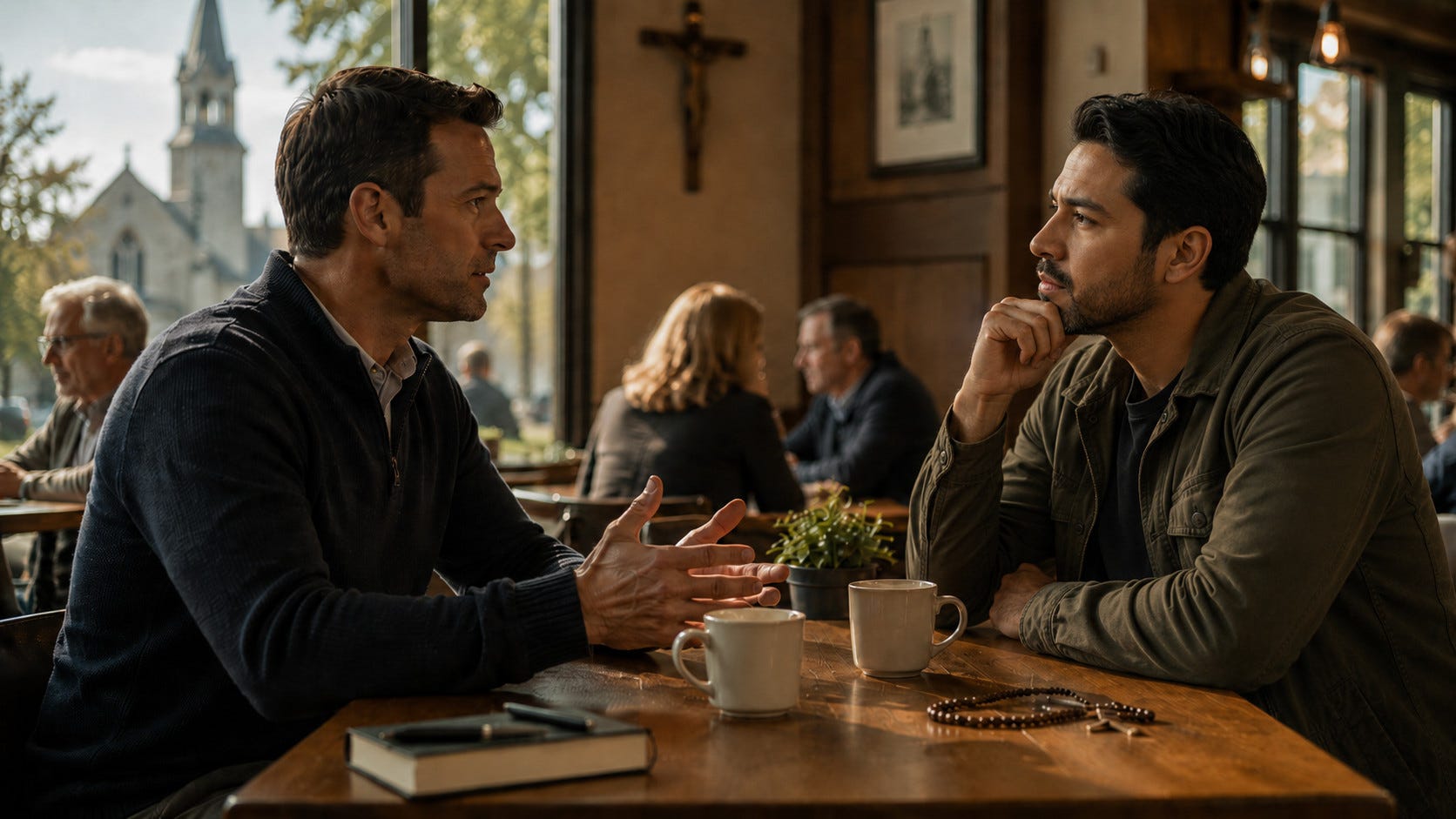
Before the Conversation
Consider, for a moment, two Catholics standing in the same wounded house.
Both smell the smoke. Both see what has been broken. Both hear voices from the upper floors insisting that the damage is merely renovation. Neither trusts the men holding the blueprints.
One believes the house must be defended precisely because it remains his home. The other believes the house has already been taken, and that fidelity now requires leaving it behind.
The conversation that follows was written before July 1, 2026, when the Society of St. Pius X proceeded with the consecration of four bishops without papal approval, and before the Vatican responded the following day by declaring the act schismatic and imposing the gravest of canonical penalties. At the time, this was still a debate about where the road might lead. Now we know that it led somewhere.
The two Catholics in this conversation are not caricatures. Neither is a modernist. Neither is indifferent to corruption. Neither believes the present crisis can be solved by pretending it does not exist. They agree about far more than they disagree about: the loss of reverence, the failure of shepherds, the confusion of the faithful, and the need to preserve what is true.
But agreement about the wound does not produce agreement about the cure. Between them lies a line each believes the other has crossed—a line between obedience and surrender, resistance and schism, preservation and abandonment.
The hour is late. The doors are closing. Two Catholics are about to discover that people can grieve the same Church, defend the same truths, and still walk away in opposite directions.
The question is not which one fears the darkness.
The question is which one has kept oil in his lamp.
Here they are now, still talking.
Michael remains in a Novus Ordo parish, drawn increasingly toward Latin, tradition, and reverence. He sees a wounded Church that must be defended from within.
Thomas has aligned himself with the SSPX. He sees a counterfeit structure from which the true faith must be protected.
Two Catholics. One wound. Two very different ideas of fidelity.
Let’s listen in.
Michael:
I get why you left. Really, I do.
If all you see is corruption, cowardice, weak bishops, confused priests, irreverence at Mass, bishops acting like politicians, and people treating the Church like she’s just another institution to be managed into the ground, and Catholics who seem to believe everything except Catholicism, then yes, of course the temptation is to say, I’m done. The only faithful answer is to get out.
I truly understand that.
Thomas:
Then why stay?
You obviously see the problem. This is exactly why some of us believe this is no longer the true Church in any meaningful sense. Vatican II gave us a counterfeit religion, and groups like the SSPX (Society of St. Pius X) are preserving what the Church used to be.
If the house is on fire, why keep sitting in the living room?
* * *
Michael:
Because if I leave, I hand the house over to the people setting the fire.
That’s really where I’m at.
That is where I think too many Catholics made the wrong move. Not because the corruption was fake. Not because the danger was exaggerated. But because once the serious Catholics left, the people gutting the place had even less resistance.
And I say that as someone who did not grow up with memories of what came before. I only knew the Novus Ordo, same as a lot of Catholics my age and younger. I did not first feel the loss by comparing missals or remembering Latin. I felt it in the irreverence. In the casualness. In the way so many Catholics seemed to believe whatever they wanted and still call it Catholic. As if the Mass were just another optional weekly event.
As my faith grew I read more, found some excellent priests online, and eventually I found a more reverent parish. I listened to my elders complaining about the way things were, how they don’t recognize the Church or Mass. I started to see the bigger picture more clearly, they left and here we are. So by then I knew this: leaving wasn’t the answer for me.
Honestly, leaving would have felt like cowardice.
No offense meant. But I think that needs to be said plainly. So yes, I understand the urge to leave. I just think leaving has costs too.
Thomas:
That’s a strong word. Some people didn’t leave because they were cowards. Some left because they were trying to protect the faith.
But staying could cost your soul or your children’s.
Staying means your children get bad catechesis. Staying makes you part of the problem as your parish gets more worldly and your bishop keeps pushing compromise in the name of pastoral care. At some point staying starts looking less like fidelity and more like Stockholm syndrome.
* * *
Michael:
I know. And I’ll say that clearly: a lot of traditional Catholics preserved things other people let get trampled. Reverence, seriousness, memory, discipline, beauty, clear doctrine. That matters. They deserve credit for that.
But preserving what others allowed to be stripped away is not the same as restoring the Church. That is where I think the split happens.
Because if your answer to corruption is always to gather the serious people and leave, then what happens to the parish? What happens to the school? What happens to the church building? What happens to the kids whose parents don’t know any better? What happens to the Catholics who know something is wrong but don’t know where to start?
They get left behind. And the people wrecking things inherit the whole field. Does that sound right to you?
Thomas:
But that assumes the parish, the school, and the diocesan structure are still meaningfully Catholic in the first place.
That is exactly where I disagree. Vatican II did not just wound the Church. It introduced a new religion wearing Catholic clothes. The old Church was not “stripped down” and waiting to be rebuilt from within. It was displaced. That is why the SSPX matters. It did not leave the Church. It continued what the Church had always been while Rome and the dioceses were busy reinventing it.
So when you say people “left,” I think you have it backwards. They did not leave the Church. They stayed with what the Church had always taught and always done, while the visible structures drifted into something else. And yes, a lot of ordinary Catholics were lied to. They were told all of this was renewal. They were told this was the Church moving forward.
* * *
Michael:
That is exactly the step I cannot take. Because once you say the visible Church became something else, I do not know how you are not also saying the Church failed.
And yes, ordinary Catholics were lied to. I do not deny that. But even saying that, I still think we have to be honest that too many Catholics left the field.
Mine did. My parents’ generation saw far more than I ever did, and when they complain now about the state of the Church, I sometimes remind them: you were there. You saw it happening. And you left.
That sounds harsh, but it is true. A lot of the people complaining loudest now are basically Monday-morning quarterbacks. They know exactly what should have been done fifty years ago, but when the house was being torn apart, they were not standing in the doorway saying no.
They backed away. And that retreat had consequences.
It let irreverence spread. It let catechesis become hollow and modernized. It let weak and corrupt priests go unchallenged. It let perversion find cover. It let beauty be stripped away.
The clergy bear enormous guilt for that, no question. But the laity are not innocent if they flee and stay silent.
Thomas:
So what are people supposed to do? Just stay in bad parishes and get steamrolled?
* * *
* * *
Michael:
Sometimes, yes. At least for a while. Because I’m not talking theory here. I’ve actually done it.
I’ve corrected priests and nuns. I’ve challenged priests after Mass over what they preached. I’ve called out fellow Catholics for their cafeteria-Catholic nonsense. I’ve asked polite questions that got me thrown out of a rectory. I was always respectful and never personal. I always respected the office. I tried to stay with the Truth.
I’m not saying that to sound brave. I’m saying it because none of that made me think, Well, I guess I should leave.
It made me think, This is exactly why I have to stay.
If everyone with a conscience leaves, then of course the place gets worse.
Thomas:
But what if the Church is too far gone?
What if I could prove to you that “The papal pretenders from Paul VI through Leo XIV have taught and acted in flagrant contradiction to the undoubtedly Catholic pre-Vatican II Popes.”1
At what point do you stop saying this is just a crisis in the Church and admit that the faithful remnant may actually be outside the visible Church structure now?
* * *
Michael:
That is where I still cannot go. Even granting the scandal, I cannot grant that conclusion without making the Church fail.
Because once you say the real Church is now somewhere else, once you say the visible Church became another body and the true Church is now found only in scattered enclaves, what are you really saying?
You are saying the Church failed. And I cannot say that.
I agree the crisis is catastrophic. I agree Vatican II was disastrous in practice. I agree reforms were misused, twisted, abused, and weaponized by enemies of the faith. I agree bishops and priests have tolerated or taught terrible things. I even agree there are serious reasons to question a great deal of what has happened.
But moving from “the Church is in a terrible crisis” to “the Church effectively became something else” is a step I cannot take. Christ founded this Church. His Church is His Body. He did not promise us a Church without betrayal, corruption, or cowardice. He promised that the gates of hell would not prevail against her.
Thomas:
Then what are we supposed to conclude when the men claiming to lead the Church openly contradict what Catholics were always taught? At what point does “crisis” become something more than crisis?
* * *
Michael:
I think the moment we appoint ourselves judges over whether the Church has ceased to be the Church, we cross a line Catholics were never given authority to cross. We are not free to declare that Christ’s Church has disappeared and that we alone now know where it really survives.
That is how you slide from resistance into something else.
And yes, before you say it, I know that sounds strong. But private judgment dressed up as fidelity is still private judgment. Protestants did that. Revolutionaries did that. The result is always fragmentation.
We can resist heresy. We can reject false teaching. We can challenge corrupt clergy. We can defend tradition. We can insist on reverence. What we cannot do is act as though we have the authority to re-found the Church by declaring the visible one dead.
Thomas:
So you think the answer is just resistance from within?
* * *
Michael:
Yes. But I don’t mean the fake kind. I don’t mean grumbling online and then doing nothing locally. I mean actual resistance. Formation, presence, sacrifice, and refusing to outsource the fight. Educate ourselves, our families, friends and parishioners where the clergy fail. Speak up respectfully where our faith is violated.
Push back against irreverence. Stop letting people get away with acting like Catholic doctrine is a buffet. Be the Catholic community you keep saying you want. That’s really my point.
So many people talk like they’re waiting for a bishop or pope or movement to come fix everything. But Christ expects us to do the work right where we are. Let me ask this, what does scripture tell us to do in this current situation?
Thomas:
I agree Catholics should know their faith, teach their children, and stop acting like doctrine is a buffet. But you are still assuming the average parish is a place that can be fought for from within.
What if the problem is deeper than weak priests or lazy laity? What if the whole system is training people to accept compromise? What if the bishop, the chancery, the seminary, and the parish programs are all pushing the same sickness in softer language?
Scripture tells us to hold fast to what we have received, to test the spirits, to reject false teaching, and to beware wolves in sheep’s clothing. So I’m asking: at what point does staying stop being courage and start becoming unnecessary exposure to poison?
* * *
Michael:
You’re right that Scripture tells us to reject false teaching and beware wolves in sheep’s clothing. But it does not tell us to abandon Christ or His Church.
When I asked what Scripture tells us to do in a situation like this, I meant: stay close to Christ.
Let me put it more directly: what did Nicodemus do?
Thomas:
I do not think Nicodemus gets you where you want to go.
Nicodemus was before the New Covenant. Before Pentecost. Before the Church as we know it. He was dealing with corrupt leaders in old covenant Israel while Christ was still revealing who He was.
That is very different from saying Catholics today have to remain under men who claim to be shepherds while pushing things that look nothing like the faith handed down. I get the point you are trying to make, but I do not think the analogy is strong enough to carry all that weight.
* * *
Michael:
But I think it does carry weight. The situations are not identical, but the principle is. Nicodemus did not bolt, did not found a rival Israel, and did not treat corruption at the top as proof that God’s people had ceased to be God’s people. He remained faithful to God in the midst of corruption, just as Lot remained righteous in the midst of debauchery.
Neither Nicodemus nor Lot was preserving a mere form. They were keeping faith with God.
Christ is the New Covenant, and He promised that the Church He built on the rock of Peter would endure. He also made it clear that His followers would carry the Cross. That is why I cannot accept that fidelity now means stepping outside the Church’s visible life and calling that the solution. However much may be preserved there, it is not the same as staying and helping bear the burden of her restoration.
Despite the corruption and errors I see Christ at work in the faithful. Not much in leadership, to be honest. Not even much in the majority of clergy.
But I do see it in younger Catholics. I see younger Catholics wanting reverence, seriousness, beauty, truth, sacrifice. I see younger priests who actually care about liturgy and doctrine. I see converts and reverts who are more alive than cradle Catholics who barely know what they believe.
That matters. That tells me Christ hasn’t abandoned His Church, even if a lot of churchmen seem determined to wound her.
Thomas:
But that only works if the men occupying the structure still truly represent the authority Christ gave His Church.
Nicodemus did not found a rival Israel, true. But he also was not being asked to pretend corrupt leaders were speaking for God when they opposed the truth standing in front of them. Lot stayed righteous in Sodom, but he was not told to remain in communion with its corruption as though nothing essential had changed.
That is where I think your analogy breaks down. I am not saying Christ failed. I am saying false shepherds have occupied what looks like the visible structure, and fidelity to Christ may require refusing them, not submitting to them while hoping the institution someday remembers what it is.
* * *
Michael:
I never said anyone should submit to falsehood. I said we submit to the truth of the Catholic faith.
That is the difference.
I also think leaving the Church, whatever her present condition, is too often a selfish answer. It protects me, my peace, my purity maybe, but it leaves the Church’s visible life to the people corrupting it.
Maybe this age is a chastisement. Maybe we are living through the consequences of generations of compromise, pride, cowardice, and sin. If so, the answer is still not flight. It is repentance, prayer, penance, truth, and endurance.
Not to stay and pretend. Not to stay and submit. To stay and suffer.
Suffer the mocking and scorn. Suffer the mistreatment from clergy and laity alike. Speak the truth with compassion, not rage. Hold fast to the faith. Stay close to Christ and his Cross. Trust that with God all things are possible, even when His plan looks nothing like what we would have chosen.
Thomas:
But why do you assume leaving is selfish? What if leaving is exactly how someone protects his family and keeps the faith intact?
You keep talking about suffering as though every form of separation is cowardice, but sometimes separation looks less like selfishness and more like refusing to hand your children over to poisoned shepherds.
At some point, is it really faithfulness to keep exposing your family to bad catechesis, compromised liturgy, and clergy who speak like therapists instead of fathers?
* * *
Michael:
I am not saying parents should hand their children over to bad formation and hope for the best. Of course they should protect them. Of course they should guard what enters their homes and their children’s souls.
But protecting your family is not the same thing as abandoning the field.
Parents cannot farm out the faith of their children anyway. They never could. Not to priests or nuns. Not to schools or parish programs. If the parish is weak, then parents have to get stronger. If catechesis is shallow, then teach your children more deeply. If the priest is weak, challenge him respectfully, offer correction and support the ones who are faithful and challenge what is false where you can.
That is my point. Do not leave the Church to the people harming her and call that fidelity. Be present, watchful and prayerful. Be hard to deceive. Build a Catholic home strong enough to resist a weak parish, and then do what you can to strengthen the parish too.
Because if every serious Catholic leaves in order to protect his own family, who is left to fight for the families that remain, the uneducated, the poorly formed or those who were never properly taught the faith at all?
Thomas:
That sounds noble, but it still feels like you are asking ordinary Catholics to hold together what bishops and priests themselves destroyed.
I can grant that this may be a chastisement. In fact, I think it is. But a chastisement does not tell us exactly where we are supposed to stand while it is happening.
And this is where I still think your view asks too much of ordinary Catholics. It still feels like you are asking laymen to hold together what bishops and priests themselves helped destroy.
Yes, Christ calls us to carry the Cross. But fidelity to Christ also means refusing corruption, refusing false shepherds, and refusing to act as though poisoned teaching and compromised worship are normal Catholic life. At some point, what you call endurance can start to look like unnecessary exposure to the very things Christ told us to beware of.
* * *
Michael:
I understand that. I really do. And I am not pretending this is easy, clean, or safe.
Maybe this is where we have to admit we are not going to resolve it. You think fidelity now requires stepping outside the visible structure in order to preserve what is true. I think fidelity requires staying, resisting, suffering, and refusing to surrender the Church’s visible life to the people deforming it.
I can admit there is danger on both sides. There is danger in passivity, cowardice, and false obedience. But there is also danger in separation, in hardening autonomy into principle, and in slowly treating the suffering Catholics who remain as though they are blind, compromised, or not really Catholic at all.
And that part matters to me.
Because we are still brothers and sisters. Even in this mess. Even in this confusion. Even with everything we disagree about.
So yes, it is painful when those of us who stay, who see the corruption, who speak up, who suffer in solidarity with Christ and His wounded Church, are treated as though we are the problem or as though we simply lack courage. That is a real wound.
You think we are surrendering. I think you are leaving the field. Maybe neither of us is going to convince the other here.
But I would still ask this much: do not confuse our staying with blindness. Some of us remain not because we trust the corruption, but because we love Christ and cannot bring ourselves to abandon His Church in her agony.
Thomas:
And I would ask you not to confuse our leaving with indifference. Some of us left because we believed staying meant watching the faith be hollowed out while calling it fidelity.
I do not think you are blind. I think you are trying to be faithful. I just think you are trying to save something from within that has already been overtaken.
Maybe we are both grieving the same wound from different sides of it.
I still believe the only way forward is outside the structure as it now stands. You still believe the fight has to remain inside it.
So maybe this is where we leave it.
* * *
Michael:
Maybe. But I will still pray for you.
Thomas:
And I for you.
After the Conversation
And that was that. No resolution. No dramatic conversion. Just two Catholics, each convinced he was defending what was holy, walking away from the same wound in different directions.
But history did not leave the conversation there. It rarely does.
The present crisis may be unique in its reach, its language, and its ability to enter nearly every parish and home at once. But confusion inside the Church is not new. There have been ages when heresy found powerful defenders, when faithful bishops were silenced or driven from their sees, and when ordinary Catholics struggled to determine which shepherds could still be trusted.
There was even a time when more than one man claimed to be the true pope, each surrounded by bishops, cardinals, nations, and faithful Catholics certain that they had chosen correctly.
Those Catholics did not have the advantage of looking backward through a settled history. They lived inside the uncertainty. They prayed, chose, obeyed, resisted, and waited. Sometimes, with the best of intentions, they chose wrongly.
Only later were the lines drawn neatly in books. Perhaps that is worth remembering now.
We speak confidently of past crises because we already know how their chapters ended. The saints have been canonized. The heresies have been named. The councils have been numbered. The true claimants and false claimants have been identified.
The people living through those events possessed none of that certainty.
Neither do we. That is the difficulty of living inside history rather than reading about it.
And somewhere, as another Sunday Mass begins, a Catholic must decide whether to kneel, speak, suffer, remain; or, walk away.
The doors have not yet closed. But the hour is late, and each of us must decide where to wait, with a lamp in hand, hoping we have brought enough oil for the darkness.

This was well considered and fair to both sides. A lot more here than I could touch on in one brief comment, but a couple things readily come to mind.
The point about the family being the primary catechist cannot be stressed enough. I teach catechism myself - I like to think I know my stuff, I like to think I care about communicating as much of the faith as I can as accurately as I can - but even if every catechist were like me, that would not solve the problem of poorly formed laity. I only get an hour and a half each week with the kids, and I consider it a win if I can even get my eighth graders to remember what Pentecost is. Taking your kids to Sunday Mass and CCD is not enough; you need to be continuously living out the faith every day by saying the rosary as a family, reading the Bible together, going to Adoration, etc. No doubt trad types do this anyway. That's not to excuse bad formation and teachers who don't know doctrine themselves, but you shouldn't be relying on that kind of limited institutional exposure anyway.
It seems to me that the main complaint of the SSPX ultimately can be reduced down to irreverence in the liturgy. If that's the case, I find it hard to believe that there does not exist at least one reverent parish - perhaps even one TLM parish - in any given US diocese. Maybe I'm just a spoiled New Englander who doesn't appreciate driving times in the South and Great Plains, but if you feel you have to flee (and maybe you do), why not flee to a refuge within Mother Church instead of casting her aside altogether? Did "Traditionis Custodes" make things harder? Yes, but that doesn't mean you're completely out of options.
I say this, of course, at a time when things have already improved thanks to the Gen Z revival; I'll concede that some SSPX members may have jumped ship decades ago when it really felt like they'd run out of options.